
Should Is Quietly Running Your Life

The Pattern Hidden Inside "Should"
The smallest words often create the biggest pressure.
Think about the last time you caught yourself saying:
I should be further along.
They should know better.
This shouldn't be happening.
I should have seen this coming.
At first glance, the word should doesn't seem like a big deal.
But after studying human behavior under pressure for more than two decades, I've noticed something fascinating.
"Should" is rarely just a word.
It's a signal.
It's often the first clue that we've stopped observing reality and started negotiating with it.
That one shift changes everything.
Reality Isn't Usually What Dysregulates Us
Most people assume difficult events create emotional distress.
Sometimes they do.
But more often, it's the meaning we assign to those events that keeps us stuck.
A meeting gets canceled.
A project is delayed.
Someone doesn't return a phone call.
A new refrigerator doesn't cool the first day it's delivered.
Those are simply events.
The pressure begins when our minds immediately explain them.
"They should have communicated."
"I should have handled that differently."
"This shouldn't be happening."
Now we're no longer responding to reality.
We're responding to a story.
The nervous system reacts to that story as though it's happening right now, even when the event is already over.
That's why emotional regulation isn't only about calming your body.
It's about recognizing the conversations you're continuing to have with yourself.
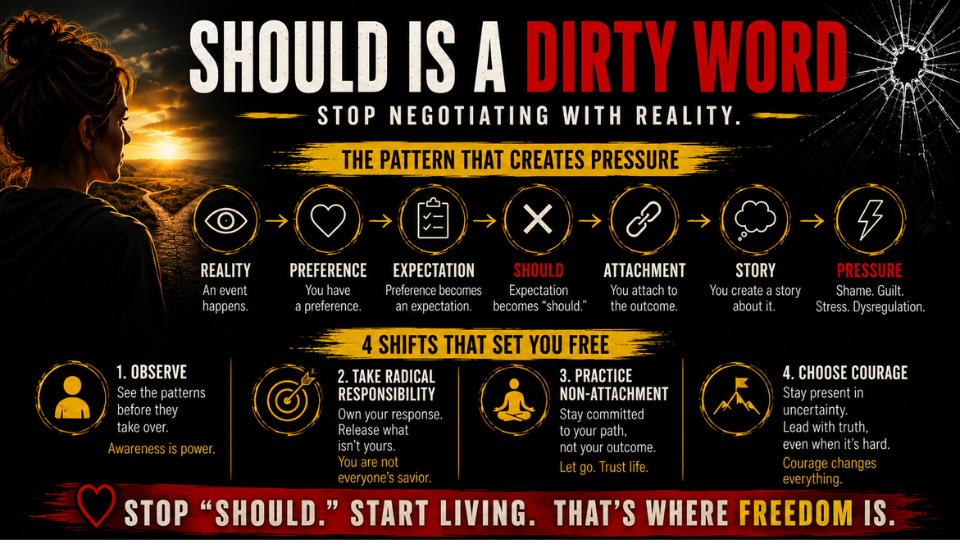
The Pattern Most People Never Notice
Over time, I've observed a pattern that shows up in leadership, parenting, relationships, and business.
It usually looks something like this:
Reality happens.
A preference exists.
The preference becomes an expectation.
The expectation becomes "should."
The "should" creates attachment.
Attachment creates a story.
The story creates shame, frustration, or guilt.
The nervous system reacts.
By the time most people notice they're overwhelmed, they're responding to a story they created several steps earlier.
Observation allows us to interrupt that cycle.
Preferences Aren't the Enemy
This was one of the biggest lessons I've had to learn.
There is nothing wrong with preferences.
We all have them.
The difficulty begins when preferences quietly become demands.
"I'd prefer this meeting start on time."
becomes...
"This meeting should have started on time."
"I'd like my team to understand."
becomes...
"They should already know this."
The event hasn't changed.
Only our relationship to it has.
The tighter we hold our expectations, the more pressure we create for ourselves.
What Non-Attachment Really Means
Non-attachment doesn't mean you stop caring.
It doesn't mean lowering your standards or giving up on your goals.
It means releasing the belief that life must unfold according to your script before you can experience peace.
Recently, the AI tool I use almost every day unexpectedly went offline.
I could have spent the afternoon frustrated, waiting for it to return.
Instead, I grabbed a notebook.
I reflected.
I organized my own thoughts.
Ironically, that interruption led to insights I probably wouldn't have discovered otherwise.
The same thing happened with a brand-new refrigerator that initially appeared not to be working.
A replacement had already been arranged.
Then, about twenty-four hours later, it started cooling perfectly.
Neither situation required panic.
Both required patience.
Sometimes the greatest lesson isn't found in getting what we expected.
It's found in discovering what becomes possible when we stop insisting reality meet our expectations.
Radical Responsibility Changes Everything
For years, I misunderstood responsibility.
I believed being responsible meant carrying everyone else's emotions.
Fixing everyone's problems.
Preventing everyone's disappointment.
That's not responsibility.
That's over-responsibility.
Radical responsibility asks a different question:
"What actually belongs to me?"
My response belongs to me.
My thoughts belong to me.
My behavior belongs to me.
The stories I tell myself belong to me.
Other people's reactions do not.
That distinction is incredibly freeing.
Courage Lives in Uncertainty
This is where courage enters the conversation.
It takes courage to pause before believing the first story your mind creates.
It takes courage to admit you don't know the whole picture.
It takes courage to remain curious instead of rushing toward certainty.
The mind wants immediate answers.
The observer is willing to wait.
That willingness creates emotional flexibility.
And emotional flexibility is one of the foundations of resilient leadership.
Don't "Should" on Yourself—or Others
One observation has become impossible for me to ignore.
We don't only "should" on ourselves.
We "should" on other people.
As leaders.
As parents.
As spouses.
As coworkers.
When we tell someone what they "should" be doing, we may unintentionally communicate that they're already falling short.
Curiosity creates connection.
"Should" often creates defensiveness.
The next time you're tempted to say, "You should..."
Try asking a question instead.
You might be surprised by what you learn.
A Different Way to Observe
This week, don't try to eliminate the word should.
Simply notice it.
Notice when you say it to yourself.
Notice when you say it to someone else.
Notice when someone says it to you.
Pause before believing it.
Ask yourself:
Am I observing reality... or am I negotiating with it?
Because every "should" is a clue that you've left reality and entered negotiation with it.
And once you notice that pattern, you've already begun changing it.
About the Author
Kathie Owen is a workplace consultant, speaker, and author specializing in Human Patterns Under Pressure. She helps founders, executives, and leadership teams identify the hidden behavioral patterns that influence culture, communication, emotional regulation, and decision-making under pressure.
Through speaking engagements, leadership workshops, and Human Patterns Under Pressure Live, Kathie equips leaders with practical tools to build healthier workplaces, stronger cultures, and more resilient organizations.
Books: The Truth Bubbles Up and Human Patterns Under Pressure
Learn more about upcoming live events, speaking engagements, and leadership resources on the Human Patterns Under Pressure Live page.
Read More Articles from Kathie




Transcript
Should is a dirty word. I have been saying that for years. People laugh when I say it, but I'm actually serious because I've noticed something. Almost every time I hear myself say the word should, I'm no longer looking at reality. I'm arguing with it. I should be further along. They should know better. My team should understand. My kids should appreciate me. This shouldn't be happening. Have you ever noticed how quickly one little word can change your entire emotional state? Because here's what I've observed. Reality isn't usually what creates our suffering. It's our negotiation with reality, and that negotiation almost always begins with one word: should. Welcome to the Kathie Owen Perspective podcast. My name is Kathie Owen. I'm a workplace consultant, speaker, and author of Human Patterns Under Pressure. For over 20 years, I've studied what pressure reveals about people, leaders, and organizations, because pressure doesn't create character. Pressure reveals the patterns that were already there. Now, if you've listened to me for any length of time, you probably know I'm fascinated by one question: How does something as simple as one word create so much pressure? That's the word, pressure. Because let's be honest, the word should isn't what hurts us. It's what comes with it. Think about what happens in your own mind. Reality happens. Maybe someone doesn't call you back. Maybe a meeting gets canceled. Maybe your business grows slower than you expected. Maybe your child makes a decision you wouldn't have made. Those are just events. They're neutral until we begin adding meaning. The mind steps in almost immediately. "That shouldn't have happened. They should know better. I should have seen this coming." And before we know it, we've left reality. We've entered a conversation with ourselves. That's where the pressure begins. Not in the event, but in the meaning we've assigned to the event. And once that meaning takes hold, something else quietly follows. Expectation, attachment, guilt, shame. And think about guilt for a moment. Most of us have experienced it. We made a mistake, we apologize. Maybe we even make it right. But instead of letting go, we carry it, we replay it, we punish ourselves with it. "I should have known. I shouldn't have done that. I should be better than this." And notice what's happening. The event is over, but the mind keeps reliving it. The nervous system doesn't know the difference between something happening right now and something you're replaying over and over in your head, so it continues reacting. That's why emotional regulation isn't just about calming yourself down. It's about becoming aware of the stories you're continuing to feed your own nervous system. And that brings me to something I've been observing in my own life: preferences. For years, I had preferences about almost everything. How people should treat me, how quickly my business should grow, how conversations should go, how leadership should look, how relationships should unfold. I didn't realize it at the time, but those preferences were quietly shaping how I experienced reality. Now, there's nothing wrong with having preferences. They're natural. The problem begins when we become attached to them. Because once I'm attached to a preference, it doesn't take long before that preference becomes an expectation. And expectations are interesting. In fact, I talk about expectations in one of my speeches. I say, "Expectations are a funny thing." They're often just unspoken agreements we've made with ourselves that no one else knows exists. When reality doesn't match that expectation, something shifts inside of us. We become frustrated, disappointed, sometimes even ashamed. Not because reality is wrong, but because reality didn't follow the script we had already written in our minds. Lately, I've been experimenting with something different. Instead of deciding ahead of time how I want every situation to unfold, I've been trying to stay open, curious, observant. I've noticed that when loosening my grip on my preferences, I experience more peace. Not because life suddenly got easier, but because I'm no longer arguing with it, and that's different from not caring. I still care deeply. I still prepare. I still work hard. I still have goals. But I'm learning that peace doesn't come from getting everything I prefer. It comes from meeting reality as it is before deciding what it means. The next principle is radical responsibility. And I want to be careful here because this principle is often misunderstood. Radical responsibility doesn't mean taking responsibility for everything. In fact, for many years, that's exactly what I did. I took responsibility for other people's emotions, other people's reactions, other people's choices. If someone was upset, I felt like I had to fix it. If something went wrong, I assumed I had done something wrong. That isn't responsibility. That's over-responsibility, and that takes a lot of energy. Radical responsibility is much simpler than that. It means I become responsible for what actually belongs to me. My thoughts, my behavior, my words, my reactions, the stories I create. When I catch myself saying, "They should," I pause because now I have a choice. I can continue trying to manage another person's behavior, or I can become curious about my own. That's where my power lies. Not in controlling other people, 'cause that's not gonna happen. Not in making life unfold the way I expected, but in choosing how I respond to what is happening right now. I learned that responsibility isn't heavy. It's actually freeing because the moment I stop carrying what was never mine to carry, I have more energy for what is. That's where emotional regulation begins. Not by controlling your emotions, but by taking responsibility for the stories that are creating them. When we observe the story instead of automatically believing it, our nervous system has room to settle. We become less reactive, more present, more thoughtful, more intentional. That's emotional regulation. It's not the absence of emotion, it's the ability to stay present with reality without letting every story pull you away from it. The final principle is courage, and I think this might be the hardest one because it takes courage to let go of the word should. It takes courage to admit that maybe the story in your mind isn't the whole story. It takes courage to sit in uncertainty without rushing to fill in the blanks. Our minds don't like uncertainty. They want answers. They want certainty. They want to know who's right, who's wrong, and what everything means. But courage says, "Maybe I don't know yet." That's uncomfortable, and that's okay because discomfort isn't the enemy, shame is. One thing I've noticed is that when we don't just should on ourselves, we should on other people, too. As leaders, as parents, as spouses, as friends, you should already know this. You should be doing more. You shouldn't feel that way. Most of the time, those words aren't spoken with bad intentions. But think about how they land. They can quietly communicate you're already falling short. As leaders, one of the greatest gifts we can give another person isn't another should, it's curiosity. Instead of saying, "You should have done this," what if we ask, "What got in the way?" Instead of saying, "You shouldn't feel that way," what if we asked, "Help me understand." Curiosity opens conversations, should often closes them. The same is true for the conversation you have with yourself. How many times have you told yourself, "I should be further along. I should have figured this out by now. I shouldn't be struggling"? What if you replace judgment with observation? What if, instead of asking, "What's wrong with me?" you asked, "What am I noticing?" That single shift changes everything. So this week, I have a challenge for you. Don't try to eliminate the word should. Just become aware of it. Notice when you say it to yourself. Notice when you say it to someone else. Notice when someone says it to you. And before you believe it, pause, because every should is a clue that you've left reality and entered negotiation with it. It's an invitation to become curious, to practice non-attachment, to take radical responsibility, to choose courage over certainty. Because emotional regulation doesn't begin when your emotions show up. It begins the moment you notice the story your mind is creating, and from that place, you get to choose your response. So today, I wanna leave you with this observation. Don't should on yourself, and don't should on other people because every time we use that word, we're usually asking reality or another human being to become someone they're not in this moment. Observation creates change. Shame rarely does. All right. This has been the Kathie Owen Perspective Podcast. Until next time, stay curious, observe without judgment, and remember, pressure doesn't define you. It simply reveals the patterns that have been waiting to be seen.
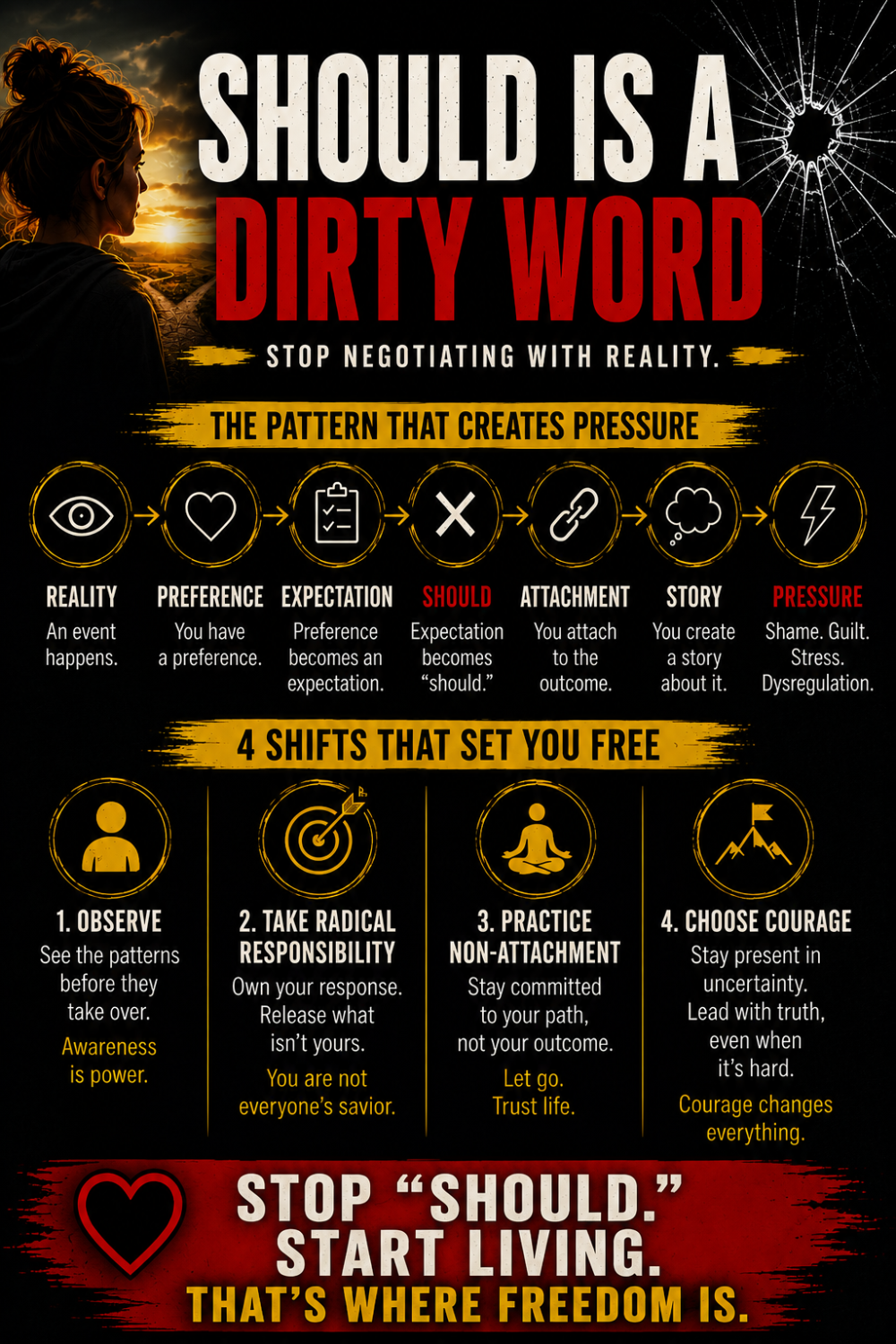

What happens in the first second after pressure hits? Kathie Owen explores the pause that helps leaders notice their reactions, regain presence, and make clearer decisions. Watch her Human Patterns Under Pressure speech and learn the three principles she returns to when the stakes are high.
#HumanPatternsUnderPressure #LeadershipUnderPressure #ExecutivePresence #DecisionMaking