
The Truth About Human Behavior: The Pattern Most People Miss

What 300 Podcast Episodes Taught Me About Pressure, Awareness, and Human Behavior
When I recorded my first podcast episode years ago, I thought I was creating a show about leadership.
Then I thought it was about workplace culture.
Then it became about toxic workplaces.
For a while, I thought it was about fitness and wellness.
Then I became fascinated with nervous system regulation.
But after more than 300 podcast episodes, something unexpected happened.
I realized I had been studying one thing all along.
Human behavior.
No matter where I looked—business, sports, families, leadership, relationships, or even my own life—the same patterns kept appearing.
The truth kept bubbling up.
And that truth became the foundation of my work.
Lesson One: Pressure Reveals Patterns
Most people believe pressure changes people.
I don't.
Pressure reveals people.
Pressure shines a light on patterns that were already there.
You see it in championship games.
You see it in boardrooms.
You see it during mergers and acquisitions.
You see it around the holidays.
You see it in families.
Everything can appear calm until uncertainty enters the room.
That's when the real information appears.
Instead of asking, "Why is this happening to me?" try asking, "What is this showing me?"
Pressure isn't the enemy.
Pressure is information.
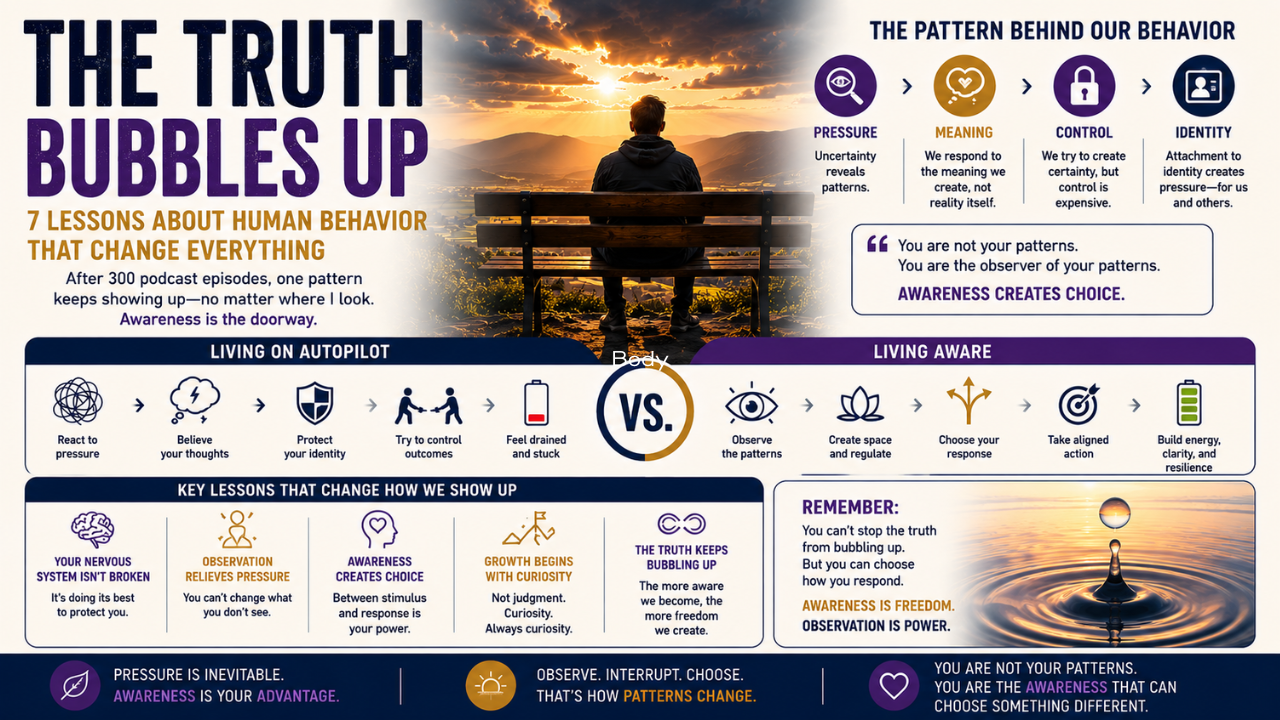
Lesson Two: Most People Respond to Meaning, Not Reality
One of the biggest discoveries I've made is that people often aren't reacting to reality.
They're reacting to the meaning they've assigned to reality.
Think about birthdays.
For one person, a birthday is a celebration.
For another, it represents aging or disappointment.
The date didn't create the emotion.
The meaning did.
The same thing happens with holidays.
Many people become attached to how Christmas, Thanksgiving, birthdays, vacations, or family gatherings are supposed to look.
When reality doesn't match the picture in their mind, pressure builds.
Reality Transurfing calls this excess potential and over importance.
The more importance we attach to an outcome, the more pressure we create for ourselves.
Meaning creates emotion.
Emotion creates behavior.
Behavior creates outcomes.
The event may be the same.
The experience often isn't.
Lesson Three: Control Is Often an Attempt to Create Certainty
Control is one of the most misunderstood human behaviors.
People often assume controlling behavior is about power.
In my experience, it's usually about uncertainty.
When life feels unpredictable, many people try to create safety by controlling something.
They overthink.
They micromanage.
They over-plan.
They take responsibility for everyone else's emotions.
The problem is that control is expensive.
It drains energy.
It consumes attention.
It keeps the nervous system activated.
Ironically, the more we try to control life, the more exhausted we become.
Real resilience isn't learning to control everything.
It's learning to trust yourself when uncertainty inevitably arrives.
Lesson Four: Identity Creates Pressure
Identity is powerful.
But attachment to identity can become exhausting.
We become attached to being the perfect parent.
The successful leader.
The indispensable employee.
The favorite child.
The high performer.
The expert.
The problem isn't having an identity.
The problem is believing we must protect that identity at all costs.
I've watched families reorganize themselves around protecting one person's role.
I've seen workplaces resist change because leaders were protecting an identity instead of solving a problem.
I've seen youth sports become more about adult identities than children's experiences.
When identity becomes more important than reality, everyone around us begins carrying that pressure.
The tighter we grip our identity, the harder it becomes to adapt.
Lesson Five: Your Nervous System Is Not Wrong
This lesson changed my life.
For years, I lived with anxiety almost constantly.
I thought something was wrong with me.
What I eventually discovered was that my nervous system wasn't broken.
It was responding exactly the way it had learned to respond.
That shift changed everything.
The nervous system isn't trying to punish us.
It's trying to protect us.
The challenge is that many of the strategies it learned years ago may no longer serve us today.
Our nervous systems don't exist in isolation either.
We influence one another.
A calm leader influences a team.
An anxious parent influences a family.
A reactive workplace influences every employee.
Human beings constantly communicate through emotional states, often without saying a word.
When we stop asking, "What's wrong with me?" and start asking, "What is my nervous system trying to tell me?" we create the possibility for lasting change.
Lesson Six: Observation Relieves Pressure
This may be the most surprising lesson of all.
Most people think observation means doing nothing.
I've learned that observation is one of the most active things we can do.
Observation creates space.
Space creates awareness.
Awareness creates choice.
When we're constantly distracted, we rarely notice our patterns.
The moment discomfort appears, many of us reach for our phones, turn on the television, scroll social media, or fill every quiet moment with noise.
We unintentionally eliminate the very thing that creates clarity.
Stillness.
Some of my greatest insights haven't happened while working harder.
They've happened sitting quietly.
Walking outside.
Watching a sunset.
Driving without the radio.
Sitting in nature.
Those moments often feel uncomfortable at first.
But discomfort isn't always something to escape.
Sometimes it's an invitation to observe.
The moment we stop becoming the pattern and start observing the pattern, everything begins to change.
Lesson Seven: Awareness Creates Choice
Awareness doesn't magically solve problems.
It creates options.
Before awareness, we're operating on autopilot.
After awareness, we begin noticing our thoughts, reactions, attachments, and emotional patterns.
We still experience stress.
We still encounter uncertainty.
But now we have a choice.
We can pause.
We can become curious.
We can respond instead of react.
That single shift changes relationships.
Leadership.
Parenting.
Communication.
And even the relationship we have with ourselves.
Growth isn't about becoming perfect.
It's about becoming aware sooner.
The Truth Keeps Bubbling Up
After 300 podcast episodes, I don't believe I've discovered a secret.
I've discovered a process.
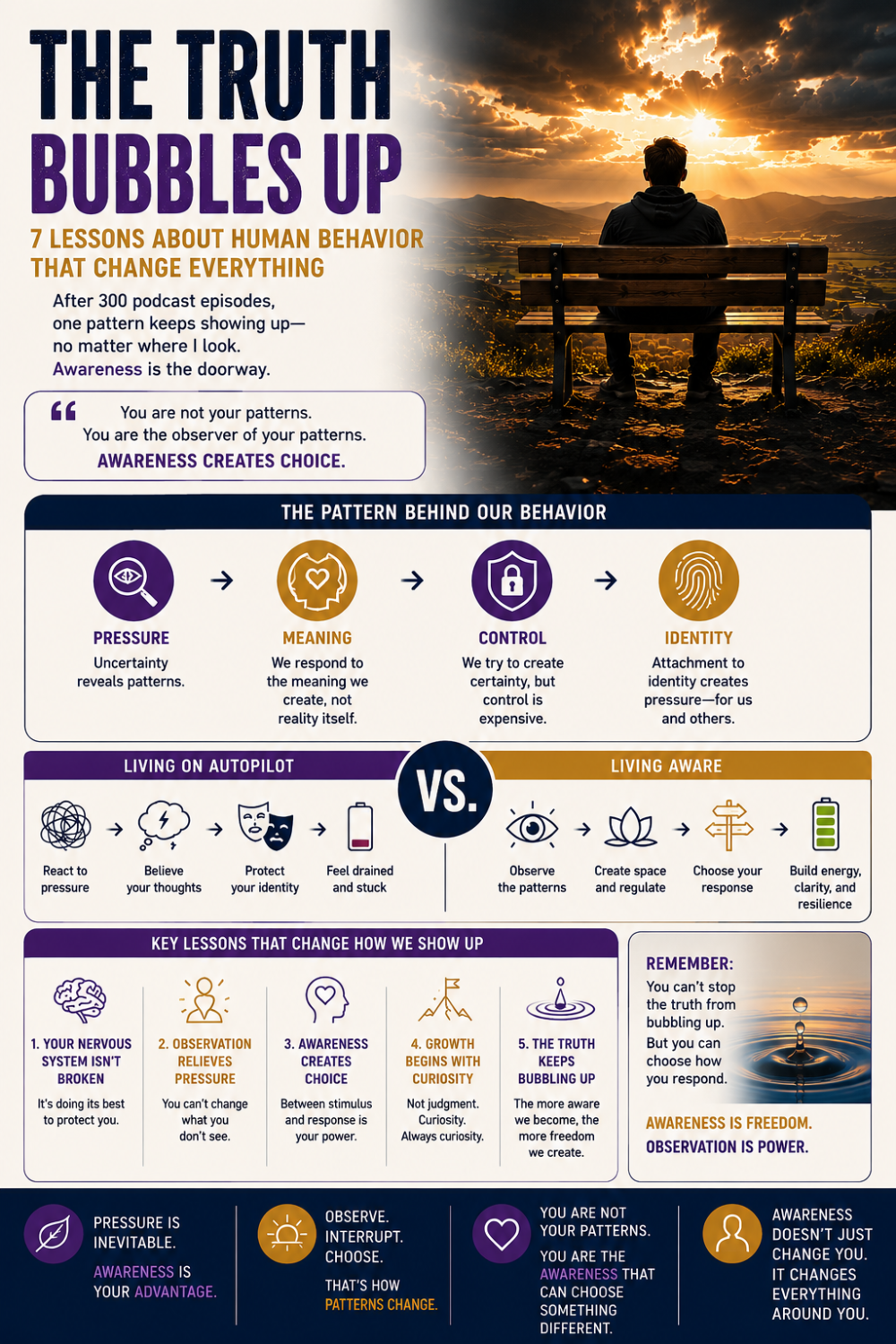
Pressure reveals patterns.
Meaning creates emotion.
Control seeks certainty.
Identity creates pressure.
The nervous system responds.
Observation creates awareness.
Awareness creates choice.
That process repeats itself in leadership.
Families.
Relationships.
Workplaces.
Organizations.
Sports.
And in every one of us.
The more I observe human behavior, the less interested I become in judging it.
The more interested I become in understanding it.
Because awareness doesn't just change behavior.
It changes how we see ourselves and the people around us.
And that may be the greatest lesson of all.
The truth doesn't force its way into our lives.
It patiently waits for us to become aware enough to see it.
The truth keeps bubbling up.
We simply have to slow down long enough to notice.
About the Author
Kathie Owen is a private consultant, speaker, author, and creator of Human Patterns Under Pressure. She helps founders, executives, leadership teams, and organizations identify the hidden behavioral patterns that influence communication, culture, decision-making, and enterprise value during periods of pressure and change.
Drawing on decades of experience in leadership psychology, corporate wellness, fitness, and human behavior, Kathie helps leaders move beyond surface-level solutions by understanding the human patterns that quietly shape every organization.
Through The Kathie Owen Perspective podcast, articles, speaking engagements, and consulting, she teaches leaders how observation, awareness, and emotional regulation create healthier people, stronger cultures, and more resilient organizations.
More Articles and Episodes from Kathie




Transcript
What if most of the pressure in your life isn't coming from what is happening? What if it's coming from what you believe "should" be happening? And if you know me, "should" is a dirty word. Think about that for a moment. How much stress have you experienced because something didn't go according to plan? A holiday, a relationship, a job, a family gathering, a business decision, a conversation, a dream that you had. Not because the event itself was difficult, but because reality showed up differently than expected. I've been studying leadership, workplace culture, toxic workplaces, fitness, communication, emotional wellness, nervous systems, and human behavior. And after hundreds of podcast episodes, thousands of conversations, years in corporate wellness, years consulting with leaders and teams, and now rewriting my book, The Truth Bubbles Up, I keep finding myself coming back to the same truths. No matter where I look, no matter what industry, no matter what relationship, no matter what challenge, the same patterns keep appearing. The same lessons keep bubbling up. Yeah. Welcome to the Kathie Owen Perspective Podcast. My name is Kathie Owen. I'm a consultant, speaker, author, and student of human behavior. This podcast actually started years ago as Kathie's Coaching Podcast. At the time, I thought I was helping people solve problems. Today, I see my role differently. I don't coach people. I observe patterns. I help people see patterns, because once you see a pattern, you have choices, and over time, that's what this podcast has become. Not a podcast about coaching, not a podcast about fixing people, a podcast about understanding human beings. And as I celebrate this milestone episode, I wanna share seven lessons that keep showing up no matter where I look. Whether I'm studying leaders, founders, athletes, families, workplaces, relationships, or even myself, the truth keeps bubbling up, and it usually starts with pressure. All right, let's get into the lessons. And lesson number one, pressure reveals patterns One of the biggest misconceptions people have is that pressure creates behavior. I don't think that's true. I think pressure reveals behavior. Pressure reveals what was already there. Pressure reveals how we communicate, how we cope, how we lead, how we react, how we avoid, how we connect. Pressure reveals patterns. You see it in sports, you see it in leadership, you see it in workplaces, you see it in families. Everything looks fine when conditions are ideal. The real information appears when uncertainty enters the room. That's why pressure is such a powerful teacher. When something triggers us, frustrates us, disappoints us, or scares us, we immediately want to ask, "Why is this happening?" But a more useful question is, "What is this showing me?" Because pressure is information. Pressure shines a flashlight on patterns that are often invisible when life feels uncomfortable. And once you see the pattern, something important happens. You gain awareness. And guess what? Awareness creates choice. That's lesson number one. Lesson number two is most people are responding to meaning, not reality. This may be one of the biggest truths I've learned over the years. Most people think they're reacting to reality, but often they're reacting to what reality means to them. Think about how often this happens. A holiday arrives, a birthday, a vacation, a family gathering, a promotion, a rejection, a criticism, a success, a failure. The event happens, but the emotional reaction isn't always about the event itself. It's about the meaning we attach to it. Take holidays, for example. For one person, Christmas means joy, connection, and family traditions. For another person, Christmas means pressure, disappointment, loneliness, or grief. Same holiday, completely different emotional experience. Why? Because of meaning. Or think about birthdays. One person sees a birthday and feels grateful. Another person sees the same birthday and starts worrying about aging, missed opportunities, or where they think they should be by now. There's that word again, should. Again, the date itself isn't creating the emotion. The meaning attached to the date is creating the emotion. The same thing happens in workplaces. A leader receives feedback. One person thinks, "That's helpful information." Another person thinks, "They don't believe in me." Same feedback, different meaning, different emotional response, different outcome. Meaning creates emotion. Emotion creates behavior. Behavior creates outcomes, and once that process starts, most people never stop to question the meaning they assigned in the first place. One of the ideas I've talked about before from Reality Transurfing is the concept of excess potential and importance. We attach too much importance to something. We create pressure. We create tension. We create emotional weight. Suddenly, the outcome feels like it means everything. The relationship means everything. The holiday means everything. The promotion means everything. The family gathering means everything. And the more importance we attach to something, the more pressure we often experience around it. I see this all the time. People aren't suffering because of what's happening. They're suffering because what they believe what's happening means. Now, let me be clear. I'm not saying meaning is bad. Meaning gives life richness. Meaning helps us connect. Meaning helps us celebrate, and meaning helps us care. But sometimes we create so much meaning around an event that we stop experiencing the event itself. We become attached to how things are supposed to happen, how people are supposed to behave, how the day is supposed to unfold, how life is supposed to look. And when reality doesn't match the story we've created, pressure appears, disappointment appears, frustration appears, sometimes even conflict appears. One question I've learned to ask myself is this: Am I responding to reality, or am I responding to the meaning I've attached to reality? Because those are two very different things, and the answer can reveal a lot about the patterns we're carrying. Lesson number three: Control is often an attempt to create certainty. This is one of the most misunderstood patterns I've observed over the years. When people think about control, they often think about power, but I don't think control is usually about power. I think it's often about fear, or maybe a better word is uncertainty. Something happens, an outcome feels important, a relationship feels important, a situation feels uncertain, the nervous system responds, and suddenly we feel the need to control something. We try to control people, we try to control circumstances, we try to control outcomes, we try to control how we're perceived, we try to control what might happen next. And the problem is that control is expensive. It consumes enormous amounts of energy. Think about how much energy people spend worrying, overthinking, micromanaging, over-planning, trying to anticipate every possible scenario, trying to make sure nothing goes wrong, trying to make sure everyone behaves the way they're supposed to behave, trying to make sure life unfolds according to the plan they've created. That's freaking exhausting. And what's interesting is that control rarely creates the certainty we're looking for. In fact, it often creates more stress because life is uncertain, people are unpredictable, change is inevitable, and no amount of control can eliminate that reality. I've seen this pattern in families, I've seen it in workplaces, I've seen it in leadership, I've seen it in sports, and if I'm being honest, I've seen it in myself. When uncertainty shows up, the temptation is to tighten our grip, to push harder, to think harder, to plan harder, to control harder. But sometimes the wiser question is, "What am I afraid might happen if I let go?" Because underneath control is often a deeper fear, a fear of failure, a fear of rejection, a fear of loss, a fear of uncertainty. And once we become aware of that fear, something interesting happens. We stop focusing on controlling the world around us, and we start understanding what's happening inside of us, and that's where awareness begins, and that's where control starts to lose its grip. Because the goal isn't to control everything. The goal is to build enough trust in ourselves that we can handle uncertainty when it arrives, and that takes far less energy than trying to control the entire world. Lesson four: identity creates pressure. This is one of the patterns that has fascinated me for years because once you start seeing it, you see it everywhere. We come attached to a role, a title, a relationship, an image, an outcome, a position, and then something interesting happens. Pressure increases, not because reality changed, because now we have something to protect. The stronger the attachment becomes, the more energy it takes to maintain, and often the pressure doesn't just affect us. It affects everyone around us. I've seen this in families. I've seen it in workplaces. I've seen it in leadership. I've seen it in sports, and I've seen it in myself. One example that always stands out to me is youth sports. Hmm. Sometimes I call it daddy ball. The game stops being about the game. The game becomes about identity. The parent becomes attached to being the parent of the star athlete. The coach becomes attached to being the successful coach. The child becomes attached to being the high performer, and before long, pressure enters the system. The sport becomes heavier than it was ever meant to be. The same thing happens in families. Sometimes a person becomes deeply attached to a role, the perfect parent, the favorite parent, the needed parent, the responsible parent, the caretaker, the rescuer, the peacemaker, and because the identity feels so important, everyone around them begins feeling pressure to support that identity. Children feel it. Family members feel it. Friends feel it. Sometimes entire systems begin organizing around protecting one person's role, not because anyone is trying to be harmful either, but because identity has become attached to importance, and attachment creates pressure. I see this happen in workplaces too. A leader becomes attached to being the smartest person in the room. A founder becomes attached to being indispensable. A manager becomes attached to being in control. A department becomes attached to being the authority, and suddenly collaboration becomes difficult. Adaptability becomes difficult. Change becomes difficult, not because people are bad, because identities are being protected. One of the things I've learned through studying human behavior is that people will often spend enormous amounts of energy defending an identity they no longer need, and the cost can be surprisingly high. Relationships become strained. Communication becomes complicated. Teams become divided. Families become exhausted. People stop responding to reality. They start responding to the role They're trying to maintain. The irony is that the tighter we hold on to an identity, the more pressure we create. And the more pressure we create, the harder it becomes to adapt when life changes. Life changes, relationships change, children grow up, workplaces evolve, people evolve, and if our identity cannot evolve with reality, suffering often follows. Now, this isn't about shame. It's not about blame. It's not about condemnation. It is about awareness because we've all done this. We've all attached ourselves to the idea of who we think we need to be. The question is, what identity am I protecting right now, and how much energy is it costing me? Because sometimes the pressure we're feeling isn't come- coming from reality at all. It's coming from our attachment to a role we've outgrown Because sometimes the pressure we're feeling isn't coming from reality at all. It's coming from our attachment to a role we've outgrown. And when we become aware of that, something powerful happens. We stop trying to protect the identity, and we start responding to reality. That's where freedom begins. Lesson five: the nervous system is not wrong. Of all the lessons I've learned over the years, this may be the one that changed me the most. Because for a long time, I thought something was wrong with me. I lived with anxiety for years, not occasionally, not once in a while, almost constantly. My nervous system always seemed to be scanning, watching, preparing, anticipating, trying to stay one step ahead of whatever might happen next. What I didn't realize at the time was that my nervous system wasn't broken. It was responding exactly the way it had learned to respond. That realization changed everything. Because when people experience anxiety, overwhelm, fear, frustration, hypervigilance, or emotional reactivity, they often assume something is wrong with them. They judge themselves, they shame themselves, they criticize themselves, and unfortunately, that often creates even more stress. The nervous system isn't trying to make your life difficult. The nervous system is trying to protect you. The problem is that sometimes it learns protection strategies that no longer serve you, and unless you become aware of them, those patterns continue running in the background. This is where many of the lessons we've already talked about begin connecting together. Think about attachment. Think about identity. Think about control. Think about meaning. Think about pressure. Those things don't just exist in our thoughts. They exist in our bodies. The person who feels responsible for everyone's happiness experiences pressure differently. The person who always believes that they must always be in control experiences uncertainty differently. The person who becomes attached to an outcome experiences disappointment differently. The body responds, the nervous system responds, sometimes before we're even consciously aware of what's happening. I've also learned something else. Our nervous systems affect each other. This is one of the most overlooked dynamics in families, workplaces, and relationships. A highly reactive nervous system affects other people. A controlling environment affects other people. A fearful environment affects other people. An anxious environment affects other people. Children feel it. Teams feel it. Families feel it. Workplaces feel it. Human beings are constantly responding to each other's emotional states. That's why awareness matters so much, because the control isn't to eliminate emotions. The goal is not to become perfectly calm all the time. The goal is to understand what's happening inside of us. Why am I reacting this way? Why does this situation create so much tension in my body? Why does this outcome feel so important? Why does uncertainty feel so uncomfortable? Why do I keep returning to the same emotional patterns? Those questions create awareness, and awareness create options. One of the things I've observed through fitness, leadership, consulting, and human behavior is that the body often tells the truth before the mind does. You can hear it in people's stories. You can see it in their posture. You can hear it in their language. You can see it in how they respond to pressure. The body keeps score of the patterns we carry, and when we begin listening instead of judging, we learn something important. The nervous system isn't the enemy. It's information. It's feedback. It's data. It's showing us where pressure exists. It's showing us where fear exists. It's showing us where attachment exists. It's showing us where awareness is needed. For me, one of the biggest shifts happened when I stopped asking, "What's wrong with me?" And I started asking, "What is my nervous system trying to tell me?" That question changed everything because awareness doesn't begin with judgment. Awareness begins with observation. And when we stop fighting the nervous system, we finally create the opportunity to understand it, and that's where healing begins. That's where regulation begins, and that's where freedom begins. Lesson number six: observation relieves pressure. This may be the lesson that surprised me the most because for most of my life, I thought observation was passive. I thought observation meant doing nothing. I learned the opposite. Observation is one of the most powerful things we can do because observation creates space. Observation reduces reactivity. Observation creates awareness, and awareness creates choice. When we're caught inside a pattern, the pattern feels like reality. We don't see it. We become it. We become the anxiety. We become the frustration. We become the fear. We become the pressure. We become the story. But the moment we can observe the pattern, something changes. We create distance, not distance from life, distance from automatic reactions. We stop becoming the pattern. We start seeing the pattern. That's where freedom begins. One of the reasons this is so difficult is because most of us spend very little time observing. We're constantly distracted. The moment discomfort appears, we reach for something, our phones, the television, social media, work, food, busyness, noise, anything that prevents us from sitting with ourselves. And I understand why, because observation can be uncomfortable, very uncomfortable. When you sit quietly with no distractions, things begin surfacing, thoughts you've been avoiding, emotions you've been avoiding, patterns you've been avoiding, questions you've been avoiding. The pressure that has been quietly operating in the background begins revealing itself. That's why so many people struggle with stillness. Stillness removes the distraction, and what remains is awareness. And I've learned that some of my greatest insights didn't come while I was working harder. They came while I was sitting quietly, taking a walk, sitting outside, driving without the radio, watching the water, sitting in nature, spending time with animals, doing absolutely nothing. Those moments often create more clarity than hours of thinking because observation allows reality to reveal itself. And here's the interesting part. Observation doesn't always feel productive. In fact, it feels like you're doing nothing. But beneath the surface, something important is happening. Your nervous system begins settling. The noise begins quieting. The pressure begins easing, and patterns that were previously invisible start becoming obvious. You begin noticing things like, "Why am I reacting so strongly to this? Why do I keep repeating this pattern? Why does this situation feel so important? What am I afraid will happen? What story am I telling myself?" Those questions don't come from reactivity, they come from observation. And observation is where wisdom begins. One of the biggest lessons I've learned is that we cannot force clarity. We create the conditions for clarity, and one of those conditions is stillness. Not because stillness magically solves problems, because stillness allows us to see what was already there. That's why I believe observation relieves pressure, not because circumstances immediately change, but because awareness changes our relationship to those circumstances. The pressure may still exist. The uncertainty may still exist. The challenge may still exist, but now we can see it, and when we can see it, we can work with it. The moment we observe a pattern, we stop being trapped inside the pattern. We become the observer of the pattern. That's a completely different place to operate from, and if there is one lesson that has transformed my life more than any other, it may be this. The answers I was searching for rarely appeared when I was reacting. They appeared when I was observing, and the truth is, they were there all along. I was finally quiet enough to see them. Lesson number seven: awareness creates choice. This may sound simple, but it changed my life, and it continues changing my life because awareness doesn't automatically change behavior. Awareness doesn't instantly eliminate anxiety. Awareness doesn't remove pressure. Awareness doesn't magically solve problems. What awareness does is create choice, and choice changes everything. Before awareness, we're often operating on autopilot. We repeat the same reactions, the same emotional patterns, the same stories, the same assumptions, the same fears, the same behaviors, and many times, we don't even realize we're doing it. The pattern is running us, not because we're weak, not because we're broken, because the pattern has become familiar, and familiar patterns tend to run automatically. Then awareness enters the picture, and suddenly something changes. We notice the reaction. We notice the attachment. We notice the pressure. We notice the story. We notice the meaning we've assigned to the situation. And for the first time, we have options. Maybe we still react. Maybe we still feel anxious. Maybe we still feel frustrated. But now we can see what's happening, and seeing creates choice. One of the biggest misconceptions people have is that growth never means we struggle again. I don't think that's true. Growth means recognizing the struggle sooner. Growth means becoming aware sooner. Growth means recovering sooner. Growth means choosing differently sooner. That's what awareness gives us, the ability to interrupt patterns that once operated automatically. I've experienced this in leadership. I've experienced it in relationships. I've experienced it in workplaces. I've experienced it in my own nervous system. The situation doesn't always change immediately, but my relationship to the situation changes because awareness creates options that didn't previously exist. Instead of reacting, I can pause. Instead of assuming, I can become curious. Instead of controlling, I can observe. Instead of forcing, I can allow. Instead of becoming the pattern, I notice the pattern. That single shift changes everything, and perhaps that's what all seven lessons have been leading toward. Not perfection, not certainty, not control, not having all the answers. Awareness, because awareness creates choice, and choice creates the possibility for something different. That's where change begins. That's where growth begins, and that's where freedom begins. So what is the truth that keeps bubbling up? As I've been preparing for this episode and rewriting my book, The Truth Bubbles Up, I realized something. After 300 podcast episodes, yep, this is number 300, I don't think I've discovered a secret. I think I've discovered a process. Pressure reveals patterns, meaning creates emotion, control seeks certainty, identity creates pressure, the nervous system responds, observation creates awareness, awareness creates choice, and that process keeps repeating itself again and again and again. Whether I'm studying leadership, workplace culture, families, relationships, athletes, founders, organizations, or myself, the same truth keeps bubbling up. Awareness is the doorway, not because awareness instantly fixes everything, but because awareness allows us to see what was previously invisible. And once we can see something, we can work with it. That's where change begins. As I celebrate this milestone episode with you, I'm actually less interested in the number 300. I'm more interested in what those 300 episodes have taught me. When I started this podcast years ago, I thought I was studying leadership. I thought I was studying workplace culture. I thought I was studying toxic workplaces. I thought I was studying nervous systems. Today, I think I've been studying something much simpler: human beings. I've been studying what happens when people encounter uncertainty, what happens when they encounter pressure, what happens when they become attached, what happens when they become afraid, what happens when they become aware. And through all of it, one lesson continues to stand out. You are not your patterns. You are the observer of your patterns. You are not your anxiety. You are not your fear. You are not your attachment. You are not your reactions. You are the awareness that can observe those things. And the moment you can observe them, something powerful happens. You create space, you create choice, you create the possibility for something different, and that's where growth begins. That's where healing begins. That's where freedom begins. And that's where the truth keeps bubbling up. Before we wrap up, I wanna thank you, whether you've been listening since the early days of Kathie's Coaching Podcast or you found me more recently through The Kathie Owen Perspective. Thank you for being part of this journey. This podcast has evolved, I've evolved, and I suspect many of you have evolved right along beside me. If you'd like to go deeper into today's conversation, I've created a companion blog post that expands on these lessons and includes additional resources. You'll find that link in the show notes and description below and in the first comment on YouTube. As always, thank you for spending time with me. Keep observing, keep becoming aware, keep getting curious about the patterns that show up under pressure, because awareness creates choice, and choice creates the possibility for a different future. Until next time, this is Kathie Owen, and you've been listening to The Kathie Owen Perspective podcast.

Why do we reach for control when life feels uncertain? Kathie Owen explores control as a human pattern under pressure, the nervous system’s search for certainty, Michael Singer’s ideas on resistance, and Reality Transurfing’s concept of excess potential. Learn how observation, awareness, and non-attachment can create more choice, clarity, and flow.
#HumanPatternsUnderPressure #RealityTransurfing #EmotionalRegulation #KathieOwen