
The Emotional Signals Leaders Miss

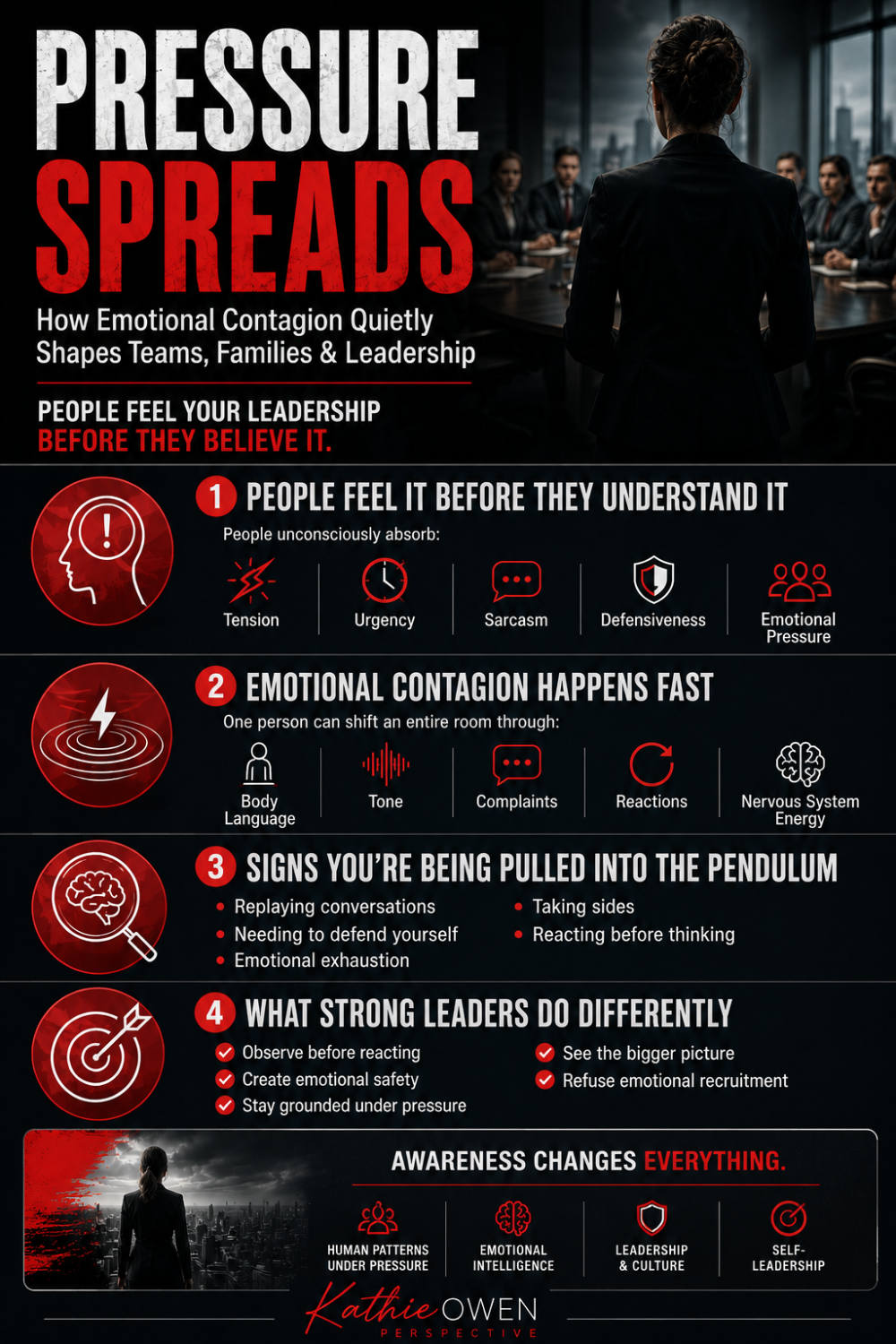
People Feel Your Leadership Before They Believe It
Have you ever walked into a room and immediately felt tension… even though nobody technically said or did anything wrong?
Maybe someone sighed.
Maybe someone rolled their eyes.
Maybe the room got quiet when a certain person walked in.
Maybe everybody suddenly started monitoring themselves.
Nothing obvious happened.
But your nervous system felt it anyway.
That’s because humans communicate emotionally long before they communicate logically.
And most people have absolutely no idea they are doing it.
I remember sitting in a restaurant once during what looked like a completely casual business lunch. A leader had invited me because he wanted my perspective on a potential client relationship. At first, I thought we were simply getting lunch before a later meeting.
Low stakes.
Normal conversation.
Nothing unusual.
But within minutes, patterns started revealing themselves.
Before we even ordered food, the client was already complaining about the restaurant. Complaining about the salads. Complaining about how the place made their food. Complaining about the service before the service had even happened.
Then the order came out wrong.
And suddenly the emotional temperature of the entire table changed.
The frustration.
The impatience.
The tone.
The dismissiveness toward the waitress.
At one point, I felt so uncomfortable for the server that when I signed the receipt, I wrote:
“Be awesome to her.”
That’s how heavy the interaction felt.
And what fascinated me most was this:
Later during the lunch, this same person started talking about how much they disliked people who complain all the time.
That moment mattered.
Not because complaining makes someone a terrible person.
Not because one stressful lunch defines a human being.
But because incongruence tells us something important.
The words and the behavior did not match.
And leadership is filled with moments exactly like this.
Leadership Leaks Through Small Moments
Most people think leadership is revealed in presentations, meetings, or major decisions.
Honestly?
I’ve found the opposite to be true.
Leadership leaks out in tiny moments.
How someone reacts when plans change.
How they treat people who cannot “do” anything for them.
How they handle inconvenience.
How they speak under stress.
How quickly they blame.
How emotionally reactive they become.
Small moments quietly reveal emotional structure.
And this is one reason I became so fascinated with human behavior under pressure.
Because people are constantly communicating things they don’t even realize they’re communicating.
Through:
tone
pacing
posture
eye contact
emotional reactions
sarcasm
urgency
impatience
defensiveness
emotional withdrawal
Everything communicates.
Especially in leadership.
People Feel Your Leadership Before They Believe It
This is one of the biggest things I observe inside organizations.
Leaders often focus on:
mission statements
policies
company slogans
culture decks
leadership language
But employees focus on something very different.
They focus on how the environment feels.
Do people relax when leadership walks in?
Do people speak honestly?
Do people feel emotionally safe?
Do people constantly monitor themselves?
Because if people are managing their nervous systems every time leadership enters the room, that is not psychological safety.
That is emotional survival.
Huge difference.
And the fascinating part is most leaders are not intentionally creating this environment.
They are leaking pressure unconsciously.
Emotional Contagion Is Real
Humans adapt to emotional environments incredibly fast.
One sarcastic comment changes the room.
One defensive reaction shifts the atmosphere.
One emotionally reactive leader can dysregulate an entire team.
And once the emotional environment becomes normalized, people stop noticing it.
Tension becomes culture.
That’s why toxic workplaces often confuse people.
Employees say:
“I don’t know what’s wrong here… but something feels off.”
That “off” feeling is usually emotional incongruence.
People sensing:
tension
distrust
fear
hidden resentment
emotional volatility
performative positivity
without consciously understanding why.
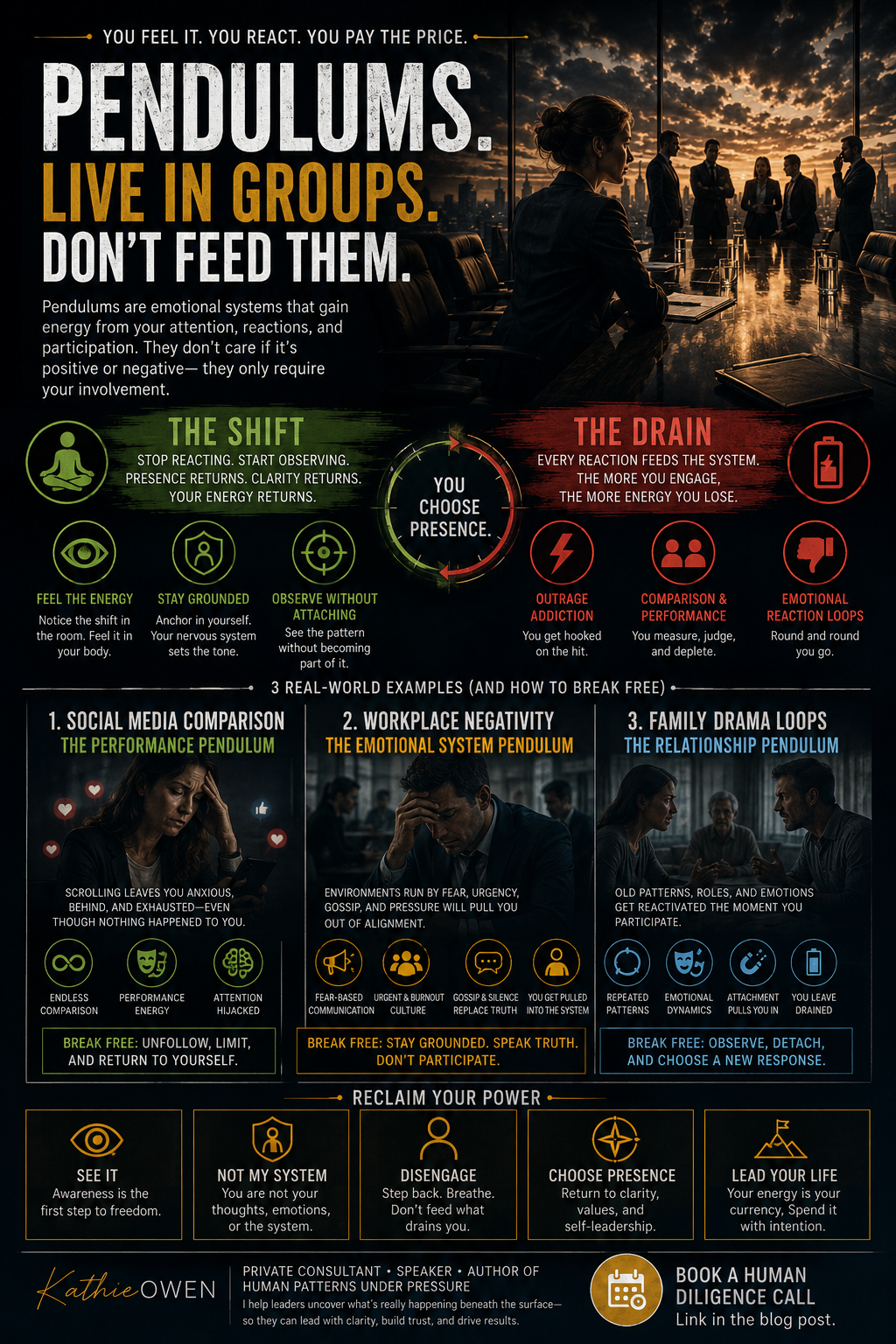
This is a concept I talk about all the time in Reality Transurfing. Pendulums.
The Little League Baseball Lesson
Oddly enough, one of the clearest places I ever observed this was youth sports.
If you’ve ever sat at a little league baseball game, you’ve probably seen it too.
Parents emotionally fused with outcomes.
Fused with belonging.
Fused with identity.
Fused with their child’s performance.
And listen… that’s human.
Of course parents care deeply.
But what fascinated me was watching how emotionally consumed adults became over moments that would barely matter twenty years later.
The facial expressions.
The aggressive body language.
The emotional intensity.
The boasting.
The tension in the stands.
And while most people probably forgot those moments years ago…
I didn’t.
Because emotional energy leaves impressions.
What those years taught me was something incredibly important:
If I wanted peace, I had to learn how to zoom out and see the bigger picture.
Not because I didn’t care.
Not because I was detached.
Not because I was pretending emotions didn’t exist.
But because emotional pendulums feed on reactivity.
The more emotionally recruited you become, the harder it becomes to see clearly.
And that lesson applies everywhere:
families
workplaces
social media
leadership teams
relationships
politics
organizations
True Self-Leadership Requires Endurance
People often think self-leadership means staying calm all the time.
It doesn’t.
Self-leadership means staying aware while activated.
Huge difference.
Because awareness is hard when:
your ego feels threatened
your belonging feels threatened
your child feels threatened
your identity feels threatened
your nervous system feels unsafe
That’s why patience matters.
Persistence matters.
Endurance matters.
Sometimes the strongest thing a leader can do is pause long enough to not feed the emotional system.
Not suppress emotions.
Not deny emotions.
Just observe them long enough to avoid becoming consumed by them.
That’s real power.
Observation Changes Everything
One of the most freeing realizations I’ve ever had is this:
You do not have to win the emotional game in order to leave it.
That changes everything.
Especially for emotionally intelligent and highly sensitive people who feel everything deeply.
Because once you begin observing emotional systems instead of automatically reacting to them, your leadership changes naturally.
You become:
calmer
clearer
more grounded
less reactive
less emotionally recruited
more emotionally intelligent
And ironically…
that’s usually when people trust your leadership more.
Because people feel your nervous system long before they process your words.
Awareness Over Villains
The longer I study human behavior under pressure, the less interested I become in villains.
And the more interested I become in awareness.
Most people are not waking up trying to create emotional damage.
They are reacting unconsciously.
Adapting unconsciously.
Participating unconsciously.
And once you begin seeing that clearly, you stop feeding emotional systems the same way.
You stop needing to prove.
Defend.
Attack.
Win every emotional battle.
And that creates something rare today:
Grounded leadership.
The kind that creates emotional safety instead of emotional tension.
The kind people feel immediately.
About Kathie Owen
Kathie Owen is a private consultant, speaker, and thought leader specializing in human patterns under pressure, leadership psychology, emotional regulation, and organizational dynamics.
Based in Houston, she helps leaders, founders, and organizations identify the invisible emotional and behavioral patterns that quietly shape trust, performance, and workplace culture.
Through her podcast, consulting work, and writing, Kathie explores leadership congruence, psychological safety, nervous system awareness, and the hidden signals people send without realizing it.
Kathie wrote the book Human Patterns Under Pressure.
Read More Articles from Kathie





Transcript
Have you ever met someone for a casual lunch and left knowing you would never wanna actually work with them? Not because of some huge dramatic event, and not because they failed a personality test, and not even because they said anything shocking, but because of the little things. You know, the way they treated people, the way they handled inconvenience, the way they complained, the way they spoke, the emotional heaviness they carried into every interaction without even realizing it. I was invited to a business lunch one time because a leader wanted my perspective on a potential client relationship, and honestly, at first I thought we were just having lunch before a later meeting. Very low stakes, very casual. But within minutes, I started observing patterns. Before I had even ordered my food, this man was already complaining about the restaurant salads, and that's what I was about to order. And he was talking about how terrible they were. He was talking negatively about the menu, negative about the service. Then his order came out wrong, and the way he reacted to the waitstaff immediately caught my attention. He was impatient and dismissive and frustrated over something incredibly small in the big picture. At one point, I actually felt bad enough for the waitress that I even signed the receipt. I wrote, "Keep being awesome." That is just how uncomfortable the interaction felt. And what really got to me the most was this: later in the lunch, this same person started complaining about people who complain all the time. And I remember thinking, "Wait a second. That's incongruent." The words and the behavior did not match. And after the lunch, the leader I was with asked me, "How did you catch that so fast?" And honestly, that's exactly why people hire me. Welcome back to the Kathie Owen Perspective podcast. If you're new here, my name is Kathie Owen, and this channel is all about human patterns under pressure, leadership, emotional regulation, self-leadership, workplace dynamics, nervous system awareness, and the invisible signals people send without realizing they're sending them. And if this kind of content resonates with you, make sure you like and subscribe because it helps YouTube recognize that these conversations matter, and it also helps this message reach more people who genuinely need it. Now, here's what's interesting about that lunch story. Most people would focus on the food or the order being wrong or whether the restaurant was good or bad, but I wasn't observing the food. I was observing the emotional patterns underneath the behavior because small moments reveal big themes. The way somebody handles a small inconvenience often tells you how they handle pressure. The way someone treats waitstaff often tells you how they treat people when there's no status attached. The way somebody speaks casually tells you a lot about their internal world. And the reason this matters so much is because people are constantly leaking information about themselves through their language, their posture, their reactions, their emotional regulation, their nervous system, their tone, their pacing, their facial expressions, their habits. Everything communicates, and most people have no idea what they're broadcasting. One thing I've noticed over the years is that people often tell on themselves through repetition, especially through complaints. Now listen, this does not mean that people cannot have bad days or even complain. Heck, I do it too. We all have those moments where we feel overwhelmed, emotional, frustrated, tired, reactive, human. That's not what I'm talking about. I'm talking about patterns, chronic patterns, patterns that quietly shape how people experience you. Because eventually your internal state starts leaking externally. And leaders especially need to understand this. Your team feels your leadership before they consciously believe it. They feel your tension. They feel your urgency, your groundedness, your steadiness, your emotional inconsistency, your resentment, your patience, your presence. People feel all of it. And this is where self-leadership becomes so important because leadership is not just about managing other people. It's about managing yourself, your reactions, your habits, your focus, your emotional regulation, your ability to stay grounded under pressure. And to tell you the truth, that is not easy. Especially when emotions get involved, especially when your identity gets attached to something, especially when your children are involved. I saw this all the time and during my sons' little league years. Parents completely emotionally fused with the game, fused with the performance, fused with the outcome, fused with the identity, fused with the belonging, and you could literally watch the nervous systems of grown adults unravel over children's baseball games. Their facial expressions, the body language, the aggression, the boasting, the emotional intensity. And what's incredibly interesting to me is most of those people probably don't even remember those moments anymore. But I sure do. Like it was yesterday. Because emotional energy leaves impressions. And what I learned during those years was something incredibly important. If I wanted peace, I had to learn how to step back and see the bigger picture. Not because it didn't hurt, because it dang sure did. And not because I didn't care, because I definitely cared. And not because I was detached from my children, because, well, have you seen my sons? I gotta laugh. But because I realized getting emotionally consumed by the pendulum, AKA the drama, only created more suffering. And this applies everywhere in life. Relationships, workplaces, leadership, families, social media, politics, business. Pendulums want emotional reaction. They want attachment. They want identification. They want reactivity. And true leadership is learning how to stay aware without being consumed. That takes patience. A lot of patience. It takes endurance. A lot of endurance. It takes persistence. A lot of persistence. And honestly, sometimes it hurts. It hurts very badly because human nature wants to react. Human nature wants to defend, to control, to prove, to win, to belong, to attack back. But I have to tell you, there is incredible power in staying grounded enough to observe before reacting. Not suppressing emotions and not pretending not to care, but learning how to regulate yourself enough to stay connected to reality instead of emotional chaos. That is real leadership. And one of the biggest shifts that changed my life was realizing this: not every emotional reaction deserves my full identification. Sometimes the strongest thing you can do is pause long enough to zoom out and ask, "Will this really matter in the big picture?" Not because your feelings are invalid, but because perspective creates freedom. And the leaders I trust the most are not perfect people. They're very self-aware people. They understand their energy affects others. They understand their reactions create emotional environments. They understand their language matters. They understand their posture matters, their tone matters, their nervous system matters, their habits matter. Everything communicates. And the more pressure someone is under, the harder it becomes to hide who they really are. That's why I study human patterns under pressure, because pressure reveals things people don't even realize they're revealing. Whoo. All right. Thank you so much for being here and for listening to this episode. If this resonated with you, make sure you subscribe to the channel so you don't miss future videos. And if you know someone who could benefit from this conversation, please share it with them, and I appreciate you being here more than you know. And I'll see you in the next episode of the Kathie Owen Perspective podcast.

Whose nervous system is running the room? Explore emotional contagion, leadership under pressure, and Reality Transurfing pendulums. Kathie Owen explains how pausing, reducing excess importance, and dialectical thinking can help you recognize patterns and choose your response.
#EmotionalRegulation #Leadership #RealityTransurfing #HumanDiligence