
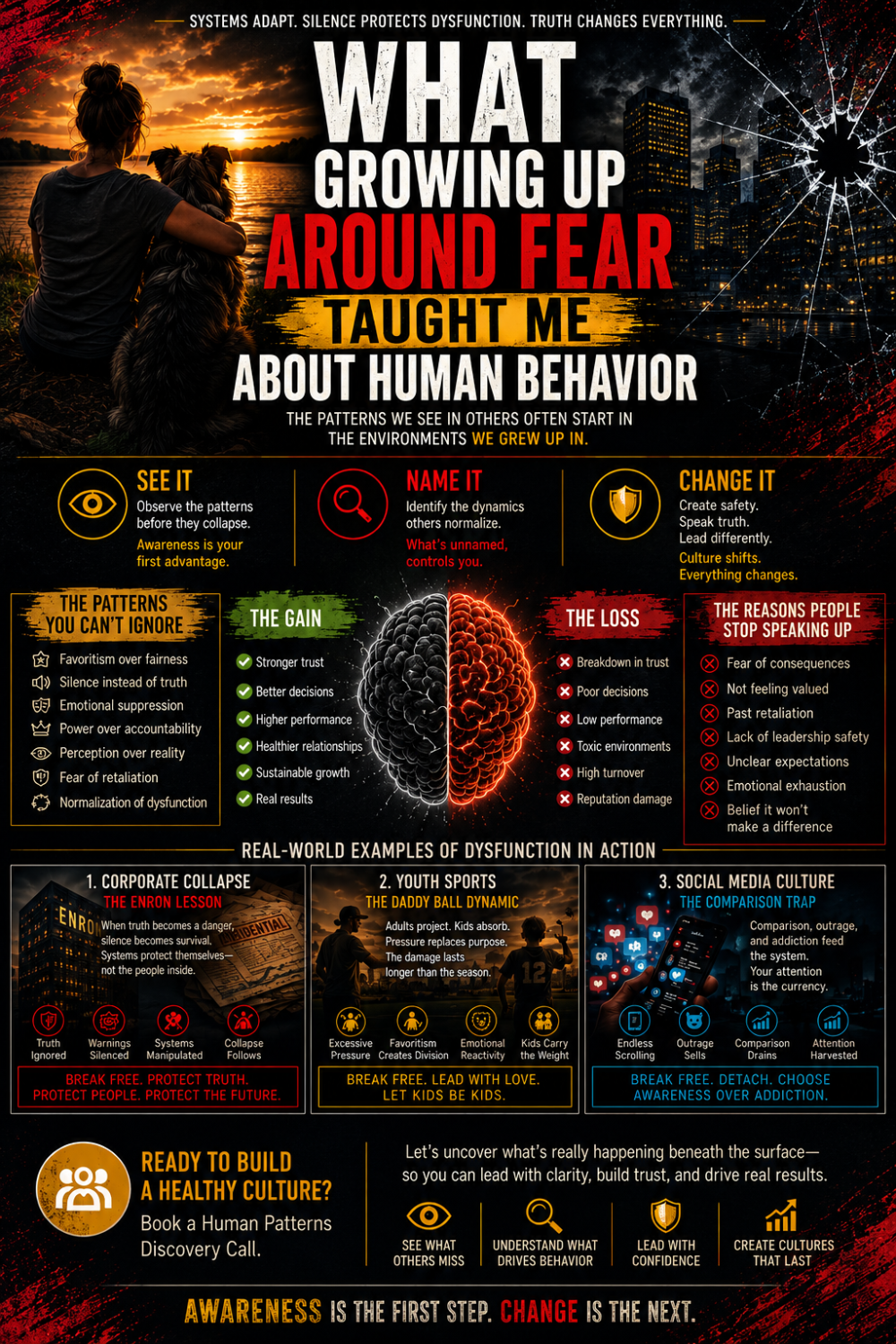
What Growing Up Around Fear Taught Me About Human Behavior
People often ask me the same question.
“How did you see that so fast?”
I hear it after speaking engagements.
I hear it in consulting conversations.
I hear it when I’m observing leadership teams.
I hear it when I’m talking with founders.
I hear it when I’m working with individuals who are trying to understand why they keep finding themselves in the same situations over and over again.
The truth is, I’ve been studying human behavior for most of my life.
I just didn’t know I was doing it.
Growing up, fear was everywhere.
Not the kind of fear most people imagine.
There were no dramatic fights.
There wasn’t constant chaos.
There wasn’t a crisis every day.
The fear was quieter than that.
My mom was terrified of driving on freeways.
She planned her life around avoiding traffic.
She scheduled appointments around traffic patterns.
She avoided uncertainty whenever possible.
Even now, decades later, she still does.
There is no blame in that observation.
But there is truth.
Fear shapes behavior.
And when fear shapes behavior long enough, it begins shaping everyone around it.
As children, we don’t just learn what people say.
We learn what they fear.
We learn what activates them.
We learn what they avoid.
We learn what feels safe to express and what doesn’t.
Without realizing it, we begin organizing our lives around those patterns.
Looking back, I don’t think I was learning fear.
I think I was learning observation.
I Thought I Was Learning Rules
I wasn’t.
I was learning people.
I learned how to tell when someone felt threatened.
I learned how to tell when someone was anxious.
I learned how to tell when someone needed control in order to feel safe.
I learned how to tell when someone was reacting instead of responding.
I learned how to tell when someone’s nervous system was driving the conversation.
At the time, I thought everyone could see these things.
I thought everyone noticed the shift in a room.
I thought everyone noticed when a person’s words and behavior didn’t match.
I thought everyone noticed when fear was hiding underneath certainty.
Later, I realized most people don’t.
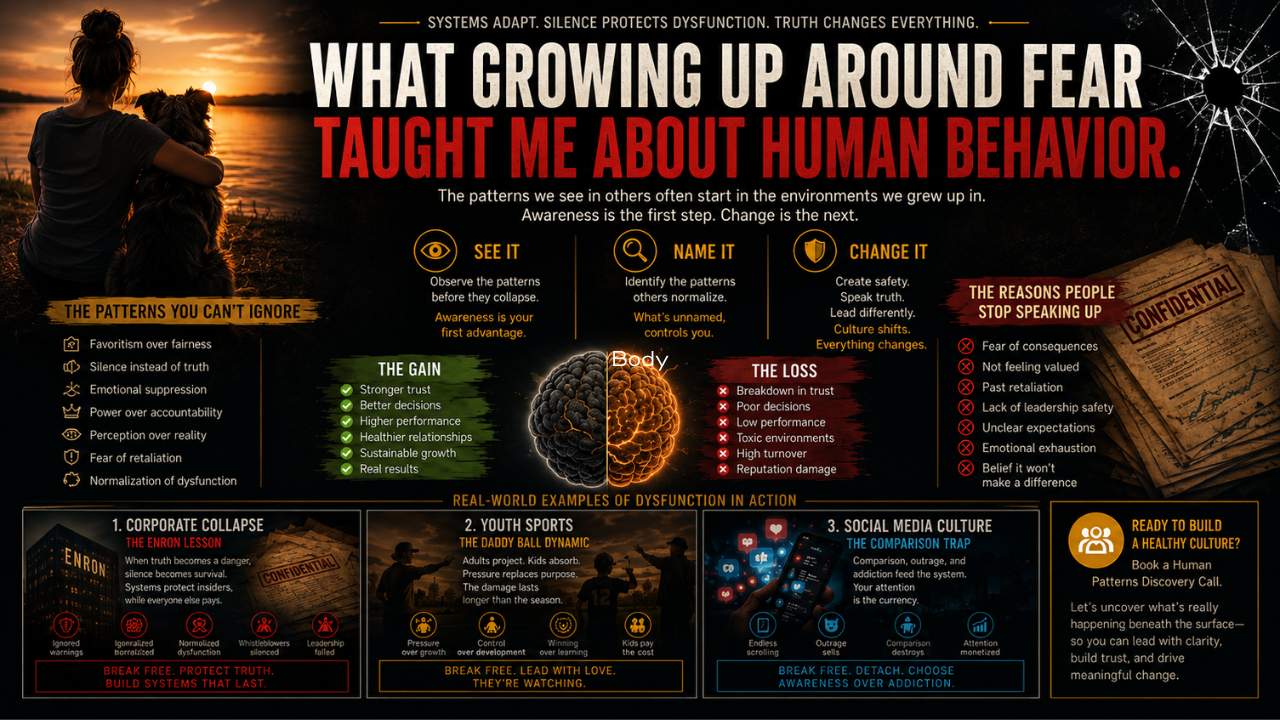
The Lesson Animals Taught Me
My family used to call me Ellie Mae.
For those of you too young to know the reference, Ellie Mae was the animal-loving character from The Beverly Hillbillies. She was always rescuing animals, talking to animals, and bringing home strays.
That was me.
Animals made sense to me.
People often didn’t.
Animals felt honest.
Animals responded to what was actually happening.
They weren’t performing.
They weren’t protecting an image.
They weren’t pretending to be something they weren’t.
Looking back, I think animals became one of my earliest experiences with regulation.
Years later, Rusty would become one of my greatest teachers.
Many people knew Rusty through my social media posts.
What most people didn’t know was how much he taught me.
He seemed to know when I needed movement.
He seemed to know when I needed stillness.
He seemed to know when I needed comfort.
Long before nervous system regulation became a popular topic, Rusty was teaching it.
The Pattern Followed Me Everywhere
As I got older, I started seeing the same pattern everywhere.
In schools.
In friendships.
In relationships.
In organizations.
In leadership teams.
In founder-led companies.
Different people.
Different circumstances.
Same pattern.
Fear.
Fear of uncertainty.
Fear of being wrong.
Fear of losing control.
Fear of judgment.
Fear of change.
Fear of what might happen next.
I eventually realized something important.
Most people are not reacting to reality.
They’re reacting to their nervous system’s interpretation of reality.
That changed everything for me.
Because suddenly behavior made sense.
The micromanager made sense.
The founder who couldn’t let go made sense.
The executive who couldn’t hear feedback made sense.
The leader who needed everyone to agree with them made sense.
Not because I agreed with the behavior.
Because I understood what was driving it.
Then the Pandemic Amplified Everything
The pandemic fascinated me.
Not because of the virus.
Because of the human behavior.
Pressure reveals patterns.
And suddenly the entire world was under pressure.
Fear spread faster than facts.
People became reactive.
People became tribal.
People became exhausted.
People became certain.
People became rigid.
And social media amplified all of it.
Today we have access to more information than any generation in history.
We can consume fear twenty-four hours a day if we choose.
Our nervous systems were never designed for that.
Yet many people don’t realize it’s happening.
They think they’re responding to reality.
They’re often responding to nervous system activation.
And if you’re unaware of that activation, it will run your life.
The Gift Hidden Inside Projection
One of the most valuable lessons I ever learned came from a therapist years ago.
She taught me about projection.
At first, I didn’t fully understand it.
Now I see it everywhere.
Projection is fascinating because it often tells you more about the speaker than the target.
The accusation becomes the clue.
The criticism becomes the clue.
The reaction becomes the clue.
For years, I’ve jokingly referred to projection as God’s gift.
Because if you’re willing to observe it without becoming defensive, it often reveals exactly what is happening inside the other person’s nervous system.
The founder who accuses everyone of being disloyal.
The leader who constantly questions everyone’s motives.
The person who sees threats everywhere.
The person who believes everyone is judging them.
The person who believes everyone is trying to control them.
Projection leaves breadcrumbs.
And if you know how to observe it, it tells a story.
What People Hire Me To Do
For years, I thought everyone could see these patterns.
I thought everyone could feel when something was off.
I thought everyone could identify the pressure points inside a system.
Then I realized they couldn’t.
That’s why people hire me.
Not because I have all the answers.
Not because I’m trying to fix people.
Because I can often see the pattern before the pattern becomes obvious.
I can see when fear is driving decisions.
I can see when someone’s nervous system is creating unnecessary friction.
I can see when a leadership team is solving the wrong problem.
I can see when an organization is treating symptoms while ignoring the source.
And the question I hear most often is:
“How did you see that so fast?”
The answer is simple.
I’ve been studying human behavior my entire life.
The Lesson That Changed Everything
But there was one lesson that took me much longer to learn.
Seeing a pattern does not make me responsible for it.
Seeing fear does not make me responsible for managing it.
Seeing dysregulation does not make me responsible for regulating it.
For years, I carried responsibility that didn’t belong to me.
I managed emotional weather.
I absorbed tension.
I tried to stabilize environments that weren’t mine to stabilize.
That is exhausting.
And I know I’m not the only person who does it.
Many high performers do the same thing.
Many leaders do the same thing.
Many people who grew up around fear do the same thing.
The real breakthrough wasn’t learning how to see patterns.
The breakthrough was learning which patterns belonged to me and which ones didn’t.
That is where awareness begins.
And awareness is where regulation begins.
Today, nervous system regulation has become a popular topic.
I think that’s a good thing.
But before regulation comes awareness.
You cannot regulate what you refuse to see.
And that may be the most important thing I’ve learned from a lifetime of observing human behavior.
Human Patterns Under Pressure didn’t start in a boardroom.
It started in a house where fear looked normal.
It continued through schools, relationships, workplaces, and organizations.
And after decades of observation, I’ve come to believe something simple:
The most disruptive force inside most families, teams, and companies isn’t conflict.
It isn’t uncertainty.
It isn’t disagreement.
It’s unrecognized fear.
Because what remains unseen gets projected.
What gets projected spreads.
What spreads shapes cultures.
What shapes cultures shapes lives.
Most people are trying to solve the behavior.
I’m interested in the pattern underneath it.
That’s the work.
That’s why people ask me what I see.
And that’s why awareness will always be the first step.
Because once you can see the pattern, you finally have a choice.
And choice changes everything.
About the Author
Kathie Owen is a workplace consultant, speaker, and creator of Human Patterns Under Pressure.
She helps leaders, founders, and organizations identify the hidden behavioral patterns that impact trust, communication, decision-making, and performance.
Drawing from decades of experience in psychology, fitness, leadership development, and human behavior, Kathie is known for her ability to spot patterns others miss and translate them into practical insights that create meaningful change.
What Growing Up Around Fear Taught Me About Human Behavior is one of Kathie's most personal reflections on how she developed the lens that would eventually become Human Patterns Under Pressure.
Read More Articles from Kathie

Transcript
When I was growing up, I thought everybody got angry in traffic. I thought that was normal. My dad had terrible road rage. If someone cut him off, he got mad. If someone drove too slow, he got mad. If someone made a mistake, he got mad. And my dad wasn't usually a mad person. And at the same time, there was my mom, who was terrified of traffic. She avoided freeways. She planned her day around traffic. She worried about traffic. So I grew up watching two completely different reactions to the same thing, fear and anger. And then one day when I was about 17 years old, I was riding in the car with someone else. A driver cut us off, and I waited. I waited for them to get upset. I waited for them to complain. I waited for them to react, and they didn't. They just kept driving. And I remember sitting there thinking, "Wait a second. That's an option?" I know it sounds funny now, but that moment stuck with me because it was the first time I realized people weren't actually reacting to traffic. They were reacting to what was happening inside of them. And looking back, I think that moment changed the way I see people. Because once I saw it in traffic, I started seeing it everywhere, in families, in schools, in friendships, in workplaces, in leadership teams, in founder-led companies. Different situations, same pattern. People responding to what was happening inside their nervous system and believing they were responding to reality. And that's what we're gonna talk about today because growing up around fear taught me something I didn't fully understand until much later. I wasn't just learning about people, I was learning how nervous systems shape behavior. Welcome to the Kathie Owen Perspective podcast. My name is Kathie Owen, and I help leaders, founders, and high performers understand the human patterns under pressure. I study what happens when stress, uncertainty, conflict, change, and fear enter a system, whether that's a family, a workplace, a leadership team, or a single individual. And today, I want to share something a little bit more personal, because people often ask me, "How did you see that so fast?" Or, "How did you pick up on that?" Or, "What do you see that other people miss?" And honestly, I've been thinking about that question a lot lately, and I think I finally know the answer. I didn't learn human patterns under pressure in a board room. I learned it as a child, not because my childhood was chaotic, and not because there was constant conflict. Actually, from the outside, my family looked pretty normal. What I grew up around was fear, the quiet kind, the socially acceptable kind, the kind that hides behind protection, the kind that hides behind certainty, the kind that hides behind control, the kind that says, "I'm just trying to help," or, "I'm just worried," or, "I'm just being careful." And looking back, I can see that fear was shaping decisions everywhere around me, and without realizing it, I became a student of human behavior. I thought I was learning rules, but I wasn't learning rules. I was learning people. I learned how to tell when someone felt threatened. I learned how to tell when someone needed control in order to feel safe. I learned how to tell when someone was operating from fear. I also learned how to tell when someone could handle reality and when they couldn't. And honestly, I thought everybody could see this. I thought everybody noticed the shifts. I thought everybody could feel tension in a room. I thought everybody could tell when someone's words and behavior didn't match. Later, I learned something important. Most people don't see those things. As I got older, I kept seeing the same pattern everywhere, in schools, in friendships, in relationships, in leadership, in organizations. Different people, but the same pattern. Fear. Fear of being wrong, fear of losing control, fear of uncertainty, fear of judgment, fear of what might happen next. And once I started seeing it, I couldn't unsee it. The micromanager, the founder who can't let go, the leader who needs everyone to agree, the executive who can't hear feedback, the employee who sees threats everywhere. Different behaviors, same root. Then the pandemic happened, and suddenly the entire world was under pressure. This fascinated me because pressure reveals patterns. People become reactive. People become rigid. People become tribal. People become exhausted. People became certain, and social media amplified all of it. Now we can access every crisis, every opinion, every catastrophe, and every prediction instantly. Our nervous systems were never designed for that. And here's what I think happened. The pandemic didn't create most of those patterns, it exposed them. Now, if you look around, nervous system regulation is everywhere, and honestly, I think that's a good thing. But I think most people skip the most important step, and that step is awareness. You cannot regulate something you cannot see. Most people are trying to regulate behavior. I'm interested in what drives the behavior because behavior is information. Behavior tells a story, and one of the biggest clues I've ever found is projection. Projection is a clue, and I've always been fascinated by projection. Even when I was studying psychology in college, I remember learning about projection and immediately recognizing it because I'd already seen it my whole life. Projection is one of the greatest clues you'll ever get. People reveal themselves without realizing they're doing it. The accusation becomes the clue. The criticism becomes the clue. The reaction becomes the clue. If somebody sees the threats everywhere, pay attention. If somebody thinks everyone is judging them, yeah, pay attention. If somebody believes everyone is trying to control them, pay attention. Projection leaves breadcrumbs, and if you know how to observe those breadcrumbs, you learn a lot about what's happening underneath the surface. But here's the lesson that took me decades to learn. Seeing a pattern does not make me responsible for it. Seeing fear does not mean I have to carry it. Seeing dysregulation does not mean I have to regulate it. For years, I absorbed emotional weather. I managed environments. I carried responsibility that didn't belong to me, and it was freaking exhausting. The biggest shift in my life wasn't learning how to see the patterns. The biggest shift was learning which patterns belonged to me and which ones didn't. Today, people hire me because I see patterns, not because I'm smarter and not because I have all the answers, because I've spent decades observing what happens when people come under pressure. I can often see the pattern before the pattern becomes obvious. I can see when fear is driving decisions. I can see when a leadership team is solving the wrong problem. I can see when a founder's nervous system is creating friction inside the company. I can see when someone is treating symptoms instead of addressing the source. And that's why people ask me, "How did you see that so fast?" For most of my life, I thought everyone could see what I saw. Now I realize most people don't. Human patterns under pressure didn't start in a boardroom. It started by watching people, watching fear, watching uncertainty, watching projection, watching behavior, watching what happens when pressure entered a system. And after decades of observation, I've come to believe something very simple. The most disruptive force inside most families, teams, and organizations is not conflict. It isn't uncertainty. It isn't disagreement. It is unrecognized fear. Because what remains unseen gets projected. What gets projected spreads. What spreads shapes cultures. What shapes cultures shapes entire lives. Most people are trying to solve the behavior. I'm interested in the pattern underneath it, because once you see the pattern, you finally have a choice, and choice changes everything. If you'd like to go deeper, I've written a complete companion blog post that I do with every episode that expands on today's episode and includes additional resources. You'll find it linked in the show notes and description below and in the first comment on YouTube. And in the next episode, we're going to explore something I've been thinking about a lot lately. What happens when a child grows up learning to manage other people's emotional states? Because that pattern follows a lot of people into adulthood, and most don't even realize they're still carrying it. Thank you for being here today. I trust that you found today's episode helpful, and until next time, I'll see you in the next episode of the Kathie Owen Perspective podcast.

An anomalous challenge can do more than break a routine. Learn how interrupting predictions can reveal hidden patterns, improve pattern recognition, expand choices, and open new possibilities through Reality Transurfing, awareness, and non-attachment. #RealityTransurfing #PatternRecognition #SelfAwareness #HumanBehavior