
Mean Girl Energy Is Bigger Than You Think

Summary
Most emotionally unsafe environments are not created by “bad people.” They are created by unconscious group dynamics, nervous system pressure, and emotional contagion.
In this article, Kathie Owen explores psychological safety, Reality Transurfing pendulums, leadership energy, and how awareness—not blame—changes the emotional atmosphere of a room.
The Emotional Contagion Nobody Talks About
Have you ever walked into a room and immediately felt tension… even though nobody technically said or did anything wrong?
Maybe it was:
a sarcastic tone
an awkward silence
a subtle exclusion
people suddenly acting guarded
a shift in energy you could feel in your body
Most people brush this off.
But the people who study human behavior under pressure notice something important:
Rooms have nervous systems too.
And once emotional tension enters a group, humans unconsciously begin adapting to it.
That’s why emotionally unsafe environments can quietly become “normal.”
This happens:
in families
in leadership teams
in youth sports
in friend groups
in corporations
online
everywhere humans gather
And honestly?
This conversation is much bigger than “mean girl energy.”
Because what we often call “mean girl behavior” is usually something deeper:
belonging pressure
emotional contagion
unconscious adaptation
nervous systems reacting under pressure
That distinction matters.
Because once we stop focusing only on villains, we can finally start understanding the system itself.
The Restaurant Story Nobody Forgot
Years ago, I sat at lunch with a leader who had hired me to evaluate his leadership and his client relations.
At the table was another person who spent almost the entire meal complaining about the service.
The waiter wasn’t fast enough.
The drinks weren’t right.
The food took too long.
Then something interesting happened.
That same person suddenly said:
“I just can’t stand people who complain all the time.”
After the lunch I showed the leader this dynamic and he said, “How do you see these things?” I showed him that it was simple.
Because the nervous system often reveals things the words try to hide.
The leader sitting next to me missed it entirely.
But I noticed the contradiction immediately.
Not because I was trying to “catch” anyone.
But because pressure reveals patterns.
That’s what I study.
And honestly, most people are not consciously trying to create emotionally unsafe environments.
They are reacting unconsciously.
That’s why awareness matters so much.
How Emotional Contagion Quietly Takes Over
Humans are wired for belonging.
That is not weakness.
That is biology.
The problem happens when belonging becomes more important than awareness.
One sarcastic comment enters a group.
Then:
eye rolling spreads
gossip spreads
defensiveness spreads
emotional tension spreads
And eventually the emotional atmosphere changes.
Not because one giant dramatic thing happened.
But because humans unconsciously mirror each other emotionally.
This is why some workplaces feel exhausting.
Leadership may say:
“We have a great culture here.”
But when leadership walks into the room:
nobody relaxes
nobody speaks honestly
everyone monitors themselves
That is not psychological safety.
That is nervous system management.
Huge difference.
And people feel it immediately.
Even if nobody can explain why.
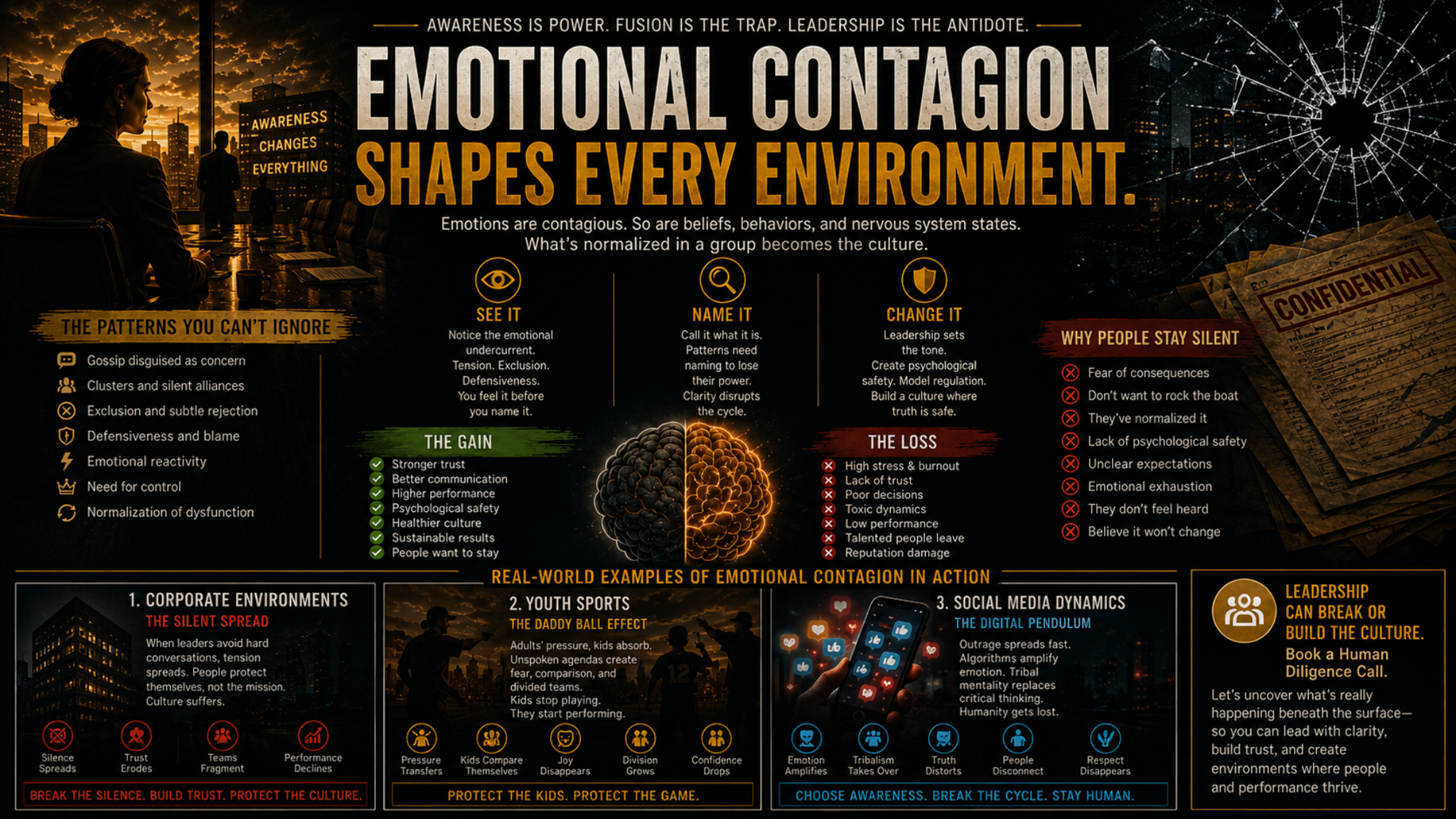
People Feel Your Leadership Before They Believe It
This may be one of the most important leadership truths nobody talks about enough.
People feel your nervous system before they process your words.
You cannot force emotional safety through:
slogans
mission statements
motivational speeches
leadership workshops alone
Humans read nervous systems first.
A tense leader creates tense rooms.
A defensive leader creates guarded teams.
A reactive leader creates emotional monitoring.
And ironically?
Many leaders have absolutely no idea they are doing this.
That’s why self-awareness matters so much.
Not performative leadership.
Not “looking like” a leader.
Actual emotional regulation.
Because real leadership does not recruit people into tension.
It creates safety.
The Baseball Story That Changed My Perspective
Youth sports may be one of the clearest places to observe human behavior under pressure.
Parents become emotionally attached to:
their child
their team
their side
their status
their belonging group
And honestly?
That’s normal.
But years ago, while watching one of my sons play sports, I noticed something different happening inside me.
While many parents focused only on “their side,” I kept noticing:
the embarrassed child
the kid sitting alone
the player who struck out
the nervous system under pressure
And I realized something important.
The goal is not moral superiority.
The goal is widening awareness.
That changes everything.
Because when awareness widens:
reactivity decreases
defensiveness softens
emotional rigidity loosens
compassion naturally increases
And suddenly the situation looks completely different.
Not because you became passive.
But because you stopped emotionally fusing with the system.
Reality Transurfing Explains This Beautifully
One reason the concept of pendulums from Reality Transurfing resonates so deeply with people is because it explains emotional recruitment perfectly.
A pendulum feeds on emotional energy.
It wants:
sides
outrage
defensiveness
emotional fuel
polarization
And honestly?
Group dynamics behave the exact same way.
Once emotional charge enters a system:
gossip accelerates
tension escalates
people unconsciously mirror each other
everyone starts feeding the same emotional atmosphere
Then eventually nobody even remembers how it started.
That’s why:
family conflicts repeat for decades
workplace tension spreads quickly
social media pile-ons become vicious
friend groups become emotionally unsafe
And emotionally sensitive people feel it immediately.
Usually in the body first.
What This Feels Like in Real Life
If you’ve ever been caught inside emotionally unsafe dynamics, you know this feeling.
You replay conversations over and over.
You mentally defend yourself.
You overexplain.
You desperately want people to “see” what’s happening.
Your nervous system becomes hooked.
This is why awareness is so important.
Not suppression.
Awareness.
Because the goal is not:
“Never feel activated.”
The goal is:
Awareness without fusion.
That line alone can change someone’s life.
Can I observe the emotional system without completely becoming the emotional system?
That is emotional maturity.
That is leadership.
And honestly?
That is freedom.
You Don’t Have To Win the Emotional Game
This may be the most freeing realization of all.
You do not have to win the emotional game in order to leave it.
Most emotionally charged systems desperately want participation.
They want:
explanations
reactions
defensiveness
emotional fuel
But observation changes everything.
The second you begin observing the system clearly, you stop being fully consumed by it.
That does not mean you become weak.
It means you become aware.
And aware people are much harder to emotionally recruit.
The Bigger Lesson
The longer I study human behavior under pressure, the less interested I become in labeling people as villains… and the more interested I become in awareness.
Because honestly?
Most people are not waking up thinking:
“How can I emotionally damage someone today?”
They are reacting unconsciously.
Adapting unconsciously.
Participating unconsciously.
That does not excuse harmful behavior.
But it does create understanding.
And understanding changes how we lead.
It changes how we parent.
How we communicate.
How we regulate.
How we show up under pressure.
Because in the end…
people feel your leadership long before they believe it.
And the emotional atmosphere you create may be speaking louder than your words ever will.
#HumanPatternsUnderPressure #PsychologicalSafety #Leadership #RealityTransurfing #EmotionalIntelligence #WorkplaceCulture #LeadershipDevelopment #NervousSystem #HumanBehavior #CorporateCulture
About Kathie Owen
Kathie Owen studies human patterns under pressure inside organizations, leadership teams, families, and emotionally charged environments. Her work focuses on psychological safety, emotional regulation, workplace culture, leadership behavior, and the hidden nervous system dynamics that quietly shape human performance.
Drawing from years of experience in corporate wellness, leadership observation, and organizational consulting, Kathie helps leaders recognize the invisible emotional patterns that impact trust, communication, culture, and performance. She is especially known for her ability to observe what people feel inside systems — not just what organizations say about themselves.
Kathie’s work blends practical leadership insight with deeper concepts like emotional contagion, nervous system awareness, Reality Transurfing, and group dynamics under pressure. Through her podcast, articles, speaking, and consulting, she explores how emotionally charged environments influence behavior — and how awareness can create calmer, healthier, more psychologically safe leadership.
She is the creator of Human Patterns Under Pressure and host of The Kathie Owen Perspective Podcast, where she shares conversations on leadership, emotional intelligence, workplace psychology, emotional regulation, and the human side of performance under pressure.
Read More Articles from Kathie

Transcript
Have you ever walked into a room and immediately felt the emotional temperature change? Nobody said anything directly, and nobody technically did anything wrong, but suddenly you feel tension, exclusion, sarcasm, defensiveness, pressure. And what's always been interesting to me is most of the time, people don't even realize they're doing it. And the longer I study human behavior under pressure in workplaces, in families, in sports, in leadership teams, and even online, the less I become interested in villains, and the more I become interested in unconscious group dynamics. Because what we call "mean girl" energy is often something much deeper. It's emotional contagion. It's nervous systems adapting to group pressure. It's belonging behavior. And if you look closely, almost all humans are susceptible to it. I would even venture to say that all humans are susceptible to it, and that's what we're gonna talk about today. Welcome to the Kathie Owen Perspective podcast. My name is Kathie Owen, and I study human patterns under pressure. I spent years observing leadership behavior, emotional regulation, workplace culture, group dynamics, and psychological safety inside organizations. And one of the biggest things I look for when I walk into a workplace is not policies, mission statements, or leadership slogans. I look for how the room actually feels, because people feel your leadership before they believe it. I'm going to repeat that 'cause that's really important. People feel your leadership before they believe it. That's true in corporations, that's true in families, that's true in sports, that's true in friend groups. And if we each look clearly into this, that's true everywhere humans gather. If you've watched some of my recent content on psychological safety, trust in leadership, human performance under pressure, reality transurfing, emotional pendulums, and group behavior, then this conversation connects deeply to all of that. And before we dive in, if this conversation resonates with you, like, subscribe, and leave a comment below, not because I'm trying to be some big, giant audience on the internet, but because I genuinely think these conversations matter. And I think people are hungry for emotional intelligent conversations that help us understand ourselves and each other better. One thing I really wanna make clear in this conversation, this is not about attacking any one person in particular, and this is definitely not about creating a victim mentality. I actually talk about the victim-victimizer cycle all the time, and I will be talking about it a lot more. However, I will also link to my articles on this cycle in the show notes and description below because I find the victim-victimizer cycle to be very helpful in understanding these dynamics. So today, actually what I am doing is the exact opposite of victim mentality. What I'm talking about is something profoundly human, because men and women do this, leadership teams do this, families do this, friend groups do this, sports teams do this, entire organizations do this. Humans unconsciously adapt to emotional environments all the time. And one sarcastic comment, one eye roll, one exclusion, one dismissive tone can completely shift the emotional atmosphere of a room. And what fascinates me is how fast people unconsciously join the emotional energy, not because they're evil, but because humans are wired for belonging. And when belonging pressure enters the system, people start adapting emotionally without even realizing it. That's why emotionally unsafe environments become normalized. People stop noticing the tension because the tension becomes the culture. I see this in my consulting work constantly. Leaders will tell me, "We have a great culture here." But when I observe the environment, nobody relaxes when leadership walks in. Nobody speaks honestly. Everyone is monitoring themselves. That's not psychological safety. That's nervous system management. Huge difference. Huge This is actually one reason I find Reality Transurfing so relevant to this topic. Vadim Zeland, the author of Reality Transurfing, talks about pendulums. You've heard me talk about them all the time, and whether you believe that literally or metaphorically, the concept is incredibly useful psychologically. A pendulum feeds on emotional reactivity. It recruits participation. It wants polarization. It wants sides. It wants emotional fuel, and we can easily identify how group dynamics do the exact same thing. Once emotional charge enters a group, gossip spreads, defensiveness spreads, outrage spreads, sarcasm spreads, exclusion spreads, and people start emotionally mirroring each other unconsciously. And then suddenly, nobody even remembers how the emotional atmosphere got there in the first place. That's why social media pile-ons happen. That's why workplace gossip spreads. That's why family systems repeat the same emotional patterns for decades. And if you're emotionally sensitive, you feel it immediately. You feel it in the shift in the room before anyone says a word. You feel it in your nervous system. This is the part people don't talk about enough. What does this actually feel like in the body? Because if you've ever experienced emotionally unsafe group dynamics, you know exactly what I mean. You replay conversations in your head over and over and over again. You mentally defend yourself. You over-explain. You want people to see what's happening. Wake up. See it. You feel emotionally hooked. Your nervous system gets activated, and sometimes people end up reacting badly simply because their nervous system feels trapped. That's why awareness matters so much. Not suppression, awareness. Because the goal is not never feel activated, 'cause it's gonna happen. The goal is awareness without fusion. That's the work. Ask yourself, "Can I observe the emotional system without completely becoming the emotional system?" That question alone changes everything, and I have to tell you that awareness is not always easy. That is why pendulums are so tricky. They steal your energy before you even become aware of it. Youth sports is one of the clearest place to observe this, and I talk about this often. You know, parents get emotionally attached to their child, their side, their team, their disappointment, their status, their belonging group. And again, that's human, that's normal. But what stood out to me for many years, because my sons were very active in youth sports, was this: I found myself thinking about the other child on the other side, the embarrassed kid, the excluded player, the child who struck out, the nervous system under pressure. And I realized something important. The goal is not moral superiority. The goal is widening the field of awareness, and that's very, very different because widening awareness changes behavior naturally. When you widen awareness, you become less reactive, less defensive, less emotionally recruited, less consumed by our side versus their side. And honestly, that's leadership. Real leadership creates emotional safety. It does not emotionally recruit people into tension. So the big question I get asked is, "Kathie, how do I step out of the system?" And where do you actually start with this? A few things I've personally found helpful is notice the activation first, not the story, the activation. Pause before defending yourself. Pause before reacting. Pause before explaining. Sometimes physically stepping away from the environment helps tremendously. And I just have to add that sometimes that pause will take patience, persistence, and endurance because so many times those pendulums do not want to relinquish their energy. I feel another episode coming on this topic too. And humor can interrupt emotional rigidity. I will be doing an episode on this very soon on how humor stops the pendulum because this one is true. Observation changes everything because the second you begin observing the emotional system, you stop being fully consumed by it. And this part is really important. You do not have to win the emotional game in order to leave it. That realization alone is incredibly freeing, incredibly freeing, especially for highly sensitive, emotional intelligent people who feel everything deeply. You know, the longer I study human behavior under pressure, the less interested I become in labeling people as villains, and the more interested I become in awareness. Because if we really think about it, most people are not waking up thinking, "How can I emotionally damage someone today?" They're reacting unconsciously. They're adapting unconsciously. They're participating unconsciously. And once you begin seeing that, you stop feeding the emotional pendulum the same way. You become calmer, more observant, more grounded, and ironically, that's usually when your leadership becomes more powerful too because people feel your nervous system long before they process your words. As I said, people feel your leadership long before they believe it. If this conversation resonated with you, I'd genuinely love to hear your thoughts in the comments below. And if you wanna go deeper into these ideas, you know, leadership under pressure, emotional regulation, reality transurfing, especially on pendulums and dealing with them, that one is very popular. Psychological safety is another thing I talk about, and human patterns under pressure. I will link a full blog post and additional resources below on my website. They will be in the show notes and description below. All right, that's my episode for today. Thank you for being here. I trust that you found it helpful. And if you know someone who could benefit from this, please share it with them. And until next time, I will see you in the next episode of the Kathie Owen Perspective Podcast.
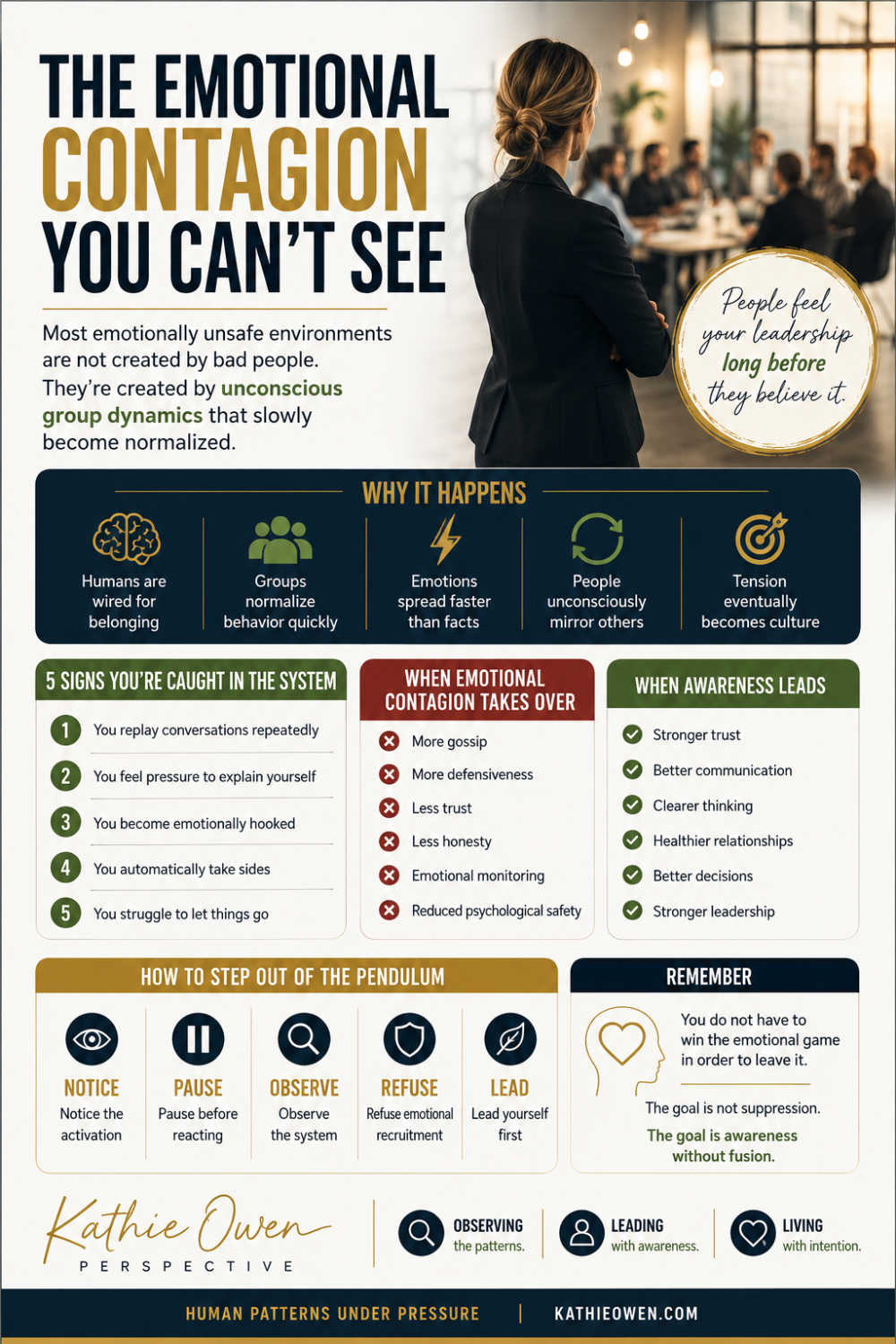

Whose nervous system is running the room? Explore emotional contagion, leadership under pressure, and Reality Transurfing pendulums. Kathie Owen explains how pausing, reducing excess importance, and dialectical thinking can help you recognize patterns and choose your response.
#EmotionalRegulation #Leadership #RealityTransurfing #HumanDiligence