
The Emotional Systems You Can't See (Pendulums Explained)

The Hidden Workplace Pattern That Hijacks Your Nervous System
A man walks into a meeting late.
He doesn’t say much at first.
But everybody can feel him before he speaks.
His energy is rushed.
His breathing is shallow.
His phone is in his hand.
He immediately starts talking about traffic, layoffs, a rumor upstairs, a scary news story, and something “everybody needs to hear.”
Within minutes, the room changes.
People stop focusing.
People start reacting.
People start checking their phones.
People start speculating.
The emotional temperature rises.
And here’s the interesting part:
Nothing dangerous is actually happening inside the room.
But the nervous systems inside the room no longer know that.
This happens every single day inside workplaces, families, leadership teams, group chats, and social media feeds.
Most people think they are reacting to information.
What they are actually reacting to is emotional contagion.
And once you understand this concept, you start seeing it everywhere.
What Is A Pendulum?
One of the frameworks I use often in my work comes from a book series called Reality Transurfing by Vadim Zeland.
Inside Reality Transurfing, Zeland describes something called a “pendulum.”
A pendulum is essentially an energetic structure that survives through emotional reaction, attention, identification, and collective energy.
Now before that sounds too abstract, let’s make it practical.
You already know what a pendulum feels like.
A rumor spreads through the office.
Slack explodes.
Someone sends a panic-filled text.
A family member forwards alarming news.
Social media floods with outrage.
A leadership team spirals into fear and urgency.
That is a pendulum in action.
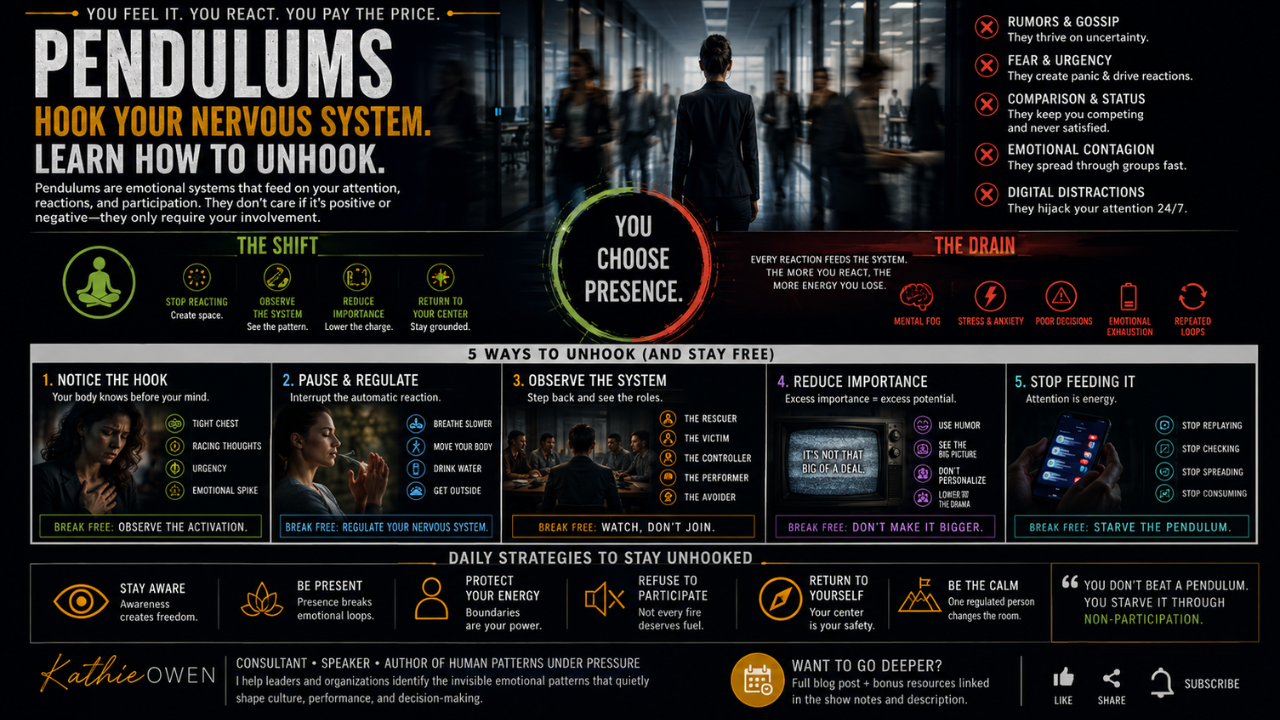
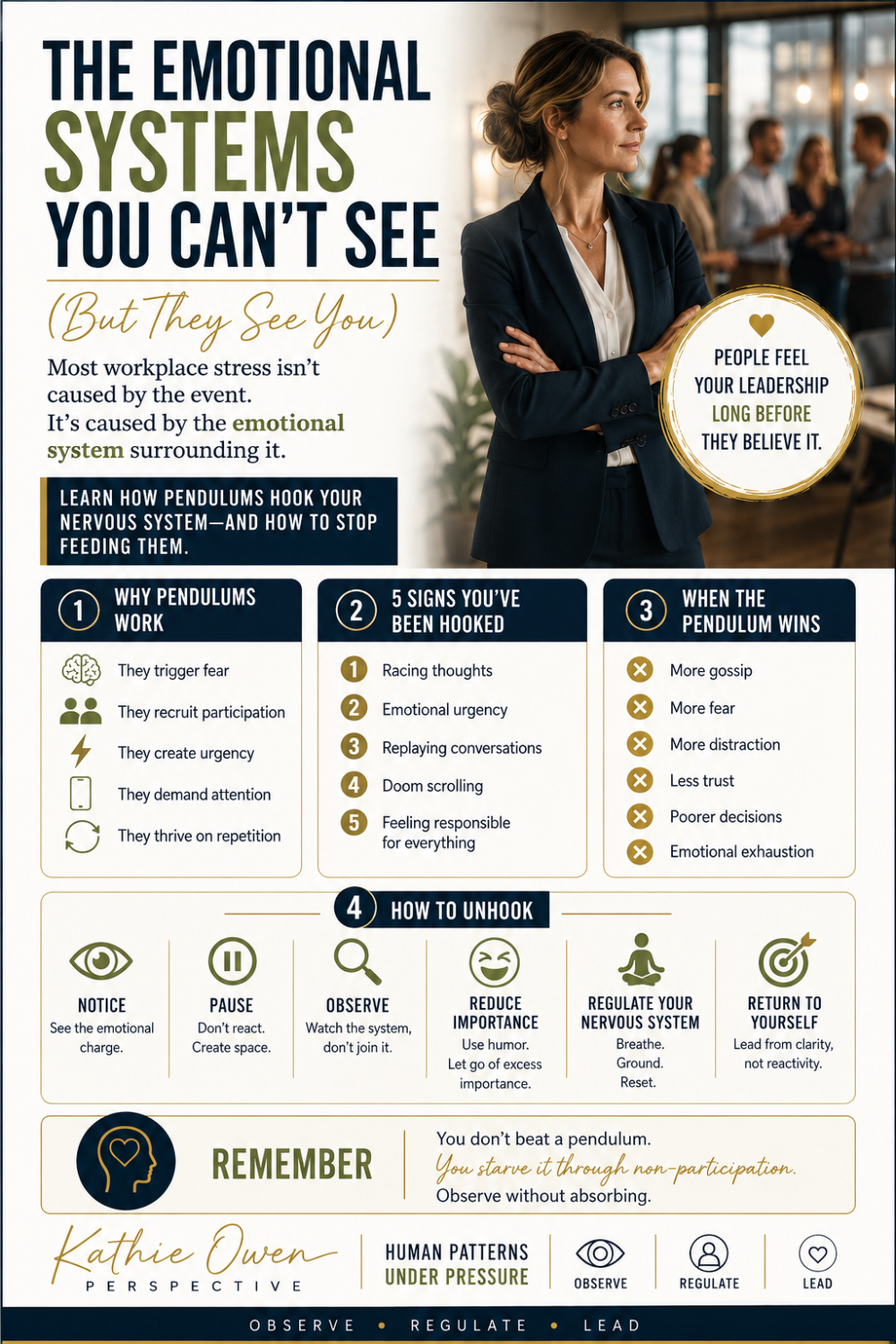
Pendulums feed on:
fear
outrage
urgency
obsession
attention
emotional reaction
collective activation
And modern life is full of them.
Workplace drama.
Political hysteria.
Family conflict.
Internet outrage.
Scarcity messaging.
Fear-based leadership.
Performance anxiety.
Gossip.
Validation seeking.
The problem is not that pendulums exist.
The problem is that most people do not realize when they’ve been emotionally hooked by one.
The Pendulum Hooks Your Nervous System First
This is where the conversation gets really important.
Most people think they become emotionally hooked through thinking.
They don’t.
The pendulum hooks the nervous system first.
That tight chest.
The emotional spike.
The sudden urgency.
The obsessive thinking.
The replaying conversations.
The doom scrolling.
The compulsive checking for updates.
The mental arguing.
That is the hook landing.
And most people mistake that activation for importance.
But activation and importance are not the same thing.
That distinction can change your life.
Because once people become emotionally activated, they stop observing clearly.
They start reacting automatically.
The Workplace “Information Hub”
Years ago, I worked with someone who unconsciously became the emotional distributor for the entire office.
If there was:
gossip
executive tension
traffic
a weather alert
a recall
bad news
emotional drama
fear
urgency
she became the delivery system.
She would move from office to office spreading emotionally charged information.
And fascinatingly, people flocked to her.
Because if you wanted to know what was happening, you asked her.
But if you wanted peace, you avoided her.
One day I realized something important:
She wasn’t spreading information.
She was spreading emotional charge.
That’s a massive difference.
And honestly, most organizations unknowingly reward this behavior.
Why?
Because emotionally activated people become information hubs.
People seek them out to reduce uncertainty.
But the cost is enormous.
Because the nervous system inside the organization stays activated all day long.
And activated nervous systems make poor decisions.
Dissatisfaction Is The Pendulum’s Favorite Dish
One of the most powerful lines from Reality Transurfing is this:
“Dissatisfaction and lack of fulfillment are the pendulum’s favorite dish.”
That line stopped me in my tracks the first time I read it.
Because emotionally dysregulated people are easier to hook.
Think about modern workplaces for a moment.
Many people are already:
exhausted
overwhelmed
disconnected
anxious
under pressure
emotionally depleted
That creates the perfect environment for emotional contagion.
The pendulum thrives in environments where people are:
reactive
fearful
uncertain
emotionally overstimulated
disconnected from themselves
And most people do not realize how much energy they lose every day feeding emotional systems they never consciously chose to join.
You Do Not Have To Emotionally Join Every System Around You
This may be one of the most important lessons I have learned in both leadership and life.
You do not have to emotionally join every system around you.
That is power.
Most people unconsciously believe:
“If I don’t emotionally react, I don’t care.”
But that is not true.
Compassion does not require emotional contagion.
You can care deeply without becoming emotionally hijacked.
You can stay informed without spiraling.
You can support people without drowning with them.
You can remain grounded without becoming cold or detached.
That distinction is incredibly important for:
leaders
parents
teachers
healthcare workers
highly sensitive people
helpers
executives
Because emotionally regulated people stabilize environments.
Emotionally reactive people spread activation.
How To Unhook From A Pendulum
This is the question I am asked most often.
“How do I stop the pendulum once I’m hooked?”
The answer is not force.
In fact, fighting the pendulum usually feeds it.
The goal is not to destroy the pendulum.
The goal is to stop feeding it.
Here are several ways to do that:
1. Notice The Hook
The moment you notice:
“My nervous system just activated…”
you create separation.
Observation weakens the pendulum.
Most people immediately merge with the emotional energy.
Instead, observe it.
That single moment changes everything.
2. Pause Before Reacting
Most emotional contagion spreads through automatic reaction.
Pause.
Breathe slower.
Relax your shoulders.
Notice the room.
Notice your body.
The pause interrupts the loop.
3. Observe The Emotional System
Instead of immediately personalizing behavior, ask:
“What role is everyone playing right now?”
Suddenly you can see:
the rescuer
the victim
the controller
the avoider
the performer
the martyr
the emotional distributor
Once you see the system, you stop drowning inside it.
4. Reduce Importance
This is a huge Reality Transurfing principle.
The more emotionally important something becomes, the more distorted perception becomes.
Zeland calls this “excess potential.”
Pendulums thrive on excess importance.
Humor can be incredibly helpful here.
Why?
Because humor collapses importance.
The pendulum wants a courtroom.
Humor turns it into a sitcom.
Emotionally healthy teams often laugh more not because they avoid pressure, but because they refuse emotional hypnosis.
5. Stop Feeding The Loop Physically
Pendulums survive through repeated attention.
Attention is energy.
That means sometimes the healthiest thing you can do is:
stop rereading the email
stop checking the comments
stop replaying the conversation
stop consuming more fear-based input
stop spreading the emotional charge
Interrupt the loop.
6. Regulate The Nervous System
Sometimes the fastest way to stop feeding a pendulum is physical.
Go outside.
Take a walk.
Drink water.
Move your body.
Breathe slower.
Get off your phone.
The nervous system often needs safety before the mind can regain clarity.
One Regulated Person Can Change An Entire Room
This is one of the biggest things I now observe in leadership and consulting work.
I am constantly watching:
who spreads emotional charge
who escalates systems
who personalizes everything
who destabilizes rooms
who remains grounded under pressure
Because one emotionally regulated person can completely change the emotional field around them.
That is leadership.
Real executive presence says:
“I do not need to emotionally join this chaos to survive.”
That is strength.
That is regulation.
That is emotional maturity.
And honestly, it may be one of the most important skills people can develop right now.
Because modern life is designed to hook your nervous system constantly.
But not every emotional spike deserves your attention.
And not every workplace fire deserves your nervous system.
Final Thoughts
If you take anything from this article, let it be this:
You can observe without absorbing.
You do not have to emotionally join every system around you.
Pendulums collapse when:
nobody reacts
nobody feeds the drama
people stop personalizing behavior
someone remains grounded
observation replaces emotional contagion
That is emotional regulation under pressure.
And that is where real power begins.
About The Author
Kathie Owen is a consultant, speaker, and thought leader specializing in human patterns under pressure, emotional regulation, executive presence, and workplace dynamics. Based in Houston, she works with leaders, founders, and organizations to identify the invisible emotional patterns that quietly shape trust, culture, performance, and decision-making inside teams.
Her work bridges leadership psychology, nervous system regulation, Reality Transurfing principles, and organizational behavior to help leaders remain grounded in high-pressure environments. Through speaking, consulting, podcasting, and content creation, Kathie helps people understand how emotional systems influence human performance in real time.
Read More Articles from Kathie


Transcript
A woman walks into the office. She's carrying her phone, and her eyes are wide open, and before she even says a word, the emotional temperature of the room changes. "Did you hear what happened?" she said. Somebody's husband had a heart attack. There's a weather emergency. There's a recall. Traffic is terrible. Construction on the roads is terrible. There's executive gossip upstairs. A school shooting is trending on social media. Something bad happened somewhere, And within minutes, the entire office feels emotionally different. People stop working. People start reacting. People start speculating. People start doom scrolling. People start spreading the emotional charge to the next person. And here's the interesting part, the information itself is not what changed the room, the emotional contagion did. That's the pendulum, and once you understand this concept, you start seeing it everywhere. Welcome to the Kathie Owen Perspective podcast. My name is Kathie Owen, and if you're new here, my work sits at the intersection of leadership psychology, emotional regulation, workplace dynamics, and what I call human patterns under pressure. I help leaders in organizations identify the invisible emotional patterns that quietly shape culture, performance, trust, decision-making, and nervous system regulation inside teams. And one of the frameworks I use constantly in my work comes from a book series called Reality Transurfing by Vadim Zeland. Reality Transurfing introduced me to the concept of pendulums, and once I understood this idea, I could never unsee it. Because pendulums are everywhere. They are inside workplaces, inside families, inside relationships, inside politics, inside social media, inside group chats, inside leadership teams. And today, I wanna teach you something incredibly important, how to stop getting emotionally hooked by these pendulums. Because most people don't realize they've already been captured until their nervous system is completely activated. So if you enjoy conversations about emotional regulation, leadership under pressure, nervous system awareness, and learning how to stay grounded in emotionally charged environments, make sure you like, subscribe, and share this episode, because it helps more people find this work. Also, there will be a full blog post with bonus resources linked in the description and show notes below. So let's talk about pendulums and how to deal with them. I talk about pendulums all the time on this channel, and I also talk about, how are we going to deal with them, because they are everywhere. And pendulums are not always a bad thing, but what does end up happening that is bad is where your energy gets hooked and how it affects your entire life and nervous system. So a pendulum is in reality transurfing the book, and it's basically an energetic structure that feeds on emotional reaction, attention, identification, and collective energy. Now before people get uncomfortable with the word energetic, let's make this practical. You already know what this feels like. A rumor spreads through the office. Somebody sends a panic-filled group message. Everybody starts reacting emotionally. Slack explodes. People speculate. Fear spreads. Urgency spreads. That's a pendulum. Social media outrage, a pendulum. Family drama, a pendulum. Political hysteria, a pendulum. Group panic, a pendulum. Workplace gossip, huge pendulum. And here's the important part. Pendulums survive through emotional hooks. They need your reaction. They need your fear, your outrage, your urgency, your obsession, your attention. That's why Vadim Zeland says, and I love this quote, he says, "Dissatisfaction and lack of fulfillment are the pendulum's favorite dish." Yes, they are. When you're dissatisfied and when you feel a lack of fulfillment, you have been hooked by the pendulum Emotionally dysregulated people are easier to hook, and honestly, modern workplaces are filled with hooks. There's fear, there's comparison, micromanagement, urgency, scarcity, status, validation, performance anxiety, emotional contagion. Most organizations don't realize they're operating inside collective nervous system activation. Now, here's where this gets fascinating. I used to work with someone who was basically a walking pendulum in action, and I can bet that you can picture somebody in your head as I speak about this, and I don't mean that cruelly. She probably had no idea she was doing this. But if there was bad news, gossip, fear, urgency, executive tension, a recall, weather alerts, traffic, construction, drama, panic, or emotional stimulation, she became the delivery system. She would move from office to office spreading emotionally charged information, and what fascinated me was this. People flocked to her because if you wanted to know what was happening, you asked her. But if you wanted peace, you avoided her. And one day, I realized something important. She wasn't just spreading information. She was spreading emotional charge, and this is where people miss the lesson. The pendulum doesn't hook your mind first. It hooks your nervous system first. That tight chest, the urgency, the shakiness in your body, that emotional spike, the need to react immediately, the replaying conversations in your head, the doom scrolling, the compulsive checking for updates, the mental arguing, that obsession, that's the hook landing. And most people mistake that feeling for, "Oh my gosh, this must be really important." Uh, not always. Sometimes it's simply activation. This is why emotional regulation matters so much because the goal is not to destroy the pendulum. They are always going to be there. The goal is to stop feeding it, and that is very, very different. You don't beat a pendulum through force. In fact, it can get worse through force. You starve it through non-participation. And I have to say that changed my life because I started realizing something. I do not have to emotionally join every system around me. That's power. Now, let's talk about the big picture here, how to actually unhook yourself, and this is a question I'm often asked because this is the part most people skip. The first step is notice the hook. Most people are unconscious during this moment. They immediately merge with the emotional energy. But the second you notice, "Oh, my nervous system just got activated," you create separation. Observation weakens the pendulum. The moment you observe the hook instead of becoming hooked, something changes. You stop becoming part of the emotional system. You start watching the system. That's a completely different experience. And here's a good one that I mention often. One of the fastest ways to weaken a pendulum is through humor. Because humor collapses importance. The pendulum wants a courtroom. Humor actually turns it into a sitcom. I, I love that analogy. And that doesn't mean you become dismissive or cruel. It means you stop feeding emotional hypnosis. You stop treating every emotional spike like an emergency. This is also why emotionally healthy teams laugh more. Not because they avoid pressure, but because they reduce excess importance. And this brings us to another concept in reality transurfing, importance and excess potential. The more emotionally charged and important something becomes in your mind, the more distorted your perception becomes. You stop observing clearly. You start reacting automatically. That is excess potential, and pendulums love excess potential. They thrive on emotional intensity. This is why some people unconsciously spread fear to everybody around them. Not necessarily because they're bad people, but because fear seeks reinforcement. The nervous system says, "If everybody feels unsafe too, maybe I'll feel safer." But all that does is spread the emotional field. Now, here's something incredibly important. You can care deeply without becoming emotionally hijacked. A lot of people think, "If I don't emotionally react, I'm cold." Um, no. Compassion does not require emotional contagion. In fact, I would say the opposite. You can be informed without drowning. You can care without spiraling. You can stay grounded without becoming detached from humanity. And that distinction is massive, especially for helpers, teachers, leaders, parents, and highly sensitive people. Because when you react without drawing into the emotional contagion, you conserve your energy, and that's where your power lies. Now, let's get practical. What do you do in the moment the pendulum hooks you? Let's say somebody walks into the office and says, "Oh my God, did you hear what just happened?" And suddenly your nervous system spikes. Here's what most people do. They match the emotional energy. They escalate. They react. They panic. They spread it further. They replay it. They obsess over it. That feeds the pendulum. Instead, pause. Notice the activation. Slow your breathing. Observe the room. Observe the emotional system, and silently ask yourself, "What role is everyone playing right now?" Now suddenly you can see the rescuer, the victim, the controller, the performer, the avoider, the martyr, the emotional distributor. I have to laugh. And once you see the system, you stop drowning inside of it. This is also where nervous system regulation becomes incredibly important. Sometimes the fastest way to stop feeding a pendulum is physical. Go outside, take a walk, drink water, move your body, stop rereading the email, stop checking the comments, stop looking at your phone, stop consuming more fear-based input, stop replaying the situation. Interrupt the loop, because pendulums survive through repeated attention. Attention is energy, and if I'm being completely honest, and I bet you recognize this too, one of the most powerful things you can do is remain grounded while everybody else escalates. Because pendulums collapse when nobody reacts, nobody feeds the drama, people stop personalizing behavior, someone remains grounded, and observation replaces emotional contagion. That is emotional regulation under pressure, and this is something I now use constantly in my work, whether I'm observing leadership teams, workplace culture, executive presence, or organizational dynamics. I'm always watching. Who spreads emotional charge? Who stabilizes rooms? Who escalates systems? Who personalizes everything? Who remains grounded under pressure? Because one emotionally regulated person can change an entire room, and that is leadership. Real executive presence says, "I do not need to emotionally join this chaos to survive." That's strength, and I think this may be one of the most important skills people can develop right now, because modern life is designed to hook your nervous system constantly. But not every emotional spike deserves your attention. Not every workplace fire deserves your nervous system. So if you take anything from this episode, let it be this: You do not have to emotionally join every system around you. You can observe without absorbing. And that is where real power begins. Hmm. All right, thank you so much for being here today. If this episode resonated with you, share it with somebody who constantly gets emotionally hooked by workplace drama, family systems, social media fear, or collective panic. And don't forget to like and subscribe because it helps this message reach more people. I'll also link the full companion blog post with bonus resources, examples, and deeper insights below in the show notes and description. And if you wanna work with me directly, this is the kind of work I do every day. I help leaders, I help teams and organizations identify hidden human patterns that quietly destabilize trust, performance, emotional regulation, and culture under pressure. Because whether people realize it or not, human behavior drives everything. All right. That's my episode for today. I trust you found it helpful, and thank you for being here, and I will see you in the next episode of the Kathie Owen Perspective Podcast.

Learn how to practice non-attachment, let go of expectations, and stop carrying workplace stress into your personal life. Kathie Owen shares personal stories, Reality Transurfing insights, and simple ways to create space through meditation, hobbies, and nature walks.
#NonAttachment #LettingGo #RealityTransurfing #WorkplaceStress