
The Truth About Patterns We Miss | Yes The Truth Bubbles Up

You Don't Need More Answers. You Need Better Patterns.
There is a moment that changes everything.
Not because something new happens.
Because something old finally makes sense.
Have you ever looked back on your life and realized that what felt like random events were actually connected? The difficult boss. The strained relationship. The friendship that slowly disappeared. The opportunity you almost took but didn't. At the time, each experience felt separate. Looking back, they tell one story.
Most people spend years searching for answers.
I think we would be better served by looking for patterns.
That realization became one of the greatest gifts I received while writing The Truth Bubbles Up.
We Are Wired to Notice Events
Our minds naturally focus on what just happened.
We replay conversations.
We analyze decisions.
We ask ourselves why someone said what they said or why they treated us the way they did.
But isolated events rarely tell the whole story.
Patterns do.
One difficult conversation doesn't define a relationship.
One stressful meeting doesn't define a leader.
One mistake doesn't define a person.
Patterns, repeated over time, reveal character, culture, trust, emotional maturity, and leadership far more accurately than any single moment ever could.
That shift in perspective changed the way I see nearly everything.
Pressure Doesn't Create Character
People often say that pressure changes people.
I don't believe that's entirely true.
Pressure reveals what was already there.
It reveals the habits we've practiced.
The stories we've believed.
The fears we've protected.
The leadership we've developed—or neglected.
When life becomes uncertain, we don't suddenly become someone else.
We become more of who we already are.
That realization is incredibly freeing because it moves us away from blame and toward awareness.
Instead of asking, "Why is this happening?"
We can begin asking, "What is this revealing?"
That single question has transformed the way I approach conflict, leadership, and even my own emotional reactions.
The Most Valuable Skill Is Observation
One of the biggest lessons I learned while rewriting my book was that observation creates clarity.
Judgment creates noise.
When we're busy deciding who is right and who is wrong, we often miss the larger pattern unfolding in front of us.
Observation slows us down.
It allows us to notice the emotional tone in a room before anyone says a word.
It helps us recognize recurring behaviors instead of reacting to isolated incidents.
It gives us enough space to respond thoughtfully instead of automatically.
Whether you're leading a company, raising a family, or simply trying to understand your own life, observation is one of the most valuable skills you can develop.
The Story Didn't Change
I Did.
One of the most surprising parts of publishing The Truth Bubbles Up was realizing that I hadn't changed the facts.
The stories remained the same.
The conversations happened exactly as I remembered them.
What changed was me.
As I rewrote each chapter, I found myself removing judgment and replacing it with curiosity.
I stopped asking who was the villain.
I started asking what each person was protecting.
I stopped trying to prove my perspective.
I became more interested in understanding the invisible dynamics beneath the surface.
That shift didn't erase the pain.
It gave the pain meaning.
Why This Matters
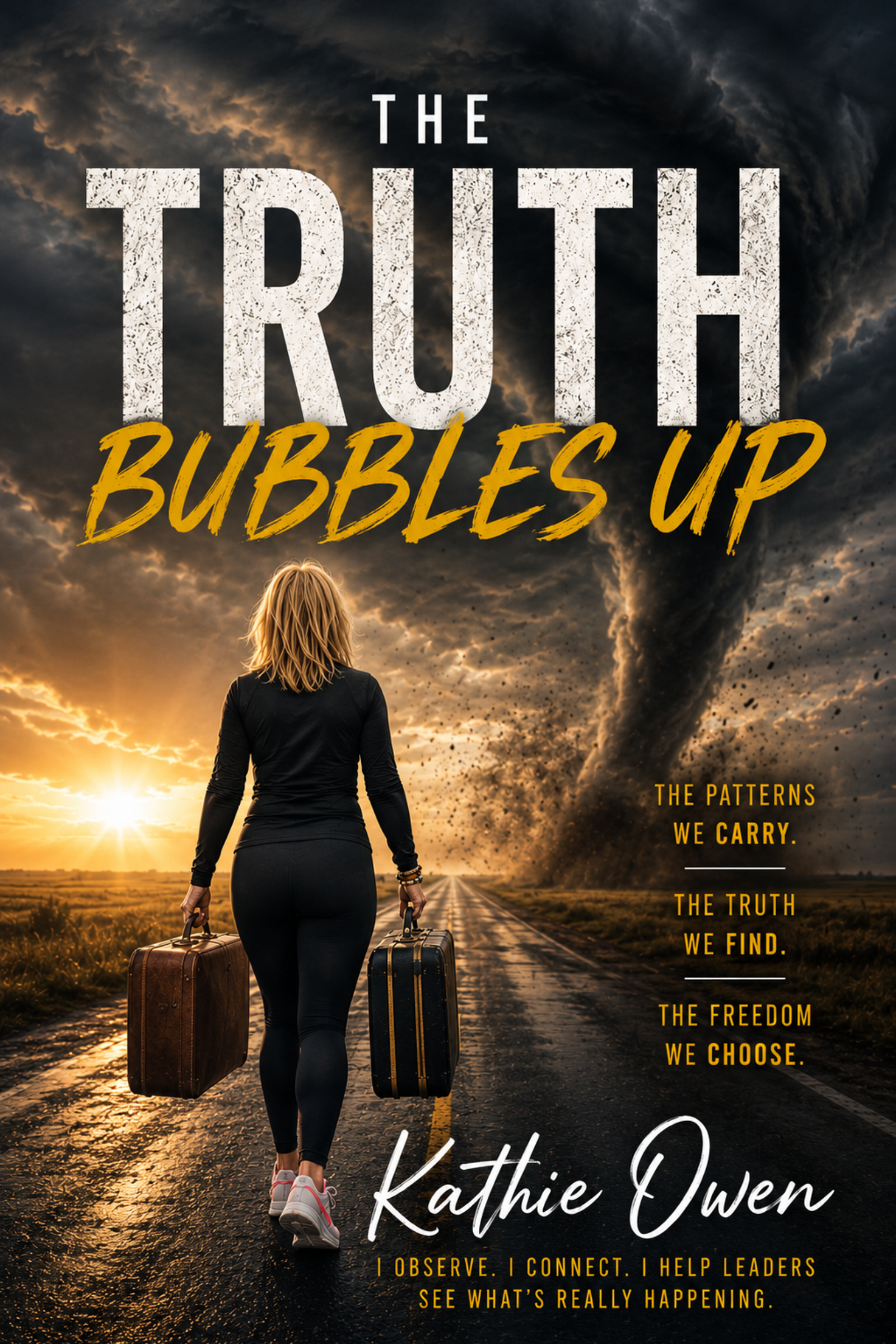
Whether you're navigating a difficult relationship, leading a team through uncertainty, or simply trying to understand your own life, patterns matter.
Events demand attention.
Patterns deserve investigation.
The next time something catches your attention, resist the urge to draw an immediate conclusion.
Instead, pause.
Ask yourself:
Is this an isolated event?
Or is this part of a larger pattern?
That question has changed my life.
It may change yours, too.
Because the truth rarely arrives all at once.
It rises slowly.
Quietly.
Patiently.
And eventually...
the truth bubbles up.
About the Author
Kathie Owen is a consultant, author, and speaker specializing in human behavior under pressure.
Through her work in leadership psychology and human diligence, she helps founders, executives, and leadership teams recognize the invisible behavioral patterns that influence trust, decision-making, organizational health, and long-term enterprise value.
Her work bridges personal insight with practical leadership, helping people move beyond reacting to individual events and begin recognizing the patterns that quietly shape outcomes.
She is the author of The Truth Bubbles Up and Human Patterns Under Pressure, and publishes regular essays exploring leadership, emotional regulation, and the hidden dynamics that emerge when people are under pressure.
Read More Articles from Kathie





Transcript
Have you ever looked back on your life and realized the biggest lesson wasn't what happened to you? It was what kept happening. The same kinds of people, the same kinds of conflicts, the same emotions, the same questions. For years, I thought I was collecting stories. It wasn't until I finished writing my book, The Truth Bubbles Up, that I realized I wasn't collecting stories at all. I was collecting patterns, and once I saw those patterns, I couldn't unsee them. Today, I wanna share six lessons that writing this book taught me, lessons I didn't fully understand when I sat down to write the first chapter. Welcome to the Kathie Owen Perspective podcast. My name is Kathie Owen. I'm a consultant who helps leaders, founders, and growing organizations recognize the hidden human patterns that influence trust, decision-making, and performance under pressure. My work focuses on what I call human diligence, the patterns traditional due diligence often misses. But today's episode is personal. After months of rewriting, reflecting, and questioning my own experiences, The Truth Bubbles Up is officially republished. And while I'm incredibly proud of the book, the biggest surprise wasn't seeing my name on the cover. The biggest surprise was discovering how much writing the book changed the way I see my own life. So today, I wanna share what it taught me. Lesson number one: truth is patient. When I was younger, I thought clarity would arrive all at once. I thought one conversation would explain everything, one breakthrough, one therapy session, one decision. Instead, truth arrived quietly, one observation at a time, one memory, one conversation, one uncomfortable realization. Looking back, I can see that truth doesn't usually force its way into our lives. It waits. It keeps showing us the same lesson until we're finally ready to see it. That's why I named the book The Truth Bubbles Up. You can push truth underwater for a while, but eventually, it rises. Lesson number two: pressure didn't create my problems, it revealed them. This idea changed everything for me. Pressure didn't make people become more controlling. Pressure revealed control that was already there. Pressure didn't create emotional distance. It exposed emotional distance that had been quietly growing. Pressure didn't suddenly make me anxious. It revealed patterns inside me that needed my attention. Pressure became my teacher because pressure tells the truth Lesson number three, I stopped asking who was right or even who was wrong. I started asking what pattern kept repeating. This may be the biggest shift in my thinking. For years, I wanted answers. Who's right? Who's wrong? Who's the problem? Those questions rarely brought me peace. But when I started asking what keeps repeating, everything changed. Patterns don't care who's winning the argument. Patterns reveal what's actually happening beneath it. Once I started looking for patterns instead of villains, I began seeing people and myself with more clarity and more compassion. Lesson number four: observation changed me more than judgment ever did. One of the greatest gifts I've discovered is learning to observe before reacting. Observation creates space. Judgment closes it. When I stopped trying to immediately explain, fix, or defend, I started noticing things I had never seen before, not because people changed, because I did. Lesson number five: the story did not change. I did. Many of the events in this book happened years ago. The facts stayed the same, but my relationship to those facts changed. When I first wrote about them, there was more pain, more frustration, more searching. As I rewrote the book today, something unexpected happened. I wasn't rewriting my past. I was rewriting my understanding of it. That was incredibly freeing. Lesson number six: this book isn't really about me. People often assume memoirs are about the author's life. In one sense, that's true, but I don't hope readers walk away thinking they know me better. I hope they walk away understanding themselves better because every chapter is really asking the same question: What patterns have been quietly shaping your life? What truths have been trying to surface? Where have you mistaken a single event for something that's actually been repeating for years? If the book helps even one person recognize a pattern they couldn't see before, then it has done exactly what I hoped it would do. So if there's one message I hope you take away from today's episode, it is this: truth does not need to be forced, it doesn't need to be defended, and it certainly doesn't disappear just because we ignore it. It has a way of rising to the surface in relationships, In leadership, in families, in organizations, and in ourselves. That's why I believe the truth always bubbles up. If you'd like to continue the conversation, I've written a companion blog post that expands on today's episode with additional reflections and resources. You'll find the link in the show notes and description below. I've also started writing regularly on Substack, where I share shorter essays and observations about human behavior, leadership, and the patterns that reveal themselves under pressure. If you enjoy these conversations, I'd love to have you join me there. I'll have a link to that in the show notes and description below as well. And if today's episode resonated with you, I invite you to read The Truth Bubbles Up. While it's now available through Amazon and other major booksellers, the best place to purchase it is through my website. When you buy it there, you'll also receive the complete audio version where I read each chapter myself and share the heart behind the words. If you're a founder, executive, or leadership team navigating change, conflict, or growth and you're curious about the human patterns shaping your organization, you can also learn more about working with me through a human patterns strategy session. There'll be a link to that in the show notes and description below as well. Thank you for spending this time with me, and if you know someone who could benefit from this, please share it with them. And until next time, remember, sometimes the greatest breakthrough isn't finding a new answer, it's finally recognizing the pattern that has been there all along

Learn how to practice non-attachment, let go of expectations, and stop carrying workplace stress into your personal life. Kathie Owen shares personal stories, Reality Transurfing insights, and simple ways to create space through meditation, hobbies, and nature walks.
#NonAttachment #LettingGo #RealityTransurfing #WorkplaceStress