
They Know You’re Under Pressure

Your Team Knows You Are Under Pressure
Think about the best leader you’ve ever worked for.
How did they make you feel?
Now think about the worst leader you’ve ever worked for.
How did they make you feel?
Notice something interesting.
You probably don’t remember their strategy.
You probably don’t remember their KPIs.
You probably don’t remember their quarterly goals.
But you remember how they made you feel.
Why?
Because people experience your nervous system long before they understand your strategy.
And whether leaders realize it or not, their team knows when they’re under pressure.
The real question isn’t whether you’re under pressure.
Everyone is.
The question is:
What does pressure reveal in you?
Leadership Is Emotional Contagion
Most people think leadership is about communication.
Or authority.
Or expertise.
Or experience.
Those things matter.
But before any of those things matter, people are asking questions that rarely get spoken out loud.
Am I safe here?
Can I trust this person?
Can I bring problems to them?
Will I be blamed?
Will I be supported?
Do they see me?
Humans are constantly reading nervous systems.
We can feel tension before a word is spoken.
We can sense frustration in a hallway.
We can detect impatience in a meeting.
We know when someone is fully present.
And we know when they aren’t.
Leadership is emotional contagion whether we intend it to be or not.
Note from Kathie emotional contagion is a pendulum. A pendulum only wants your energy and there are several ways to disengage from a pendulum. Awareness is one of them.
A pendulum is a concept from Reality Transurfing which is a book written by Russian quantum physicst Vadim Zeland.
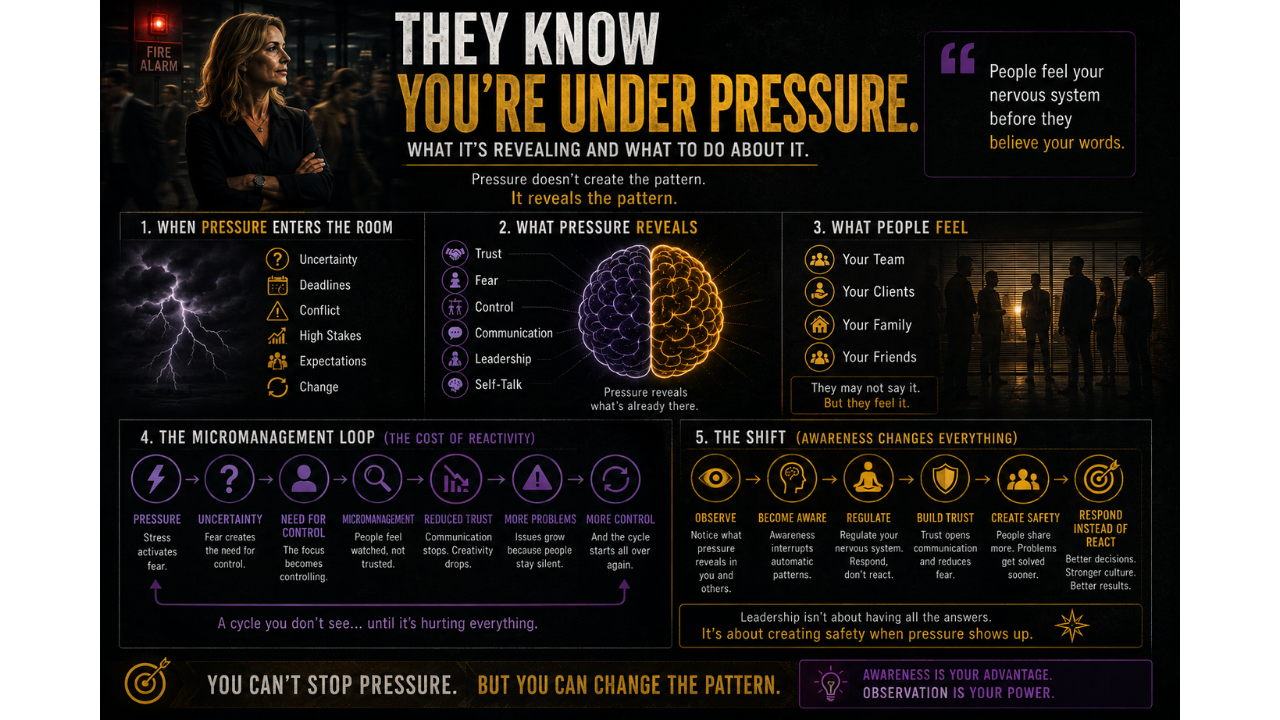
The Same Pressure. Different Response.
Imagine two leaders.
Same deadline.
Same pressure.
Same business challenge.
One leader starts rushing through the hallway.
They avoid conversations.
They become reactive.
They overcheck everyone’s work.
They micromanage.
The tension spreads through the team.
The second leader experiences the exact same pressure.
But they stay curious.
They ask questions.
They remain approachable.
They create stability when everyone else feels uncertainty.
Same pressure.
Different response.
Different impact.
The pressure wasn’t the problem.
The nervous system response was.
Why Micromanagers Aren’t ‘Usually’ Bad People
One of the biggest misconceptions in leadership is that micromanagers are simply controlling people.
In reality, many are trying to control uncertainty.
Pressure enters the system.
The nervous system becomes uncomfortable.
Control temporarily reduces that discomfort.
So the nervous system learns a lesson:
“When I control more, I feel safer.”
Over time, that response becomes automatic.
The longer it exists, the more deeply ingrained it becomes.
Eventually it stops feeling like a choice.
It becomes the default reaction.
This is why simply telling someone to stop micromanaging rarely works.
The behavior isn’t the real problem.
The behavior is revealing the pattern underneath.
Pressure reveals.
Why Awareness Cannot Be Forced
This is where many leadership conversations miss the mark.
Someone notices the behavior.
They tell the leader:
“You need to stop micromanaging.”
But criticism often creates more pressure.
And more pressure often creates more control.
The cycle continues.
The nervous system interprets the feedback as another threat.
That’s why awareness matters.
Real change rarely begins with blame.
It begins with observation.
The first step is noticing.
The second step is understanding.
The third step is choosing a different response.
You cannot force awareness onto another person.
But you can become aware of yourself.
And that changes everything.
The Energy Cost of Dysregulation
A dysregulated nervous system consumes enormous amounts of energy.
Future scanning.
Second guessing.
Overchecking.
Rehearsing conversations.
Managing perceptions.
Controlling outcomes.
Worrying about things that haven’t happened.
All of it requires energy.
Pressure is expensive.
But reactivity is often even more expensive.
Many leaders believe they’re exhausted because of the workload.
Sometimes they’re exhausted because of how much energy they’re spending fighting uncertainty.
Why Teams Feel It Before Leaders See It
The leader thinks:
“I’m helping.”
The team feels:
“I don’t feel trusted.”
The leader thinks:
“I’m managing.”
The team feels:
“I’m being controlled.”
The leader thinks:
“I’m preventing mistakes.”
The team feels:
“I don’t have ownership.”
This is why awareness is so important.
The people around us often experience our nervous system before we do.
Pressure leaves clues.
And teams are reading those clues every day.
The Most Powerful Leadership Tool Costs Nothing
Years ago, I learned something simple.
People want to feel seen.
Not managed.
Seen.
Imagine a CEO walking through the office.
He sees Linda.
He stops and asks:
“How was your drive in today?”
It’s a small question.
But it communicates something powerful.
“I see you.”
Linda isn’t employee number 247.
She’s a person.
Now imagine that same CEO sees Mike.
He asks:
“How’s that project going?”
Again, a simple question.
But now Mike knows something.
The CEO remembers his name.
The CEO remembers what he’s working on.
The CEO cares enough to ask.
These moments seem insignificant.
But they create trust.
And trust changes behavior.
If Linda has a difficult customer on the phone later that day, she is more likely to represent the company differently because she feels connected to it.
If Mike encounters a problem on his project next week, he is more likely to bring the issue forward because he trusts leadership.
Not because of policy.
Not because of process.
Because of connection.
This is where enterprise value is often built or destroyed.
One conversation at a time.
Why Employees Stop Talking
People rarely stop talking because they’re disengaged.
Many stop talking because they don’t feel safe sharing.
When people don’t feel psychologically safe:
Information gets filtered.
Problems stay hidden.
Trust erodes.
Communication decreases.
The leader thinks:
“Everything is fine.”
The employees think:
“Nobody wants to hear the truth.”
And that’s when organizations become vulnerable.
Not because people don’t care.
Because people stop speaking.
Human Patterns Under Pressure
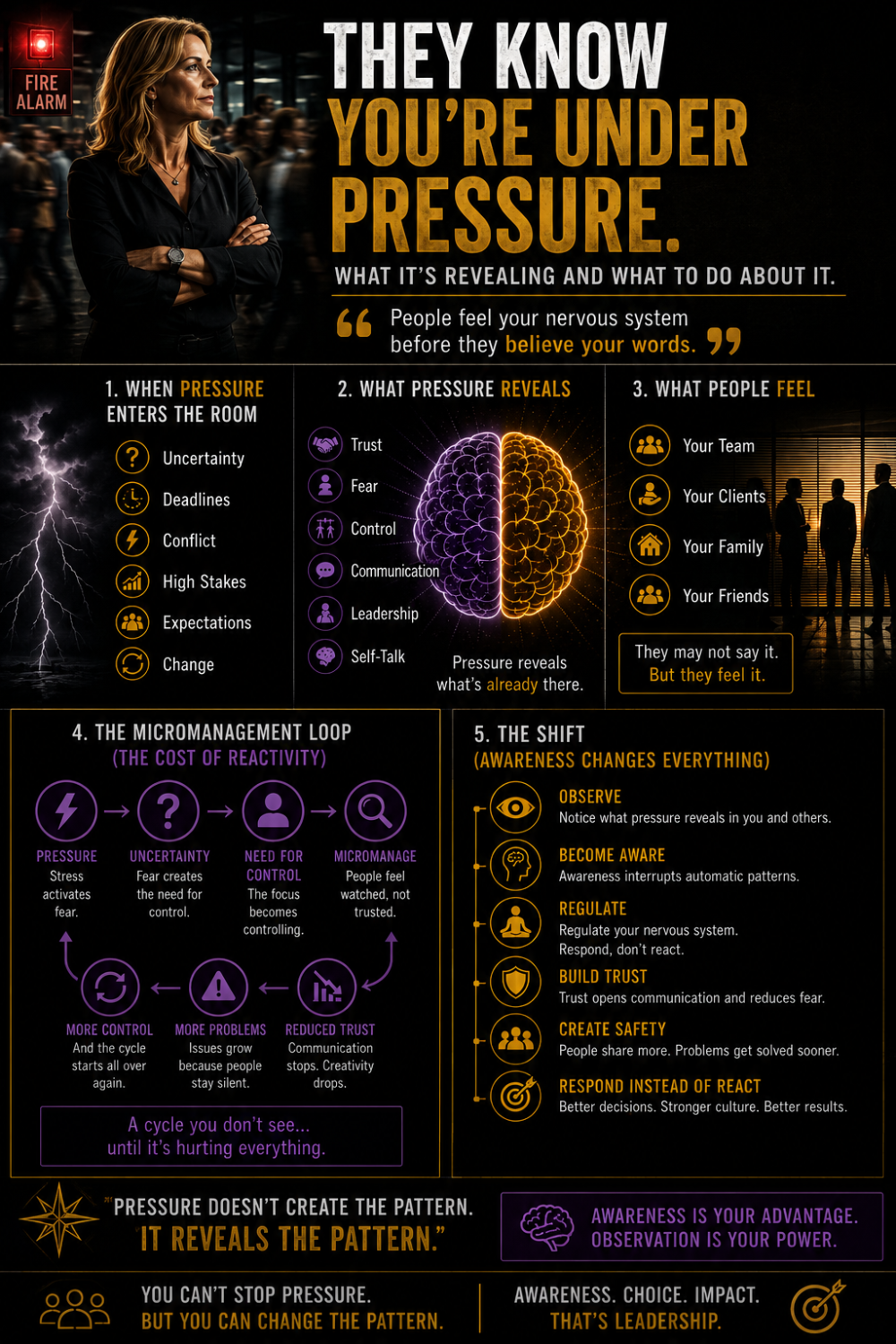
Pressure doesn’t create the pattern.
Pressure reveals the pattern.
Pressure reveals trust.
Pressure reveals fear.
Pressure reveals control.
Pressure reveals leadership.
Pressure reveals communication.
Pressure reveals self-talk.
This is why I spend less time teaching techniques and more time encouraging observation.
Observe pressure situations.
Observe how people respond.
Observe what happens when uncertainty enters the room.
Observe yourself.
Notice what changes when the stakes rise.
Notice what happens when you’re frustrated.
Notice what happens when you’re afraid.
Awareness comes first.
Awareness creates choice.
Choice creates change.
Final Reflection
Your team knows when you’re under pressure.
Your clients know.
Your spouse knows.
Your children know.
Your friends know.
People feel your nervous system whether you intend them to or not.
The question isn’t whether people feel your leadership.
The question is:
What does your leadership feel like?
Because people experience your nervous system long before they believe your words.
And pressure always reveals what is underneath.
About the Author
Kathie Owen is a consultant, speaker, and author of Human Patterns Under Pressure. She helps leaders, founders, and organizations identify the hidden human dynamics that impact trust, communication, retention, and performance.
Drawing from decades of experience in psychology, corporate wellness, leadership development, and human behavior, Kathie teaches leaders how pressure reveals patterns—and how awareness can transform the way they lead.
Through speaking engagements, consulting, and educational content, she helps organizations understand that people feel leadership long before they believe it.
Read More Articles Here


Transcript
Have you ever noticed that when pressure enters the room, people become more of who they already are? Some people become calm. Some people become controlling. Some become angry. Some become helpful. Some freeze. Some lead. And here's what's fascinating. Most people don't notice these patterns, but once you see them, you can't unsee them. One of the most powerful things I teach my consulting clients is this: study pressure situations. Watch people when pressure enters the room. Watch a sporting event. Watch a business meeting. Watch a family gathering. Watch an airport when flights get delayed. Watch what happens when a project goes sideways. Watch what happens when a leader receives bad news. Watch what happens when uncertainty shows up. Because pressure reveals patterns. Imagine you're sitting in an office building. Suddenly, the fire alarm goes off. Nobody expected it. Nobody planned for it. Pressure enters the system. Now watch. One person freezes. Another starts panicking. Someone starts becoming irritated. Someone starts blaming. Someone starts giving orders. Someone quietly starts helping people. Someone becomes the calmest person in the room. Now ask yourself this question: Who do people naturally follow? Not who has the title, not who has the authority, not who sits in the biggest office. Who do people naturally follow? The answer is usually the person whose nervous system feels safest under pressure, and that's exactly what we're talking about in today's episode. Welcome to the Kathie Owen Perspective podcast. My name is Kathie Owen. I'm a speaker, consultant, and the author of Human Patterns Under Pressure. On this podcast, we explore what pressure reveals about leadership, communication, decision-making, emotional contagion, and the hidden patterns that shape our lives long before we're aware of them. Because pressure doesn't create the pattern, pressure reveals the pattern, and today we're talking about something your team already knows. They know when you're under pressure. Your employees know. Your clients know. Your spouse knows. Your children know. Your friends know. The question isn't whether people feel your leadership, the question is, what does your leadership feel like? Most people think leadership is about communication, strategy, authority, experience, and yes, those things matter, but before any of those things matter, people are asking questions they may never say out loud. Can I trust this person? Are they stable? Do they see me? Can I bring them bad news? Will I be blamed? Will I be supported? Humans are constantly reading nervous systems. We feel tension before a word is spoken. We sense frustration before a conversation begins. We know when someone is fully present. We know when they are not. That's why your team knows when you're under pressure, even if you think you're hiding it. One of my favorite concepts comes from the book The Charisma Myth. The author talks about three qualities that create influence: power, presence, and warmth. Power is confidence. Presence is being fully here. Warmth is making people feel valued. When all three are present, people trust you. When pressure enters the room, one of those qualities often disappears first. Some people lose warmth. They become short with others. Some lose presence. Their body is in the room, but their mind is somewhere else. Some lose power. They begin doubting every decision they make. Pressure reveals all of it, which is why awareness matters, because awareness comes before change. This is also why I spend less time teaching techniques and more time teaching observation. Observe pressure situations. Watch how people respond. Watch how leaders respond. Watch how teams respond. Then start observing yourself. Notice what happens when you're stressed. Notice what happens when you're uncertain. Notice what happens when plans change. Notice what happens when expectations aren't met. Notice what happens when someone disagrees with you. Pressure leaves clues. Most people simply aren't looking for them. One place this shows up all the time is micromanagement. Many micromanagers are not bad people. They're uncomfortable with uncertainty. Pressure enters the system. Control becomes the coping mechanism. Over time, that response becomes automatic. That's why telling someone to stop micromanaging rarely works. The behavior isn't the problem. The behavior is revealing the pattern underneath. Awareness comes first, then understanding, then change, and this matters more than most leaders realize. Imagine a CEO walking through the office. They see Linda. "Good morning, Linda. How was your drive in today?" Simple question, but it communicates something powerful. "I see you. You matter." Then the same CEO sees Mike later. "Hey, Mike, how's that project going?" Again, simple, but now Mike knows the CEO remembers his name, remembers what he's working on, and cares enough to ask. These moments seem small, but trust is built in small moments, and trust changes everything. If Linda has a difficult customer later that day, later that week, she's likely to represent the company differently because she feels connected to it. If Mike encounters a problem next week, he's likely to bring it forward because he trusts leadership. This isn't just about being nice either. This is about communication. It's about trust. It's about culture. It is about enterprise value. Organizations become stronger when information moves freely. Information moves freely when people feel safe, and people feel safe when leaders create trust, one conversation at a time, one interaction at a time, one nervous system at a time. So here's the question I wanna leave you with today. What does pressure reveal in you? Because pressure doesn't create the pattern. Pressure reveals the pattern, and once you see the pattern, you can begin to change it. In an upcoming episode, we're gonna go even deeper into this conversation. We're gonna explore why some people become incredibly skilled at reading pressure situations, and how growing up around dysregulated nervous systems can shape the way we experience leadership, relationships, trust, anxiety, and emotional safety. All right, that's my episode for today. I trust that you found it helpful. I always include a blog post with every episode I do that goes deeper into this topic and includes additional resources. You will find that linked in the show notes and description below, and on YouTube it'll be in the first comments. Thank you for spending time with me today. My name is Kathie Owen speaker, consultant, and author of Human Patterns Under Pressure, and until next time, keep observing the patterns. I'll see you in the next episode.

Are you mind reading without realizing it? Learn how pattern recognition can become false certainty, fuel anxiety, narrow attention, and affect leadership and relationships—and how curiosity, Reality Transurfing, and “maybe, maybe not” can open new possibilities.
#PatternRecognition #RealityTransurfing #Leadership #HumanPatterns