
Why Pressure Doesn't Break People (And What Actually Does)
What if the thing exhausting you isn't the pressure?
What if it's your resistance to it?
Most people spend their lives trying to eliminate uncertainty.
We create plans.
We build schedules.
We develop strategies.
We predict outcomes.
We try to prepare for every possible scenario.
And then life does what life always does.
Something changes.
A deal falls apart.
A key employee leaves.
A relationship shifts.
A market changes.
A family crisis appears.
A health issue emerges.
The uncertainty we were trying so hard to avoid arrives anyway.
And that's where things get interesting.
Because pressure isn't always what breaks people.
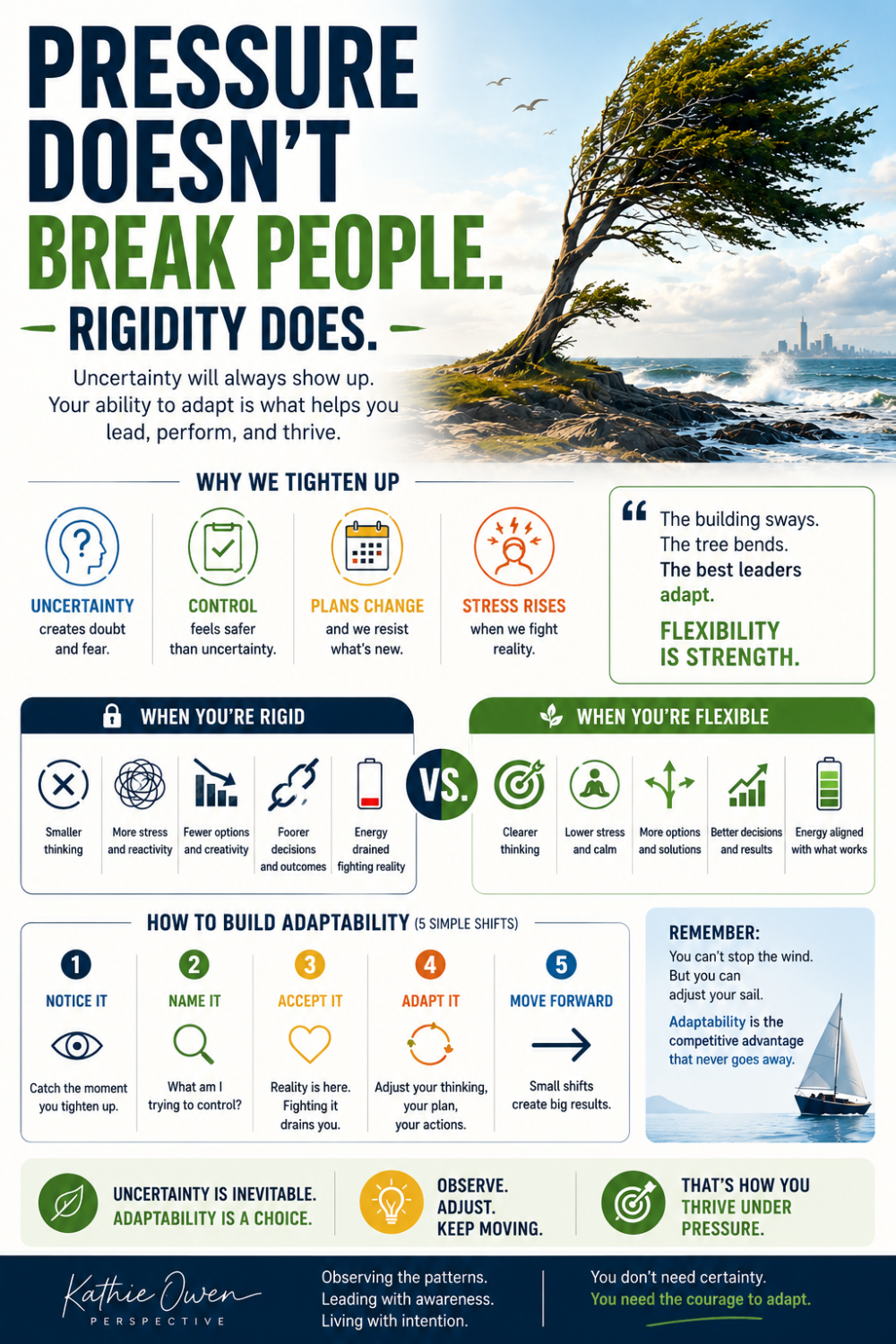
More often, it's rigidity.
The Building That Was Designed to Move
Years ago, I worked in a high-rise building in downtown Houston.
My office was on the 66th floor.
On windy days, the building would sway.
Not enough to be dangerous.
Just enough for everyone to notice.
The elevators would move differently.
The building would creak.
People would glance around the room.
You could almost feel the uncertainty spreading from person to person.
What most people didn't realize was that the building was doing exactly what it had been designed to do.
It was moving with the wind.
The engineers knew something important:
A rigid building would be more vulnerable.
A flexible building survives because it adapts.
The movement wasn't a flaw.
It was the feature that kept the building standing.
The older I get, the more I realize the same principle applies to people.
The Leadership Trap Nobody Talks About
Many leaders believe strength means certainty.
They believe they should have all the answers.
They believe confidence means knowing exactly what comes next.
But leadership rarely works that way.
The best leaders I've observed aren't attached to certainty.
They're attached to learning.
They aren't committed to being right.
They're committed to seeing reality clearly.
This becomes especially important during periods of change.
Mergers.
Acquisitions.
Rapid growth.
Succession planning.
Economic uncertainty.
Organizational restructuring.
These moments expose something many organizations don't see coming.
They don't reveal strategy problems.
They reveal adaptability problems.
I've watched founders struggle because their identity became attached to the company they built.
I've watched executive teams become paralyzed because they were trying to preserve a plan that no longer matched reality.
I've watched organizations exhaust themselves trying to force certainty where certainty didn't exist.
And underneath it all was the same pattern.
Rigidity.
When Pressure Enters the System
One reason I'm fascinated by professional sports is because pressure reveals patterns quickly.
Talent gets all the attention.
Pressure tells the real story.
An athlete misses an important shot.
A pitcher gives up a home run.
A golfer misses a short putt.
The mistake itself isn't usually what determines the outcome.
What happens next does.
Some athletes adjust.
Others tighten up.
When people tighten up, their world becomes smaller.
Their thinking narrows.
Their creativity disappears.
Their ability to see options declines.
They begin reacting instead of responding.
And performance often suffers.
Not because they lack talent.
But because they're trying to control something that requires adaptation.
This doesn't just happen in sports.
It happens in boardrooms.
It happens in marriages.
It happens in families.
It happens in friendships.
It happens whenever uncertainty enters the system.
Psychological Flexibility: The Skill Nobody Teaches
One of the most valuable skills I've encountered is something called psychological flexibility.
Simply put, it's the ability to remain present when things don't go according to plan.
It's the ability to adapt when new information appears.
It's the ability to tolerate uncertainty without immediately creating a frightening story about what it means.
It's the ability to observe before reacting.
And that ability changes everything.
Psychological flexibility doesn't mean you don't care.
It doesn't mean you become passive.
It doesn't mean you stop making decisions.
It means you stop fighting reality long enough to see it clearly.
Think about how much energy people spend arguing with what already exists.
"This shouldn't be happening."
"They shouldn't have done that."
"This isn't how I planned it."
"This isn't fair."
Maybe not.
But it's happening.
And until we acknowledge reality, we can't respond effectively to it.
The Difference Between Control and Adaptation
Many people confuse adaptation with giving up.
They're not the same thing.
Giving up says:
"There is nothing I can do."
Adaptation says:
"Given what is happening, what is my best next move?"
One is helplessness.
The other is resilience.
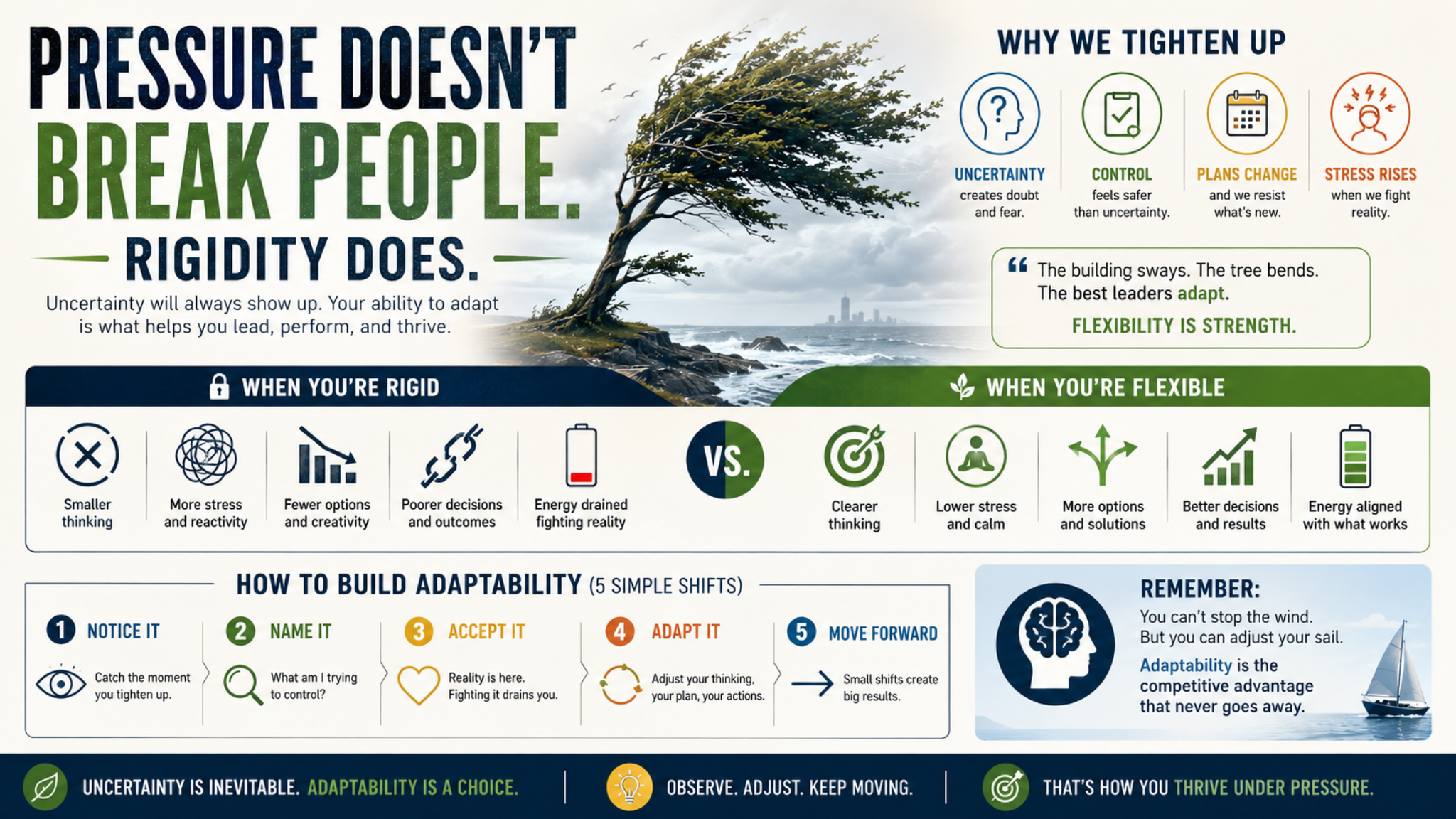
Adaptable people don't waste energy trying to stop the wind.
They adjust their sails.
They don't spend all day wishing reality were different.
They work with the reality that exists.
That shift alone can dramatically reduce stress, anxiety, and emotional exhaustion.
What Trees, Buildings, and Humans Have in Common
Think about a tree during a storm.
The tree that survives isn't always the strongest.
It's often the one willing to bend.
The same principle applies to buildings.
And the same principle applies to people.
The leaders who endure aren't necessarily the toughest.
They're often the most adaptable.
The businesses that survive disruption aren't always the biggest.
They're often the most flexible.
The individuals who navigate uncertainty most effectively aren't always the most confident.
They're often the most willing to learn, adjust, and evolve.
Adaptability isn't weakness.
It's one of the highest forms of strength.
Questions Worth Asking Yourself
If you're feeling overwhelmed right now, consider these questions:
Where am I trying to force an outcome?
What uncertainty am I resisting?
What reality am I arguing with?
What assumptions might need updating?
Where could curiosity serve me better than control?
Sometimes a single honest answer can change everything.
Bonus Resource: The Observer Exercise
The next time you feel stressed, anxious, frustrated, or overwhelmed, pause and ask yourself:
"What am I trying to control right now?"
Then ask:
"What is actually within my control?"
Notice the difference.
One question creates resistance.
The other creates clarity.
The goal isn't to eliminate uncertainty.
The goal is to become more skillful at navigating it.
Because uncertainty isn't going away.
Life isn't designed that way.
But your relationship with uncertainty can absolutely change.
And when it does, something remarkable happens.
You stop fighting the wind.
And you start learning how to move with it.
About the Author
Kathie Owen is a consultant, speaker, and creator of The Kathie Owen Perspective. She specializes in human patterns under pressure, helping leaders, founders, and organizations identify the invisible behavioral dynamics that influence trust, performance, decision-making, and long-term success.
Drawing from experience in leadership development, corporate wellness, psychology, and human behavior, Kathie helps people see the patterns that often remain hidden until pressure reveals them.
Bonus Resources
📚 Read: The Charisma Myth by Olivia Fox Cabane
📚 Read: The Obstacle Is the Way
📚 Explore: The Untethered Soul
📚 Reflect On: Where is certainty helping you—and where is your attachment to certainty creating unnecessary stress?
Read More Articles from Kathie



Transcript
What if the thing that's exhausting you isn't the pressure? What if it's your resistance to it? Think about that for a moment. Most people spend their lives trying to eliminate uncertainty, trying to control outcomes, trying to predict what happens next, trying to make sure nothing unexpected shows up, and yet uncertainty keeps showing up anyway. A difficult conversation, a leadership transition, a business challenge, a family conflict, a health scare, a setback you never saw coming. And the question isn't whether uncertainty will arrive. The question is, what happens inside of you when it does? Welcome to the Kathie Owen Perspective Podcast. My name is Kathie Owen, and this is where we explore human patterns under pressure. I study what happens to people when the stakes are high inside businesses, inside leadership teams, inside families, inside relationships, and inside our own nervous systems. For years, I've observed the invisible patterns that shape performance, communication, trust, decision-making, and resilience. One thing I've noticed over and over again is this: pressure rarely breaks people. Rigidity does. The people who navigate change most effectively are not always the smartest, they're not always the strongest, they're not always the most experienced, and they're often the most adaptable. A few weeks ago, I found myself thinking about something I experienced years ago while working in a high-rise building in downtown Houston. My office was on the 66th floor. On windy days, the building would sway. Not enough to be dangerous, just enough for everyone to notice. The elevators would slow way down. The building would creak. People would glance at each other in the elevators. Some would laugh nervously. Others would become visibly uncomfortable. You could almost feel the tension spreading in the elevator, but the building wasn't failing It was doing exactly what it had been designed to do. It was moving with the wind. The flexibility wasn't a flaw. It was the feature that kept the building standing. And the more I've thought about it, the more I've realized that's true of people too. Many of us have been taught that strength means standing firm, holding the line, pushing harder, grinding through, controlling outcomes. But when uncertainty enters the system, that strategy often backfires. The tighter we grip, the more exhausted we become. The more we demand certainty, the more anxious we feel. The more we resist reality, the more energy we waste fighting what already exists. I've seen this happen in leadership teams. I've seen it happen during mergers and acquisitions. I've seen it happen with founders whose identity becomes so attached to the company they built. I've seen it happen in relationships when people try to force certainty where certainty does not exist. And I've seen it happen in myself. Because if I'm honest, I like plans. I like knowing what's next. I like structure. I like predictability. And I like having a clear direction. But life doesn't always cooperate with our plans. You know the saying, if you wanna hear God laugh, tell him your plans." Because pressure doesn't ask permission before it arrives, change doesn't check our calendar, and uncertainty doesn't wait until we're ready. That's why psychological flexibility matters so much. Psychological flexibility is the ability to remain present when circumstances change. It's the ability to stay open to new information. It's the ability to tolerate uncertainty without immediately creating a story about what it means. It's about the ability to adapt instead of react, and that ability becomes incredibly important under pressure. One of the places I see this most clearly is in professional sports. People often assume elite athletes succeed because of talent. Talent matters, yes, but that's not what fascinates me. What fascinates me is what happens after the mistake, after the missed shot, after the strikeout, after the injury, after the losing streak. Some athletes adapt. Others tighten up. And when people tighten up, something interesting happens. Their world gets smaller. Their thinking becomes narrower. Their options become fewer. Their creativity disappears. Their performance begins to suffer, not because they lack ability, but because they're trying to control something that requires adaptation. The same thing happens in business, the same thing happens in leadership, and the same thing happens in everyday life. When uncertainty arrives, many people start fighting reality. They fight change. They fight new information. They fight possibilities they didn't expect. And in doing so, they create even more stress for themselves because uncertainty isn't the problem It's part of life. The wind is going to blow. Markets are going to shift. People are going to change. Plans are going to evolve. The real question is whether we can move with it. Can we observe what's happening without immediately reacting? Can we stay curious instead of becoming defensive? Can we trust ourselves enough to adapt when circumstances change? The strongest leaders I've observed do exactly that. They don't panic. They don't pretend uncertainty doesn't exist. They don't become attached to being right. They observe, they adjust, they learn, they adapt, and because they adapt, they endure. The building survives because it moves. The tree survives because it bends. Healthy nervous systems regulate because they adapt, and resilient people learn to do the same. So this week, I'd like to leave you with the question: Where have you been becoming very rigid, and what are you trying to force? What uncertainty are you resisting? And what might become possible if you loosened your grip just a little? Not because the pressure disappears, but because you learn how to move with it. Thank you so much for spending this time with me, and if you'd like to go deeper, I write a companion blog post for every episode. Each article includes additional insights, examples, reflections, and bonus resources that expand on the conversations we have here. You'll find the link to that in the show notes and description below. And until next time, keep observing the patterns, and I will see you in the next episode of the Kathie Owen Perspective Podcast.

Discover how resentment affects your nervous system and how forgiveness can help you release tension. Kathie Owen explores rumination, Reality Transurfing, and simple practices to redirect your attention, ease stress, and return to the present moment.
#Resentment #Forgiveness #NervousSystemRegulation #RealityTransurfing