
What Do You Actually Know? A Simple Way to Stop Overthinking
The Stories We Create When We Don't Have All the Information
Most people believe stress comes from circumstances.
Sometimes it does.
But often, stress comes from the story we create about those circumstances.
A text message goes unanswered.
A meeting appears on the calendar.
A spouse seems distant.
A client goes quiet.
An employee acts differently than usual.
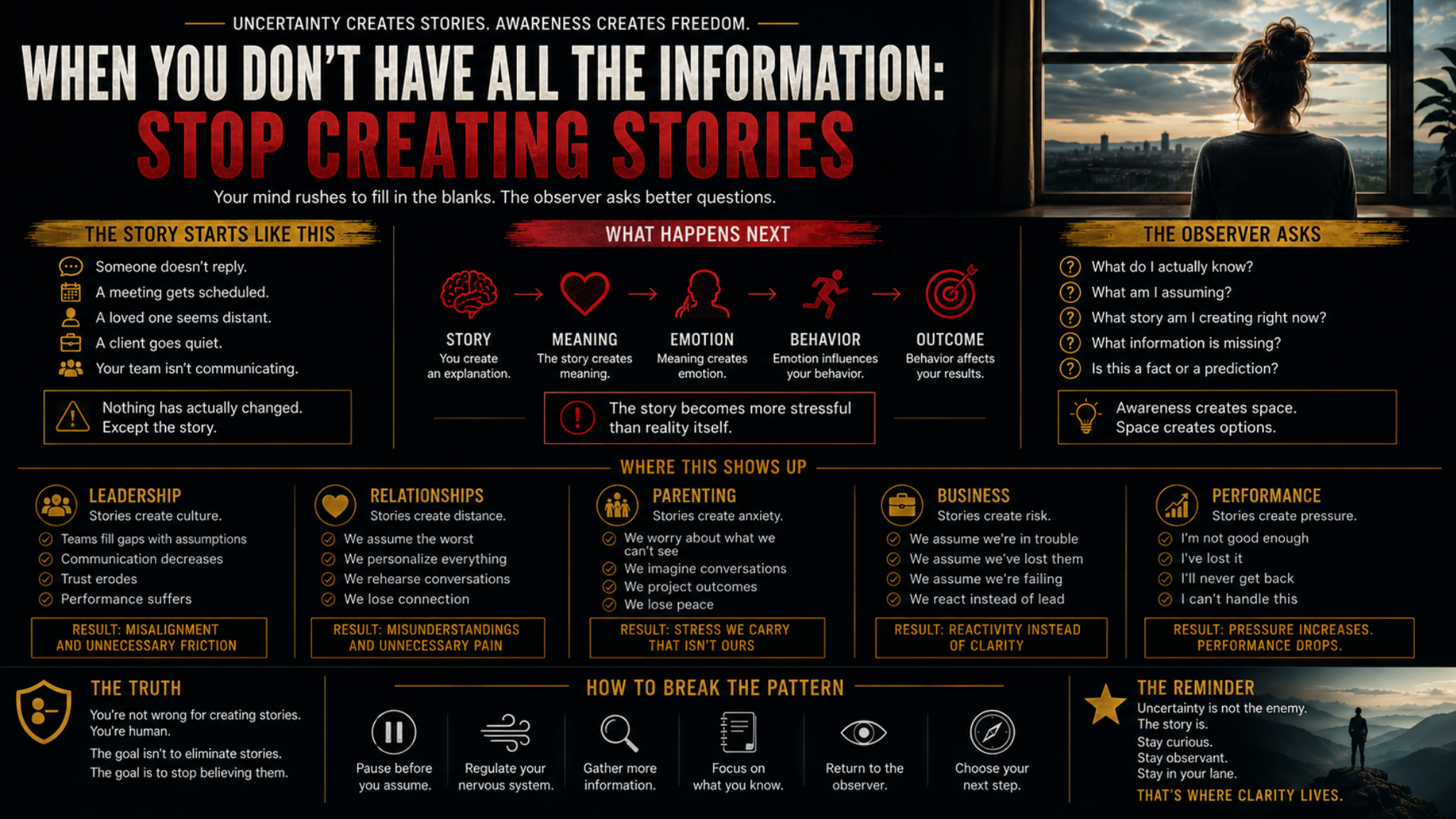
Nothing has actually happened yet.
No facts have changed.
No outcome has occurred.
And yet anxiety rises almost immediately.
Why?
Because the human mind dislikes uncertainty.
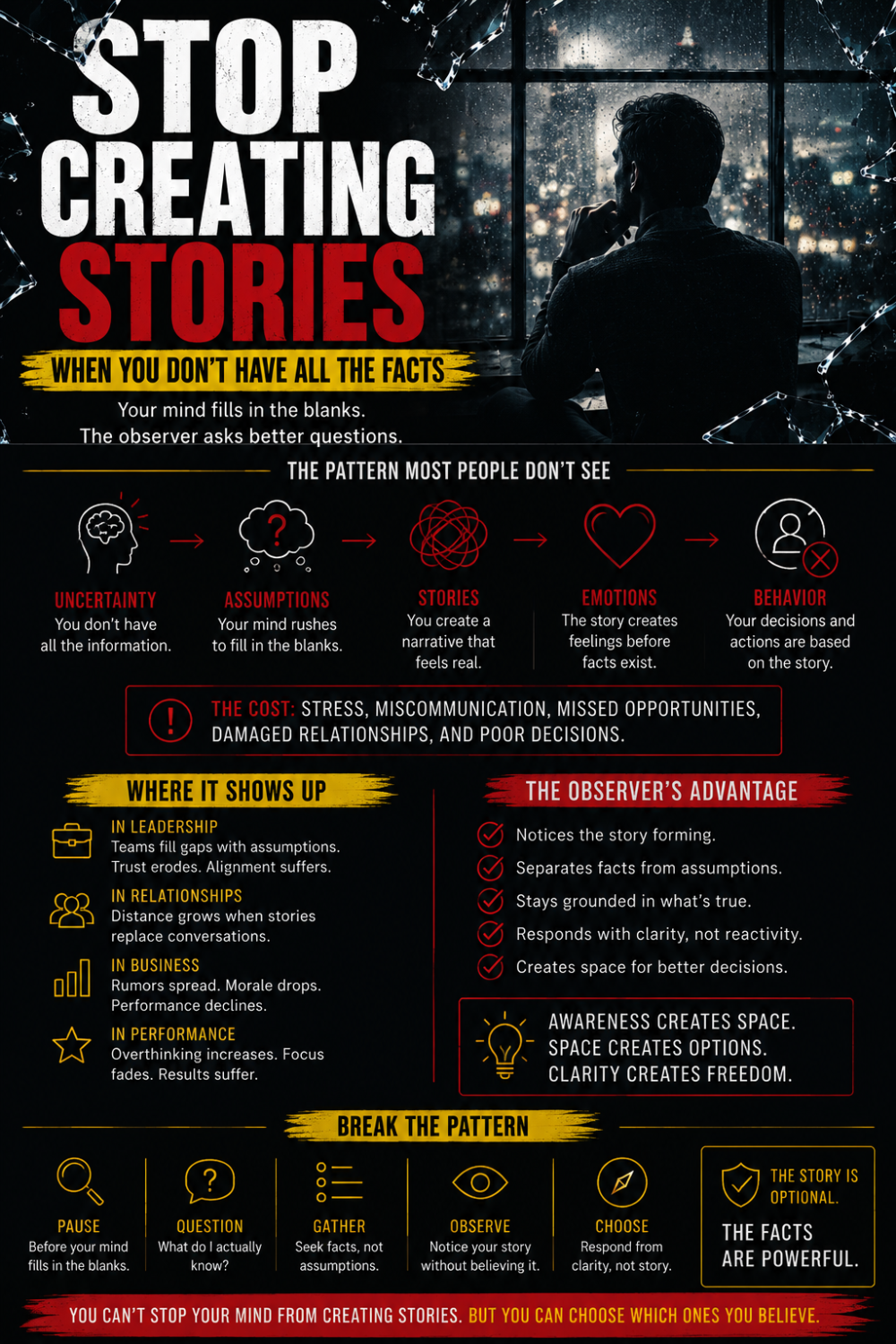
When information is missing, we instinctively attempt to fill the gap.
The challenge is that the gap rarely gets filled with neutral information.
More often, it gets filled with assumptions.
And assumptions quickly become stories.
The Brain's Need for Certainty
Human beings are prediction machines.
One of the primary functions of the brain is to anticipate what happens next.
From an evolutionary standpoint, this makes perfect sense.
Thousands of years ago, uncertainty could be dangerous.
Not knowing what was hiding in the bushes could mean the difference between survival and death.
As a result, our brains developed an incredible ability to identify patterns, predict outcomes, and create explanations.
The problem is that the brain doesn't always distinguish between a real threat and an imagined one.
Today, uncertainty often looks very different:
Waiting for a response to an email
Not knowing how a presentation was received
Wondering why a colleague seems withdrawn
Waiting for medical test results
Navigating family conflict
Managing organizational change
The nervous system still reacts.
The uncertainty still feels uncomfortable.
And the mind begins searching for answers.
The Hidden Cost of Filling in the Blanks
When we don't know what's happening, we often create explanations that feel true.
Notice I didn't say they are true.
I said they feel true.
That's an important distinction.
A leader doesn't receive immediate feedback after a presentation.
The story becomes:
"They hated it."
A parent doesn't hear from an adult child.
The story becomes:
"They're upset with me."
A founder loses a major client.
The story becomes:
"My business is failing."
A professional receives unexpected calendar invitations.
The story becomes:
"I'm about to be fired."
In reality, none of these conclusions may be accurate.
But the nervous system responds as though they are.
Heart rate increases.
Stress hormones rise.
Sleep becomes disrupted.
Focus decreases.
Emotional reactivity increases.
All because of a story that may have no connection to reality.
Why High Performers Are Especially Vulnerable
One pattern I've observed repeatedly among leaders, founders, executives, and high achievers is that they often mistake story creation for preparation.
They believe they're being responsible.
Strategic.
Proactive.
Thoughtful.
In reality, they may simply be rehearsing uncertainty.
I've watched executives spend weeks preparing for conversations that never happened.
I've watched entrepreneurs lose sleep over scenarios that never occurred.
I've watched people mentally argue with someone who never said the thing they imagined hearing.
The mind labels this preparation.
The nervous system experiences it as stress.
There's a difference.
Preparation involves facts.
Stories involve assumptions.
The Observer's Advantage
One of the most powerful shifts a person can make is learning to recognize the moment a story begins.
This is where the observer perspective becomes invaluable.
The observer doesn't immediately accept every thought as truth.
Instead, the observer becomes curious.
The observer asks:
What do I actually know?
What evidence do I have?
What assumptions am I making?
What information is missing?
Is this a fact or a prediction?
Am I responding to reality or to a story?
Those questions create something incredibly valuable:
Space.
And space changes everything.
Because when there is space between the event and the interpretation, choice becomes possible.
Leadership and the Stories We Create
This pattern shows up constantly inside organizations.
Employees create stories about leadership.
Leaders create stories about employees.
Departments create stories about one another.
Teams create stories about change.
When communication decreases, stories increase.
When transparency decreases, stories increase.
When uncertainty increases, stories increase.
In many workplaces, morale problems aren't created by reality itself.
They're created by the interpretations people attach to reality.
This is one reason effective communication matters so much.
People naturally seek meaning.
If leaders don't provide clarity, people will often create their own explanations.
And those explanations are rarely optimistic.
The Nervous System's Role
Most people think story creation is a thinking problem.
It's often a nervous system problem.
When the nervous system perceives uncertainty, it seeks resolution.
It wants closure.
It wants certainty.
It wants to know what's coming next.
The mind attempts to provide that certainty by creating explanations.
This is why awareness alone isn't always enough.
Sometimes the nervous system must be regulated before the mind can think clearly.
Simple practices can help:
Slow breathing
Walking
Strength training
Journaling
Meditation
Time in nature
Pausing before reacting
Gathering additional information
These practices don't remove uncertainty.
They help us tolerate it.
And the ability to tolerate uncertainty is one of the most valuable emotional skills a person can develop.
Professional Athletes Teach Us This Too
Recently, I've been watching documentaries about professional athletes.
What fascinates me isn't necessarily the sport.
It's pressure.
A golfer misses a shot.
A baseball player enters a slump.
A quarterback throws an interception.
The event itself lasts seconds.
But what happens next often determines performance.
Some athletes create stories:
"I've lost it."
"I'm finished."
"I'll never get back."
Others focus on facts:
"That shot wasn't what I intended."
"The adjustment needs to be here."
"The next play matters."
The difference isn't talent.
It's interpretation.
The event and the meaning attached to the event are not the same thing.
And yet many people spend their lives treating them as if they are.
A Different Question
The goal isn't to eliminate stories completely.
Human beings create meaning.
That's what we do.
The goal is to become aware of the stories before they begin driving behavior.
This week, consider asking yourself:
What story am I creating because I don't have all the information?
Not because you're doing something wrong.
Not because you're broken.
Not because you need fixing.
Simply because you're human.
Awareness creates choice.
Choice creates freedom.
And freedom begins the moment we stop confusing our stories with reality.
Because sometimes the most stressful thing in our lives isn't what's actually happening.
It's what we're imagining is happening.
And those are rarely the same thing.
Reflection Questions
Where in your life are you currently lacking information?
What assumptions have you made about that situation?
How certain are you that those assumptions are true?
What facts actually support your conclusions?
What would change if you simply allowed the uncertainty to exist?
What story would you stop carrying if you didn't need certainty right now?
The observer notices.
The observer questions.
The observer creates space.
And often, that space is where clarity finally arrives.
About the Author
Kathie Owen is a leadership consultant, speaker, and observer of human behavior under pressure. She works with founders, executives, and leadership teams to identify the invisible people patterns that influence performance, trust, communication, and organizational durability.
Through The Kathie Owen Perspective, she explores the intersection of leadership psychology, emotional regulation, workplace dynamics, and decision-making under uncertainty.
Her work helps leaders see what others miss—because the patterns that shape outcomes are often hidden in plain sight.
Read More Articles from Kathie



Transcript
Have you ever noticed that when you don't have all the information, your mind rushes in to fill the blanks? Maybe someone doesn't return your text. Maybe your boss schedules a meeting. Maybe your spouse seems quiet. Maybe your adult child hasn't called. Maybe your team isn't communicating, and before you know it, you've created an entire story. And you know what's interesting? Most of the time, we don't even realize we're doing it. We think we're solving a problem. We think we're being prepared. We think we're being responsible. But what if we're actually trying to escape uncertainty? Welcome to the Kathie Owen Perspective Podcast. This is where we explore human patterns under pressure, leadership, nervous systems, emotional regulation, workplace dynamics, and the invisible patterns that shape how we think, perform, communicate, and relate to one another. For more than 30 years, I've worked around leaders, teams, founders, high performers, and people navigating enormous amounts of pressure, and one pattern shows up everywhere. When people don't have answers, they create stories. I've done it. You've done it. We've all done it. Years ago, while co-parenting after my divorce, there were many times I didn't know what was happening on the other side. I didn't know what conversations were taking place. I didn't know what decisions were being made. I didn't know what my children were hearing. And what I eventually realized was fascinating. The less information I had, the more stories I created. I would rehearse conversations that were never going to happen, imagine outcomes that never occurred, create explanations for things I could not possibly verify. At the time, I thought I was being reasonable. Looking back, I think I was trying to create certainty. And that's a very human thing to do. Our nervous systems don't particularly enjoy uncertainty. We like answers. We like closure. We like predictability. We like knowing what's coming next. So when information is missing, the brain often fills the gap. The problem is that the story we create often becomes more stressful than reality itself. Think about how often this happens. Someone doesn't respond. We assume they're upset. A meeting gets scheduled. We assume we're in trouble. A loved one seems distant. We assume we've done something wrong. A client goes quiet. We assume we've lost the business. Notice what happened. Nothing actually changed except the story And yet our emotional state changed immediately. Why? Because stories create meaning, and meaning creates emotion. Emotion influences behavior, and behavior affects outcomes. That's why awareness matters so much. One of the core ideas I teach is this: You cannot change a pattern you cannot see, and many people never notice the moment the story begins. They believe the story is reality. But the observer notices something different. The observer asks, "What do I actually know? What am I assuming? What story am I creating right now?" Those questions can change everything, not because they magically remove uncertainty, but because they create space, and space gives us options. This shows up in leadership. It shows up in relationships. It shows up in parenting. It shows up in business. It shows up in performance. In fact, I've been watching a documentary recently about professional golfers, and what fascinates me is not golf, it's pressure. And one thing I've noticed is that when performance starts slipping, many athletes immediately create stories. "Maybe I've lost it. Maybe I'm not good enough. Maybe I'll never get back to where I was." The pressure isn't just coming from the event. It's coming from the meaning attached to the event, and honestly, we're all doing some version of that every day. The story becomes heavier than the situation itself. So here's the question I'd like you to consider this week: What story are you creating because you don't have all the information? Not because you're wrong, not because you're broken, not because you're doing something bad, simply because you're human. Awareness isn't about judging the story. It's about noticing it because once you can see it, you have a choice, and that's where real change begins. All right. Thank you so much for spending time with me. If you'd like to go deeper on this, I also write a companion blog post for every episode with additional insights and resources, and you'll find that link in the show notes and description below. And I trust that you found today's episode helpful. If you know someone who could benefit from this, please share it with them. And until next time, keep observing the patterns. I'll see you in the next episode of the Kathie Owen Perspective Podcast.

Explore human patterns under pressure with private consultant Kathie Owen. Learn how a pause, nervous system regulation, non-attachment, radical responsibility, and courage can support clearer choices at work and at home. Watch the keynote and book a conversation.
#HumanPatternsUnderPressure #KathieOwenKeynote