
The Voice in Your Head Under Pressure (And What to Do About It)

Have you ever sent a text message, an email, a proposal, or had an important conversation and then found yourself replaying it over and over in your head?
At first, everything seems fine.
Then the uncertainty arrives.
And suddenly a voice starts talking.
Did I say the wrong thing?
What if they misunderstood me?
What if I made a mistake?
What if this doesn't work out?
What's fascinating is that pressure doesn't create that voice.
It reveals it.
The voice was already there.
Pressure simply turned up the volume.
The Voice Was Already There
One of the most powerful lessons I've learned from Michael Singer's work is that there is a voice in our heads that never stops talking.
It comments on everything.
It predicts outcomes.
It judges situations.
It replays conversations.
It creates stories about the future.
The strange thing is that most people don't even realize they're listening to it.
We become so accustomed to the voice that we assume the voice is us.
Then pressure arrives.
A difficult conversation.
A financial challenge.
A health concern.
A leadership decision.
A relationship problem.
And suddenly the voice becomes impossible to ignore.
Pressure doesn't create the conversation.
Pressure reveals the conversation that was already happening beneath the surface.
Why Pressure Makes the Voice Louder
Recently, I experienced this firsthand.
After a consulting call, I found myself replaying the conversation in my head.
Not the things that went well.
Not the breakthroughs.
Not the insights.
The mistakes.
The moments I wished I had handled differently.
The things I should have said.
The things I shouldn't have said.
My mind started building a case against me.
It was subtle.
It sounded reasonable.
It sounded helpful.
It sounded like I was learning.
But the truth is, I was creating pressure long after the call had ended.
Later, while walking through the grocery store, I caught myself doing it again.
The voice was still talking.
Still analyzing.
Still replaying.
Still trying to create certainty about something that had already happened.
And in that moment, something shifted.
I became aware of it.
I stopped.
I observed it.
And that's when I noticed something important.
The pressure wasn't coming from the coaching call.
The pressure was coming from the conversation I was having with myself about the coaching call.
That realization changed everything.
The Most Dangerous Voice Isn't Negative
Most people think negative self-talk is the problem.
Sometimes it is.
But often the most dangerous voice isn't negative at all.
It's reasonable.
It says things like:
You should think about this a little longer.
You need more information.
You should wait until you're sure.
Let's prepare for every possible outcome.
Let's make sure nothing goes wrong.
That sounds responsible.
That sounds intelligent.
That sounds logical.
That's why people follow it.
The voice isn't dangerous because it sounds negative.
The voice is dangerous because it sounds true.
Excess Potential: When Importance Takes Over
Reality Transurfing introduced me to a concept called excess potential.
In simple terms, it happens when we make something so important that we create unnecessary pressure around it.
We've all done it.
A job opportunity.
A relationship.
A business decision.
A financial challenge.
A speaking engagement.
A client.
The more important something becomes, the tighter we grip.
The tighter we grip, the harder it becomes to think clearly.
Soon we're no longer responding to reality.
We're responding to the pressure we've created around reality.
The voice feeds importance.
Importance feeds anxiety.
Anxiety feeds the voice.
And the cycle continues.
How Pendulums Capture Attention
This is where things get really interesting.
The voice doesn't just create stories.
It captures attention.
And whatever captures attention gains energy.
Reality Transurfing refers to this as feeding a pendulum.
The more attention we give a fear, a conflict, a problem, or a story, the stronger it becomes in our minds.
Soon we're no longer observing the story.
We're living inside it.
Think about how often this happens:
Family conflict.
Workplace drama.
Social media outrage.
Political arguments.
Financial fears.
Health worries.
The voice says, "Pay attention to this."
And before long, the story becomes our reality.
Pressure Reveals Your Default Channel
One of the biggest insights I've had recently is this:
Pressure reveals your default channel.
When pressure arrives, some people immediately tune into:
Scarcity.
Catastrophe.
Fear.
Blame.
Control.
Others tune into:
Curiosity.
Observation.
Adaptation.
Possibility.
The same event happens.
The difference is the channel we choose to listen to.
Pressure doesn't tell us who we are.
Pressure reveals what we've been practicing.
Awareness Changes Everything
This is where Michael Singer and Reality Transurfing meet.
Neither teaches us to stop thoughts.
Neither teaches us to control the mind.
The invitation is awareness.
Observe.
Notice.
Listen.
Watch the voice without immediately believing it.
Because the moment awareness appears, a space opens.
And inside that space is choice.
You can follow the story.
Or you can observe the story.
That small shift changes everything.
We're Running on God's Time
Lately, when my mind starts demanding certainty, I've developed a simple response.
We're running on God's time.
The voice doesn't like that answer.
The voice wants guarantees.
The voice wants certainty.
The voice wants a timeline.
The voice wants proof.
The voice wants answers right now.
Life rarely works that way.
Most of the meaningful things in my life arrived through timing I couldn't have planned.
Opportunities.
Relationships.
Clients.
Lessons.
Growth.
None of it happened according to the timeline my mind wanted.
It happened when it was supposed to happen.
When I remind myself we're running on God's time, I'm not giving up.
I'm not becoming passive.
I'm releasing the demand for certainty.
And that's very different.
Peace doesn't come from knowing what will happen next.
Peace comes from releasing the need to know.
More about God’s Time
The phrase didn't start as a spiritual lesson.
It started in traffic.
Years ago, if I found myself running late, stuck behind an accident, or watching the clock while traffic crawled along, I would feel the pressure building.
I like being early.
I like being prepared.
I like knowing where I'm going and when I'll get there.
But there are some things you simply can't control.
One day I caught myself trying to mentally force reality to move faster.
As if worrying about traffic would somehow make the cars move.
So I said something that has stayed with me ever since:
"We're running on God's time."
At first, it was simply a way to let go of the frustration.
But over time, I started using it for much bigger things.
Business decisions.
Relationships.
Opportunities.
Finances.
Situations where I desperately wanted certainty but didn't have it.
And that's when I began noticing something interesting.
The mind always wants to know how.
How will this work out?
How will I get there?
How will the opportunity show up?
How will the problem get solved?
The voice demands answers before it feels safe enough to relax.
But life rarely unfolds that way.
Neville Goddard often spoke about what he called the bridge of incidents. The idea is simple: once we become attached to a specific outcome, the mind becomes obsessed with figuring out exactly how it will happen.
Yet the path often unfolds through a series of events we could never have predicted.
A conversation.
An introduction.
A delay.
A disappointment that later turns out to be a blessing.
An opportunity that appears from an unexpected direction.
Looking back, the path often makes perfect sense.
Looking forward, it almost never does.
That's why "We're running on God's time" has become more than a phrase for me.
It's a reminder that I don't need to know every step before taking the next one.
The voice wants certainty.
Life asks for trust.
And those are two very different things.
Peace doesn't come from knowing exactly how everything will unfold.
Peace comes from releasing the demand to know.
Final Thoughts
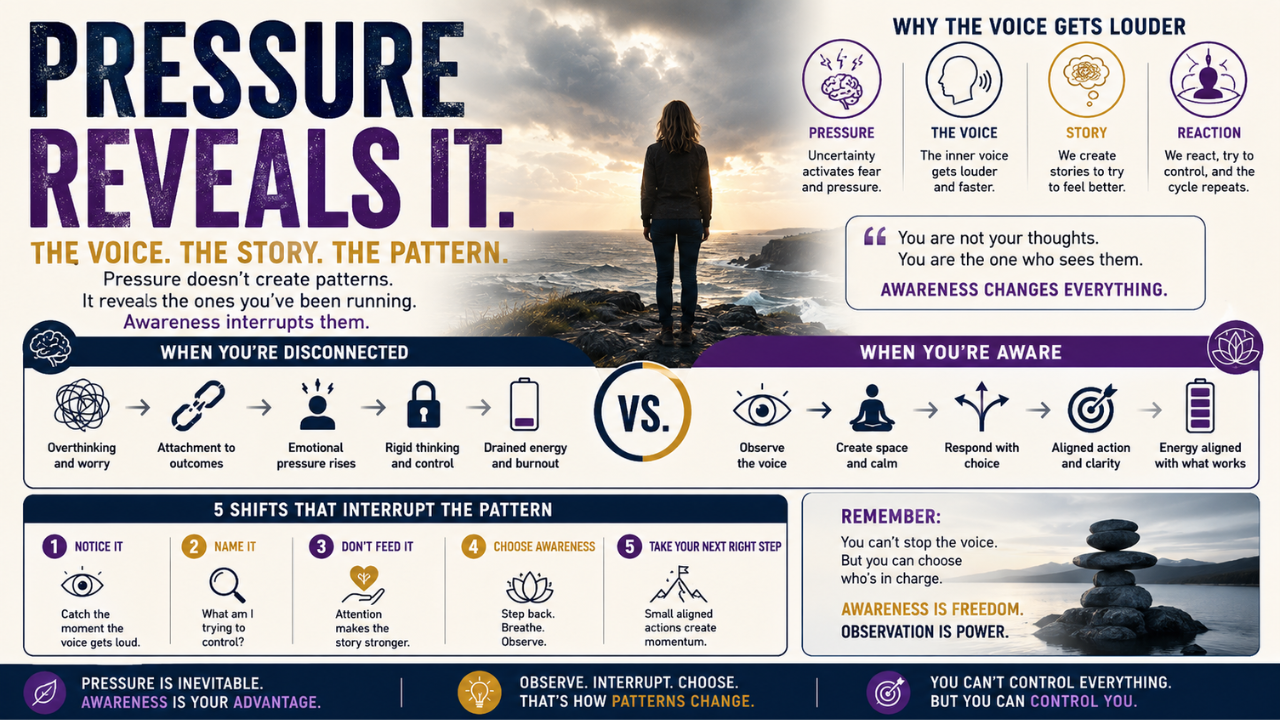
Pressure doesn't create the voice.
It reveals it.
The next time pressure shows up in your life, pay attention.
Not to the problem.
Not to the uncertainty.
Not even to the outcome.
Pay attention to the conversation.
Listen carefully.
Notice what the voice is saying.
Notice where it's trying to take your attention.
Notice how badly it wants certainty.
Then pause.
Observe.
And remember:
You don't have to follow every voice you hear in your head.
Sometimes the most powerful thing you can do is simply notice it and let it pass.
That's where peace begins.
About the Author
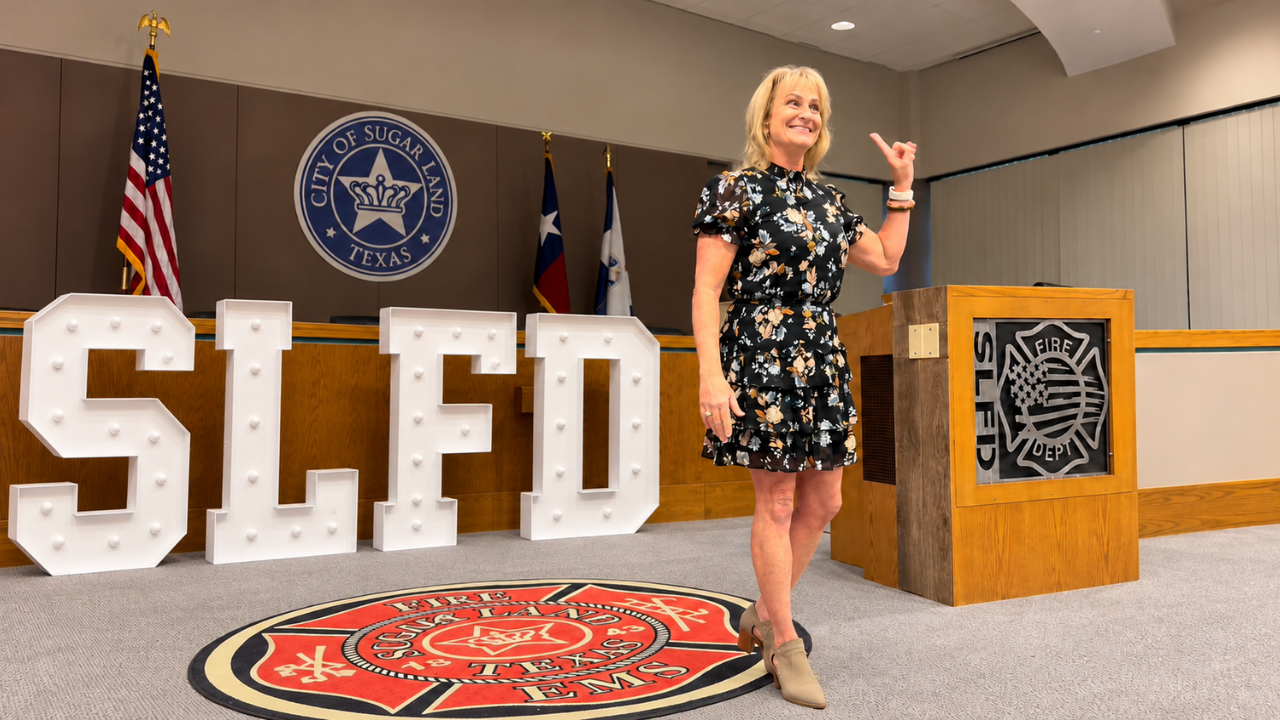
Kathie Owen is a consultant, speaker, and author of Human Patterns Under Pressure. She helps leaders, founders, and organizations identify the hidden people patterns that influence performance, communication, decision-making, and culture under pressure.
Through speaking engagements, consulting, and leadership development, Kathie helps individuals and teams recognize the invisible dynamics that often determine whether people adapt, fracture, or thrive during uncertainty.
To learn more about speaking, consulting, or working with Kathie, visit the Contact page.
Read More Articles from Kathie

Transcript
The other day, I caught myself having a conversation in my head, not with another person, with myself. I was walking through the grocery store and replaying a consulting conversation I'd had earlier that day. I was thinking about what I should have said, what I could have said differently, what I missed, what I got wrong, and the crazy part was the conversation had been over for hours. Nothing was happening. There was no emergency, no crisis, no problem to solve, yet there I was, walking through the produce section, creating pressure about something that had already happened. And then I noticed it. I noticed the voice. I noticed the story. I noticed my mind trying to create certainty around something that could no longer be changed. And in that moment, I realized something. The pressure wasn't coming from the conversation. The pressure was coming from the conversation I was having with myself about the conversation. And that's when I started thinking about something I see everywhere in leaders and founders, in families, in athletes, in teams, and even in myself. Pressure doesn't create patterns. Pressure reveals them. Welcome to the Kathie Owen Perspective podcast. My name is Kathie Owen. I'm a consultant, speaker, and the author of Human Patterns Under Pressure. I work with leaders, teams, founders, and professionals who are navigating uncertainty, conflict, change, and high-stakes decisions. And over the years, I've noticed something fascinating. People rarely struggle because of the situation they're facing. They struggle because of what pressure reveals inside of them. And today, I want to talk about one of the most important patterns I've ever observed: the voice in our heads. And what happens when pressure turns up the volume. One of the reasons Michael Singer's work resonates so deeply with me is because he points out something most people completely miss. There's a voice in your head, and it never stops talking. It's commenting, judging, predicting, explaining, worrying, planning, creating stories. The strange thing is that most people don't realize they're listening to it. They assume the voice is them. Then pressure arrives, and suddenly the voice gets louder. A difficult conversation, a delayed response, a financial challenge, a relationship issue, a business decision, and now the voice becomes impossible to ignore. What if this doesn't work? What if I made a mistake? What if they misunderstood? What if I'm behind? What if I'm not doing enough? The pressure didn't create the voice. The pressure revealed it. This is where my work differs from traditional coaching. When I work with people, I'm not primarily looking at the problem they're describing. I'm looking for the pressure point because pressure reveals patterns. Recently, after a consulting session, I found myself replaying the conversation in my head, not the breakthroughs, not the value that was created, and not the things that went well, the mistakes, the things I wish I had said differently, the places I could improve. And at first, it felt productive. Then later that day, while I was walking through the dang grocery store, I caught myself. The voice was still talking. It was still reviewing, still analyzing, still trying to create certainty about something that had already happened. And in that moment, I noticed something important. The pressure wasn't coming from the consulting session anymore. The pressure was coming from the pattern, and the pattern was pressure arrives. The voice starts talking. The voice starts analyzing. The mind starts searching for certainty. And that's exactly what I help people identify, not the event, the pattern. Because once you see the pattern, you have the ability to interrupt it. But here's what makes this difficult. The voice rarely sounds irrational. It actually sounds reasonable. That's why people follow it. The voice says, "I should think about this a little bit longer." Says, "I need more information. "Maybe I should wait until I'm sure." "I need to figure out exactly how this is gonna work." It sounds responsible, it sounds intelligent, it sounds helpful, but underneath all those thoughts is usually the same thing, the need for certainty. The mind wants certainty Because uncertainty feels unsafe, and that's where Reality Transurfing enters the conversation. Reality Transurfing is a book written by Russian quantum physicist Vadim Zeland, and it teaches that when we make something excessively important, we create what Vadim Zeland calls excess potential. Think about how often this happens. A client becomes critically important. A relationship becomes critically important. A business opportunity becomes critically important. A speaking engagement becomes critically important. The more important it becomes, the more emotional charge we create around it, and the more emotional charge we create, the harder it becomes to think clearly. The voice feeds importance. Importance feeds pressure. Pressure feeds anxiety. Anxiety feeds the voice, and now we're stuck in a loop, not because reality is creating pressure, Because we are creating pressure around reality. This is where most people lose themselves. The voice gets activated and importance rises. Emotional charge increases, and now attention gets pulled into the story. Reality transurfing calls this feeding a pendulum. The more attention we give something, the stronger it becomes, and the stronger it becomes, the more attention it demands. Soon, we're no longer observing the story. We're living inside of it, and we've all done this. A difficult email, a family conflict, a leadership challenge, a financial concern, a health issue. Nothing is actually happening in the moment, but the story is running nonstop. The pendulum has our attention, and wherever our attention goes, energy flows. And this Is where Michael Singer and Reality Transurfing beautifully come together. Michael Singer teaches awareness. Reality Transurfing teaches attention. Both are pointing to the same thing. Observe, notice, watch, become aware because the moment awareness appears, something powerful happens. You are no longer completely identified with the voice. You become the observer, and that's where choice lives. The voice may still be talking, but now you're listening to it instead of automatically believing it. That's a completely different experience, and it's where change begins. So now is a great time to share with you a lesson I call I'm Running on God's Time. And years ago, this lesson started for me when I was stuck in traffic. I was running late, watching the clock, trying to mentally force traffic to move faster, as if frustration could somehow clear the highway. And I remember saying, "We're running on God's time." At first, it was simply a way to let go, but over the years it became something much deeper. Now I use it whenever the voice starts demanding certainty, because that's what the voice always wants. The how, the timeline, the guarantee, the proof, the certainty. And Neville Goddard often talked about the bridge of incidents. Yes, I brought Neville Goddard into this episode too. You know, he talks about the bridge of incidents, and that is the path that unfolds between where you are and where you're going. The interesting thing about the bridge of incidents is that you cannot predict it. You cannot force it. You cannot map every step. Life unfolds through conversations, opportunities, delays, detours, and events we could never have imagined. Looking back, the path makes sense. You know, Steve Jobs says it, "I can connect the dots looking backward." And looking forward, the path rarely makes sense. The voice wants certainty. Life asks for trust. I'm gonna repeat that because it's super important. The voice wants certainty, and life asks for trust. The voice wants control, and life asks for participation. The voice wants answers, and life asks for presence. When I remind myself that we're running on God's time, I'm not giving up. Believe me, I'm not giving up. I'm interrupting the pattern. I'm stepping out of the need for certainty. I'm releasing the importance. I'm starving the pendulum, and I'm returning to the present moment. This is why I believe pressure can be such a powerful teacher. Pressure reveals patterns. The pattern reveals where attention goes, and attention reveals what we've been practicing. And awareness gives us the opportunity to choose something different. So the next time pressure shows up, don't focus on the problem. Observe the pattern. Listen to the voice. Notice what it's saying. Notice where it's pulling your attention. Notice how badly it wants certainty. Then step back. Become the observer, because pressure doesn't create the pattern. Pressure reveals it. And once you can see it, you can change it. All right. Thank you for being here today. I trust that you found today's episode helpful, and if you'd like to go deeper into this topic, I've written a companion blog post with additional insights and resources, and I'll have it linked in the show notes and description below. And if you're navigating uncertainty, leadership challenges, team dynamics, or major transitions, I'd love to connect and show you how pattern recognition can help you make better decisions under pressure. Until next time, remember, pressure reveals patterns, awareness interrupts them, and that changes everything.


Discover how to recognize anxiety, break negative thought patterns, and reconnect with power, presence, and peace. Kathie Owen shares her personal journey, practical self-awareness exercises, and Neville Goddard’s revision practice to support emotional regulation, mindful leadership, and personal growth.
#AnxietyAwareness #EmotionalRegulation #SelfAwareness #Leadership