
Why Humans Become Emotionally Blind Under Pressure (Houston Astros Struggles)
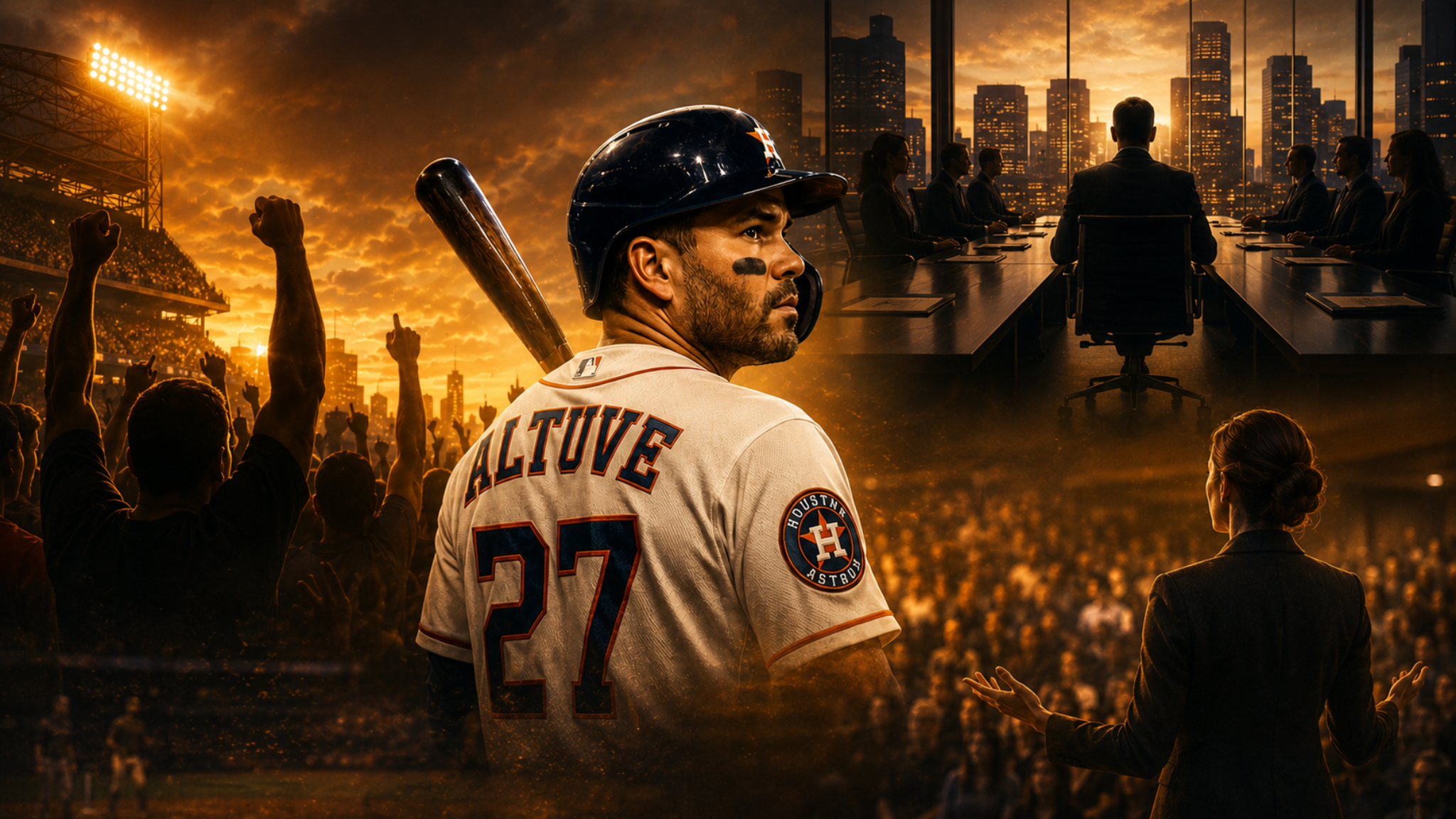
This is not really an article about baseball. It’s an article about humans. Kathie Owen explores the Houston Astros, Reality Transurfing, emotional pendulums, psychological safety, leadership under pressure, nervous system regulation, and why sports may be one of the clearest mirrors of human behavior we have today.
The Astros Are Teaching Us Something
The second I say the word “Astros,” half the room emotionally leaves.
And that intrigues me.
Every single time I speak about the Houston Astros on stage, online, or even casually in conversation, I can literally feel the emotional pendulum activate in people.
Immediately.
“They cheated.”
“The scandal.”
“They stole signs.”
I’ve even been introduced on stage as a rival.
And I actually stopped somebody once and said:
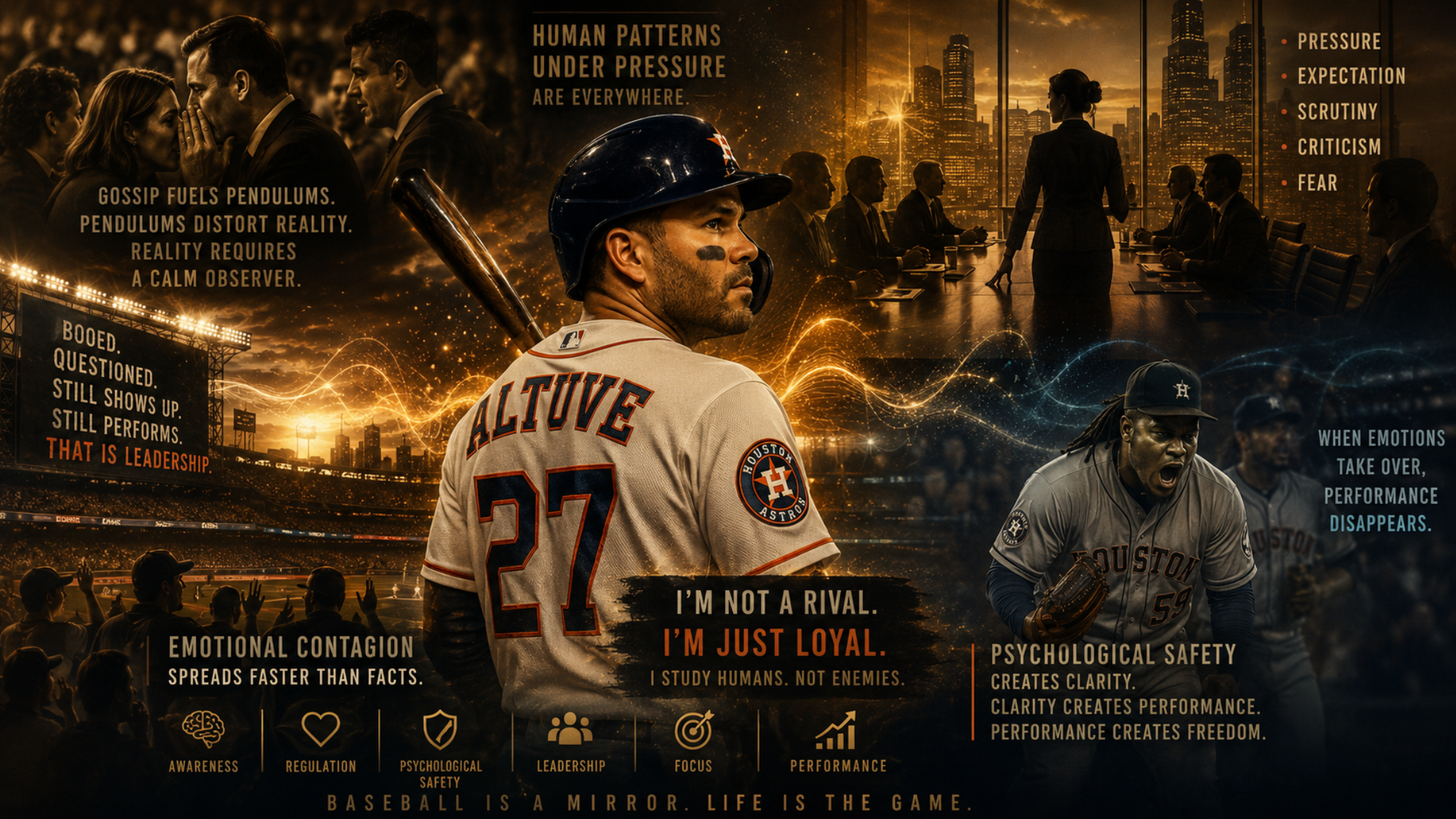
“I’m not a rival. I’m just loyal.” -Kathie 😊
That distinction matters to me.
Because I don’t study sports through hatred.
I don’t study athletes through rivalry.
And I don’t look at people — in sports or in life — as enemies.
Ever.
I study humans.
That’s what grips me to the core.
And one thing I want to make very clear before we go any further: you do not have to understand baseball, follow sports, or even like the Astros to understand this article.
Because this article is not really about baseball.
It’s about humans under pressure.
And baseball just happens to be one of the clearest mirrors of human behavior I’ve ever seen.
I Don’t Watch Baseball Like Most People
I’ve loved baseball since I was a little girl.
But I don’t watch it the way most people do.
I don’t primarily watch for statistics.
I don’t watch to argue online.
I don’t emotionally attach my identity to wins and losses.
I watch humans under pressure.
That’s what I’ve always watched.
Baseball exposes tension immediately.
A tiny hesitation changes everything.
A tiny loss of confidence changes everything.
A nervous system that no longer feels safe changes everything.
And once you begin deeply studying human behavior, leadership, emotional regulation, and performance under pressure, you realize something fascinating:
baseball has almost nothing to do with baseball.
It has everything to do with humans.
Reality Transurfing Changed The Way I See Sports
If you’ve followed my work for a while, then you already know I speak often about Reality Transurfing by Vadim Zeland.
That book series profoundly changed the way I view emotional systems, organizations, leadership, and collective human behavior.
One of the most important concepts inside Reality Transurfing is the idea of pendulums.
A pendulum is basically a collective emotional structure.
It feeds on emotional energy.
Sports are one of the strongest pendulums on earth.
Politics are another.
Social media is another.
Corporate gossip is another.
The second groups of people emotionally react together, a pendulum forms.
And once that pendulum forms, it wants attention.
It wants outrage.
It wants emotional attachment.
It wants people choosing sides.
And the Astros cheating scandal became one of the strongest sports pendulums I’ve seen in years.
The Astros Scandal Is A Perfect Example Of Pendulum Thinking
Now here’s where people become reactive.
Yes.
The Astros got caught stealing signs.
But if you know baseball, then you also know sign stealing has existed forever.
Baseball has been trying to gain competitive advantage since the beginning of the sport.
That’s not new.
And here’s the part people often skip over because the pendulum is emotionally more satisfying than nuance: you still have to hit the baseball.
You still have to hit a baseball traveling over ninety miles an hour.
That part matters.
A lot.
What gets me is not whether people are angry.
What interests me is how emotionally attached people become to narratives.
Because once people emotionally attach to a narrative, they stop observing reality clearly.
That’s true in sports.
That’s true in organizations.
That’s true in politics.
That’s true in relationships.
And it’s fascinating to watch because the second people hear the word “Astros,” many are no longer hearing the actual lesson being shared.
The emotional identity activates first.
That’s what pendulums do.
Pendulums narrow perception.
They reduce nuance.
They collapse complexity into emotional certainty.
Psychological Safety Is Deeply Misunderstood
This is one of the reasons psychological safety is such an important part of my work.
And also one of the most misunderstood.
People think psychological safety means everybody feels comfortable.
No.
That’s not it at all.
Psychological safety means people can remain open, observant, thoughtful, communicative, and emotionally regulated even when emotionally activated.
That’s very different.
Most people lose this almost instantly once identity or emotion gets triggered.
Sports fandom exposes this beautifully.
And honestly, so does social media.
The Astros Don’t Look Untalented. They Look Burdened.
What I’m seeing in Major League Baseball right now — especially with the Astros — is not just a baseball story.
It’s a human performance under pressure story.
The Astros do not look untalented.
They look emotionally burdened.
That’s different.
And now injuries continue piling up, including recent injuries to Jose Altuve.
Injuries fascinate me because I do not believe injuries are “just physical.”
That does not mean injuries are imagined.
That’s not what I’m saying.
But the body and nervous system are deeply connected.
Pressure affects recovery.
Stress affects sleep.
Emotional tension affects mechanics.
Hypervigilance affects fluidity.
And baseball is one of the most timing-dependent sports on earth.
Milliseconds matter.
Breathing matters.
Confidence matters.
Flow matters.
Now add:
years of playoff intensity
trade speculation
media pressure
fan pressure
social media criticism
aging players
dynasty expectations
constant scrutiny
That changes humans over time.
Especially when every season emotionally becomes:
“World Series or failure.”
That’s heavy.
Emotional Regulation Is Leadership
One of the most fascinating human dynamics inside the Astros organization right now is the contrast between emotional regulation styles.
Take Jose Altuve versus Framber Valdez.
You do not need to know either athlete to understand this lesson.
Altuve has spent years being booed in opposing stadiums because of the cheating scandal.
And yet somehow, he continues performing under extraordinary pressure while remaining emotionally steady.
That is psychologically remarkable.
Especially over time.
Meanwhile, Framber visibly displays frustration on the mound when tension rises.
His body language changes immediately.
His emotional state becomes visible instantly.
Last season, he even threw a pitch at his own catcher because he disagreed with the pitch call.
This season, after becoming emotionally overwhelmed during a difficult inning, he hit a batter and was ejected from the game.
That’s not just baseball.
That is visible nervous system dysregulation under pressure.
And the contrast between Altuve and Framber teaches something profound:
pressure reveals regulation.
That lesson applies everywhere.
In leadership.
In marriage.
In organizations.
In business.
In life.
The Broadcasters Are Under Pressure Too
One thing people almost never discuss is the pressure on sports broadcasters.
And I have tremendous respect for Julia Morales, Todd Kalas, and Geoff Blum right now.
Because they are navigating the emotional pendulum too.
Every game gets scrutinized.
Every loss becomes emotional online.
Every managerial decision gets criticized.
Every injury becomes a storyline.
And yet game after game, they continue showing:
steadiness
humor
professionalism
presence
emotional regulation
leadership
That matters more than people realize.
Organizations always have emotional stabilizers.
Sometimes it’s the leader.
Sometimes it’s the communicator.
Sometimes it’s the assistant.
Sometimes it’s the consultant.
Sometimes it’s the person quietly regulating the emotional atmosphere while everyone else becomes reactive.
That is leadership under pressure.
This Perspective Started Long Before Baseball
If you watched my recent episode about the Enron scandal era in Houston and my connection to that world, then you already know this perspective did not come from nowhere.
That period profoundly shaped the way I observe organizations.
I watched:
organizational pressure
silence
emotional contagion
fear
perception management
whistleblower dynamics
leadership breakdowns
human behavior inside emotionally charged systems
And once you see those patterns deeply enough…
you begin seeing them everywhere.
Including baseball.
Sports May Be One Of The Clearest Mirrors Of Human Behavior
What fascinates me most is that sports may actually be one of the clearest mirrors we have for understanding humans.
Not because of statistics.
Not because of rivalries.
Not because of wins and losses.
But because sports expose:
pressure
identity
fear
emotional contagion
nervous system regulation
leadership
tension
confidence
resilience
psychological safety
And the more emotionally charged the environment becomes, the more visible those human patterns become.
That’s what I study.
And honestly, I believe these conversations matter now more than ever.
Because humans are overwhelmed.
Organizations are overwhelmed.
Leaders are overwhelmed.
And most people are trying to solve deeply human problems without understanding humans.
That’s the disconnect.
And that disconnect is exactly what I study.
Recommended Reading
Related Topics Coming Soon
The psychology behind emotional regulation in professional athletes
Leadership lessons from baseball clubhouses
Blue-collar industries and hidden and obvious human dynamics
Private equity and organizational pressure
Psychological safety inside emotionally charged systems
Humor as a pendulum breaker
The Houston Enron era and how it shaped my lens on organizational behavior
Here’s the first article I did on the Enron era and my association with it.
About The Author
Kathie Owen is a private consultant, speaker, and author of Human Patterns Under Pressure, where she studies the invisible emotional, behavioral, and nervous-system dynamics that affect leadership, trust, communication, and organizational durability.
With more than 25 years of experience spanning corporate wellness, leadership observation, blue-collar industry exposure, and high-pressure workplace environments, Kathie brings a unique lens to the human patterns most organizations miss.
Her work explores what happens to people and teams under stress — from professional sports organizations to founder-led companies, mergers and acquisitions, private equity environments, and emotionally charged leadership systems.
Through her podcast, writing, coaching, and consulting work, Kathie helps audiences better understand emotional contagion, nervous system regulation, psychological safety, and the hidden human dynamics quietly shaping performance and culture.
Read More Articles from Kathie







Transcript
📍 📍 📍 The second I say the word Astros, half the room, or probably more than half the room, emotionally leaves. And that fascinates me because every time I speak about the Houston Astros on stage, online, or even casually in conversation, I can literally feel the emotional pendulum activate in people immediately. Here's what they'll say. "They cheated." "That's a scandal." "They stole signs." I've even been introduced on stage as a rival. I am not a rival. I'm just loyal. But what's fascinating to me is people stop listening to the message that I'm trying to share just because I say the word Astros. It's like the nervous system locks onto one emotional headline and completely loses the larger conversation, and that right there is actually what this episode is all about. 📍 📍 Welcome to the Kathie Owen Perspective podcast. My name is Kathie Owen, and I study human patterns under pressure, the invisible emotional, 📍 behavioral, and nervous system dynamics that affect leadership, communication, trust, performance, and organizational durability. And today, I want to talk about baseball, whether you know the sport or not, whether you like the Astros or not because today, I'm not talking from the perspective most people watch baseball because I don't watch baseball like most people. I never have. I've loved the game since I was a kid, but I don't primarily watch for stats. I don't watch to argue online. I don't watch to emotionally attach my identity to wins and losses. I watch humans under pressure. That's what fascinates me. Baseball is one of the greatest psychological mirrors that exist because baseball exposes tension immediately. A tiny hesitation changes everything. A tiny loss of confidence changes everything. A nervous system that no longer feels safe changes everything. 📍 And once you start studying human behavior deeply, you realize baseball has almost nothing to do with baseball, and it has everything to do with humans. Now, before I go any further, I want to explain something because I reference this often in my work. I talk a lot about 📍 Reality Transurfing. Reality Transurfing is a book series by Vadim Zeland. He's a Russian quantum physicist. And this book deeply impacted the way I view emotional systems, organizational energy, and collective behavior. One of the concepts inside Reality Transurfing is the idea of pendulums. 📍 A pendulum is basically a collective emotional structure. It feeds on emotional energy, and sports are one of the strongest pendulums on Earth. Politics are another. Social media, yep, it's another one. Corporate gossip, there's another one. The second people emotionally react together, a pendulum forms, and once that pendulum forms, it wants attention. It wants outrage. It wants emotional attachment. It wants people choosing sides. And the Astros cheating scandal is one of the strongest sports pendulums I've seen in years. Now, here's where people get reactive when I say this. Yes, the Astros got caught stealing signs. But if you know baseball, you also know sign stealing has existed forever. Baseball has been trying to gain competitive advantage since the beginning of the game. That's not new. And here's the part people conveniently skip over because the pendulum is more emotionally satisfying than this very nuance. You still have to hit a baseball traveling over ninety miles an hour. That part matters a lot, even if you know the sign or the pitch is coming. Because what fascinates me is not whether people are angry. What fascinates me is how emotionally attached people become to narratives. And once people emotionally attach to a narrative, they stop observing reality clearly That's true in sports, that's true in corporations, that's true in politics, that's true in relationships, and I see this happen constantly when I speak publicly about the Astros. People hear Astros, and suddenly they're no longer listening to the actual lesson. That fascinates me as somebody who studies psychological safety. Because psychological safety is actually one of the deepest layers of my work, and psychological safety is wildly misunderstood. People think psychological safety means everybody feels comfortable. Nope. That's not it. Psychological safety means people can remain open, observant, thoughtful, and communicative even when emotionally activated, and that is very different, and most people lose that immediately once emotional identity gets triggered. That's what pendulums do. Pendulums narrow perception. They reduce nuance. They collapse complexity into emotional certainty, and sports fandom does this constantly. Now, let's bring this back to baseball itself. What I'm seeing in Major League Baseball right now, especially with the Astros, is not just a baseball story. It's human performance under pressure story. The Astros don't look untalented. They look burdened, and that is different. I've heard reports that we have the most injuries of a team ever in history of professional baseball. And injuries are fascinating to me because I don't think injuries are just physical. That doesn't mean injuries are imagined. That's not what I'm saying. But the body and the nervous system are connected, deeply connected. Pressure affects recovery. Stress affects sleep. Emotional tension affects mechanics. Hypervigilance affects fluidity, and baseball is one of the most timing-dependent sports on Earth. Milliseconds matter. Breathing matters. Rhythm matters. Confidence matters. Flow, oh my gosh, flow matters. Now add years of physical playoff intensity, trade speculation, aging players, media pressure, fan pressure, constant criticism, social media, and the emotional residue of carrying dynasty expectations for nearly a decade. That changes humans. And I think people underestimate how exhausting sustained pressure becomes over time, especially when every season becomes World Series or failure. That's heavy. Now compare that to lower pressure teams right now. The athletics are fascinating to me because they're operating in almost the opposite emotional environment. Lower expectations, less spotlight, less emotional weight, and oddly enough, shared adversity can create bonding. Humans often perform differently when they emotionally feel we have nothing to lose. That creates looseness. That creates flow. And baseball punishes tightness immediately. And here's something I'm actually going to do an entire episode on because it fascinates me psychologically. When you watch the Astros closely, you can see completely different nervous system responses to pressure in different ways. Take Jose Altuve versus Fromber Valdez. And you don't need to know either athlete or either team they play for right now this very moment to understand what I'm about to explain. Altuve has spent years being booed in opposing stadiums because of the cheating scandal. And now somehow he still remains incredibly, incredibly emotionally steady and high performing under pressure. I love watching him play under pressure. Meanwhile, on the other side of the coin, you can visibly see Fromber emotionally unravel on the mound when frustration hits him. He actually threw a pitch at his catcher because he was angry at the pitch call. That's insane. And that is obviously a human who is not emotionally regulating on the mound and on national television. In fact, that happened last year. This season, he actually gave up several runs in an inning and back to back to back. And he was thrown out of the game because he hit a batter. That is a human who cannot handle pressure, and it's obvious. So the contrast between Altuve and Framber tells us something really important about leadership, emotional regulation, and human performance under pressure, not just in baseball, in life. Now, another thing I really want to mention, because almost nobody talks about this, is the pressure on the broadcasters. I have so much respect for Julia Morales, Todd Kalas, and Geoff Blum right now. If you don't know who they are, that doesn't even matter. Just know that they announce for the Houston Astros. And Julia is also very active on social media, and she takes a lot of backlash for the Astros, and she's been with the Houston Astros since twenty-thirteen. So she has seen the good, the bad, the ugly, and a lot more ugly than the good or even the bad. But people forget when they're watching the game, these announcers are navigating the emotional pendulum too. Every game is scrutinized. Every loss becomes emotional online. Every managerial decision gets criticized. Every injury, and there are so many of them this season, becomes a storyline. And yet night after night, these announcers still show steadiness. They show professionalism. They show humor. And I want to add humor is one of the best ways to break a pendulum, and I will be doing an episode on that very soon. But they also add presence. I talk about presence all the time. They also add leadership, and all of that matters, especially inside emotionally charged systems. And honestly, these people often become emotional stabilizers whether they realize it or not, and that's where my work lives. Organizations always have emotional stabilizers. Sometimes it's leadership. Sometimes it's a manager. Sometimes it's an assistant. Sometimes it's the communicator. Sometimes it's your wellness director. Sometimes it's your consultant. And sometimes it's the person who helps regulate the emotional atmosphere when everyone else becomes reactive. That is leadership under pressure. Now, the reason this topic matters so deeply to me because I've been studying these dynamics for decades. And if you watched my recent episode about the Enron scandal era in Houston, and my connection to that world, then you already know this perspective did not come out of nowhere. And I will link that episode in the show notes and description below so you can check that out. And actually, I write a blog post for every episode I do, and I include it in the show notes and description below, and those blog posts, include bonus resources and more detail that I go into it. They also have the podcast episode. They have the video. You can check that out by looking in the show notes and description below. But that Enron scandal era and my experience with it, that period of time shaped me profoundly. I've watched organizational pressure. I've watched silence. I've watched emotional contagion. I watch fear. I watch perception management. I watch whistleblower dynamics. Watching what humans do when systems become emotionally charged, that changed the way I see organizations forever. And over the next few weeks, I'm gonna be diving much deeper into this. I will be talking about blue-collar industries, private equity, organizational pressure, psychological safety. That one is in almost every episode I talk about. Human behavior under stress, and the invisible patterns most people completely miss. Because I believe we are entering an era where understanding humans matter more than ever. Not just data, not just metrics, not just surface-level performance. Humans, nervous systems, emotional environments, trust, fear, pressure, identity. And what fascinates me is sports may be one of the most clearest mirrors we have for all of it. So if this perspective resonates with you, 📍 please like this video. It tells YouTube that this content matters. Please subscribe to the channel so you don't miss another episode. And please share this episode with someone that may benefit from hearing it. Not because I'm trying to build some massive audience because I'm not. I'm trying to have conversations that I genuinely believe need to happen right now Because humans are overwhelmed, organizations are overwhelmed, leaders are overwhelmed, and most people are trying to solve deeply human problems without understanding humans. That's the disconnect, and that disconnect is exactly what I study. So with that, thank you for being here. I trust that you found today's episode helpful, and I will see you in the next episode of the Kathie Owen Perspective podcast.
Explore the hidden habits of thought that shape emotional regulation, pattern recognition, and decisions under pressure. Kathie Owen explains how assumptions can make one difficult moment feel permanent, and how an aware pause helps you respond with more clarity at work, at home, and in leadership.
#EmotionalRegulation #PatternRecognition #Habits #LeadershipUnderPressure