
He Never Waited for Permission: Imagination, Identity, and Leadership Under Pressure

Rusty never applied for the job.
He had no certification, no employee badge, and no official title. Technically, he was not even qualified to use most of the equipment.
That did not stop him from becoming the unofficial trainer at my fitness studio.
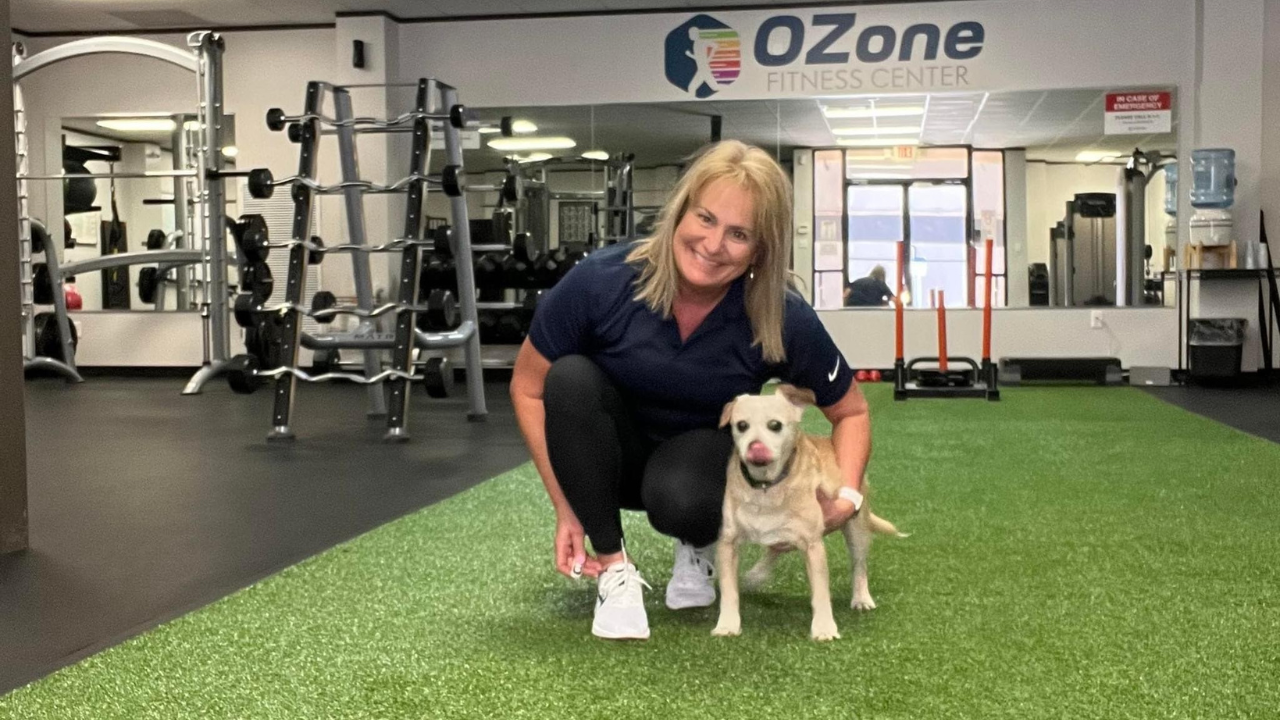
Look at him standing in that gym. He appears completely certain that he belongs there. There is no apology in his posture. No request for approval. Just that joyful face, ready to report for work.
He never stood at the edge of the gym wondering whether a dog belonged there. He did not wait for someone to announce his role or give him permission to occupy it.
He simply showed up as if he already belonged.
Rusty never waited for permission to become who he already believed himself to be.
Humans tend to make this far more complicated.
We enter a room and immediately look for evidence that we belong. We compare our ability to everyone around us. We notice what we cannot do, what we do not know, and what has not happened yet.
Then pressure turns that evidence into an identity.
I struggled in this room, so I do not belong here.
This door did not open, so the goal must not be mine.
I do not have the title, so I cannot occupy the role.
Pressure does not simply make us uncomfortable. It can make one interpretation feel like the only interpretation. When that happens, our imagination begins to shrink. We stop seeing choices, alternative meanings, and doors we have not considered yet.
Years before Rusty confidently strolled into the gym, I had to learn this lesson in a mirrored aerobics room—surrounded by perfectly choreographed instructors while I could not make my body follow an eight count.
That room revealed something I could not do yet.
It could not reveal everything I would become.
Sometimes imagination is what prevents one uncomfortable moment from deciding an entire future.
Hello, World!
When One Moment Becomes an Identity
Over 25 years ago, I walked into an aerobics instructor certification course.
There was only one small problem.
I could not dance.
I understood an eight count in my mind. I knew there were eight beats. I could watch the instructor and understand what she wanted us to do.
My body had other plans.
The other instructors seemed perfectly choreographed. They moved together. They stepped in the same direction. They knew when to turn and when to change movements.
I was trying to determine which foot we were using.
It was humiliating.
I was not struggling alone in my living room. I was standing in front of a room filled with people who appeared to know exactly what they were doing. My difficulty was visible.
The pressure of that moment could have created a very convincing conclusion:
I cannot dance, so I cannot become a fitness instructor.
The first half of that statement contained some truth. I could not perform the choreography well.
The second half did not follow.
That room showed me one thing I could not do yet. It could not show me everything I would become.
I completed the certification. Soon afterward, I became a certified fitness trainer. I fell in love with working with older adults and later earned specialized certification to serve them.
I became a highly sought-after water aerobics and SilverSneakers instructor. I became very good at the work.
Not because I turned into the most beautifully choreographed dancer in every room. I discovered the kind of instructor I was capable of becoming.
My strengths were connection, observation, encouragement, and modification. I could look at the person in front of me and help that person move safely. I could make exercise feel approachable. I could help people feel capable in their bodies.
None of that evidence existed while I stood in the certification room.
I needed enough imagination to see beyond the immediate threat.
This photo was taken in a restroom. Yes! And I believe it builds courage to dream.
Imagination Changes What the Moment Means
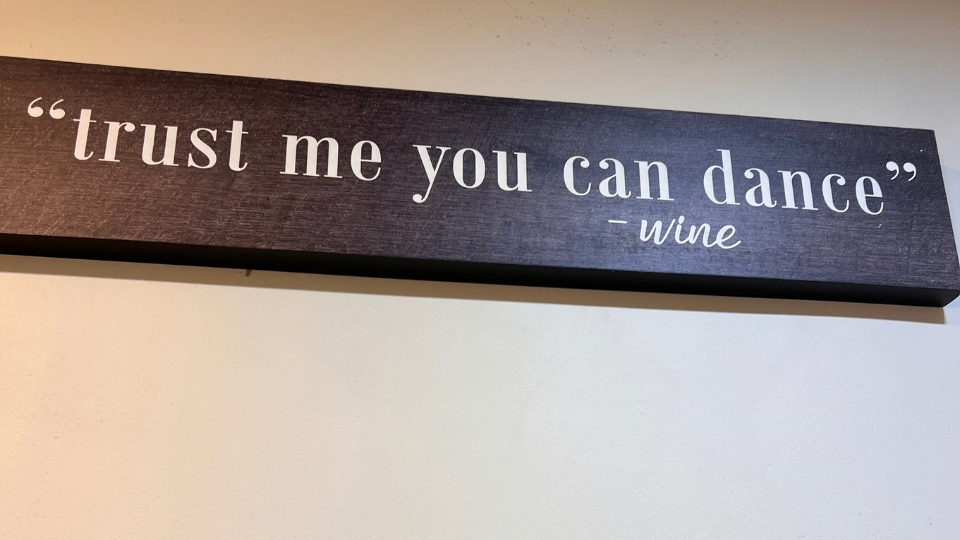
I have a funny picture that says,
“Trust me you can dance.” -Wine.
I changed the last word in my mind.
“Trust me you can dance.” -Imagination.
In my imagination, I could experience myself as an excellent fitness instructor before my circumstances gave me proof.
That was not fantasy. I did not sit at home imagining myself teaching while refusing to enter the uncomfortable room. I entered the room. I learned. I got certified. I kept showing up.
Imagination did not replace action.
Imagination changed what the action meant.
Without imagination, the struggle could have meant, “I do not belong here.”
With imagination, it could mean, “I have not discovered how I belong here yet.”
One interpretation closes the future.
The other leaves room for life to surprise us.
This is one reason limiting beliefs can be so powerful. A limiting belief often takes a temporary experience and turns it into a permanent identity.
I struggled in this room, so I do not belong in rooms like this.
I received one rejection, so nobody wants what I offer.
My business had a slow month, so it must be failing.
I am moving more slowly today, so I must be lazy.
I feel anxious right now, so something must be wrong with my life.
The experience may be real. The conclusion may still be incomplete.
All truths are half-truths.
Imagination creates a little space around the first conclusion. It asks one important question:
What else could be true?

The Goal and the Door Are Not the Same
This connects to one of my favorite concepts in Reality Transurfing: Goals and Doors.
The goal is the experience or direction that genuinely calls to you. The door is the route through which you reach it.
But we often confuse the two.
We try one door. It feels awkward. It does not open easily. We become embarrassed, rejected, or uncomfortable. Then we decide the goal must not belong to us.
One difficult door does not always mean the goal is wrong.
Sometimes we are standing at the wrong door. Sometimes we are still learning how to open it. Sometimes that door is helping us discover which version of the goal truly belongs to us.
If I had decided that perfect choreography was the only door into fitness, I might have abandoned the goal.
Instead, other doors opened.
Water aerobics opened. Older-adult fitness opened. Personal training opened. Speaking, consulting, and studying human patterns under pressure opened later.
I did not need to know every door in advance.
I needed enough imagination to stop treating the first uncomfortable door as the final answer.
This is where imagination and non-attachment work together.
Imagination allows us to experience the goal before every circumstance agrees. Non-attachment prevents us from demanding that life use the exact route our minds selected.
We can hold the goal without gripping one door.
We can act without trying to control every result.
We can pay attention to what is happening without turning every obstacle into a final verdict.

Pressure Shrinks Leadership
This same pattern appears inside companies every day.
A customer becomes angry. Revenue falls. A key employee resigns. Two executives begin fighting. A deal starts to wobble. A founder feels control slipping away.
The pressure is real.
But pressure can make the most threatening interpretation feel like the only interpretation.
Someone must be blamed.
Someone must be removed.
We must act immediately.
This employee is disloyal.
The team cannot handle the truth.
If I pause, I will appear weak.
If I do not control this now, everything will collapse.
This is how intelligent and experienced leaders can make narrow decisions. It is not always because they lack knowledge. Pressure may have reduced the number of possibilities they can see.
The quality of a leader’s decisions depends partly on how many possibilities that leader can still see under pressure.
A reactive leader may see one interpretation and one response.
A clear leader creates enough internal space to see more.
That does not mean delaying every difficult decision. It does not mean avoiding conflict or pretending a serious problem is harmless.
It means refusing to let urgency do all the thinking.

The Pause Protects the Imagination
The pause is not passive.
It is the moment in which awareness becomes choice.
The pause allows a leader to ask:
What else could be true?
What am I assuming?
Is this an actual emergency, or has emotional urgency taken control of the room?
What information do I still need?
What options will disappear if I react too quickly?
What will this decision do to the people who remain?
Who do I want to be while I handle this?
Those questions reopen the imagination.
They do not remove the problem. They keep the problem from controlling the leader’s entire field of vision.
That is strategic imagination.
It is not soft leadership. It is the ability to look beyond the first story pressure offers and make the decision the situation actually requires.
The best leaders are not people who never experience pressure. They are people who can create enough internal space that pressure does not make every decision for them.
You Do Not Need Permission to Occupy the Role
My dog Rusty understood this in his own way.
Rusty became the unofficial trainer at the gym I ran for a company as their wellness director.
He did not allow the fact that he was a dog—or that nobody had officially hired him—to limit his contribution.
He greeted people. He offered high fives. He became part of the experience. I would walk around campus with him, and people I did not know would call his name.
Rusty never stopped to ask whether he had the right title. He did not wait for an announcement confirming that he belonged.
He simply occupied the role.
We often wait for evidence that we are allowed to become the person we can already imagine ourselves becoming.
We want the title first.
We want the invitation first.
We want the applause, the perfect circumstances, or a clear guarantee first.
But identity often begins quietly.
You enter the room.
You teach the class.
You wear the dress.
You ask a better question.
You make one decision from the person you are becoming.
Quiet confidence does not mean you will never doubt yourself again.
It means doubt does not have to choose your next door.

The Immediate Threat Is Not the Whole Future
You may leave the state you prefer. You may wake up afraid. You may believe an old story for a little while. You may feel pressure closing around you.
That does not mean you have lost everything you practiced.
You can pause.
You can remember.
You can imagine again.
You can return without shame or condemnation.
Returning does not mean the practice failed.
Returning is the practice.
The room you are standing in may reveal a current limitation. It may show you a skill you need to learn, a truth you need to face, or a door that is not opening.
Pay attention to that information.
But do not confuse the room with the whole future.
The room does not get to name you.
Pressure does not get to reduce your life to one interpretation.
One difficult door does not get to decide whether the goal belongs to you.
Pause long enough to imagine beyond the immediate threat.
There may be another meaning.
There may be another response.
There may be another door.
And there may be a future version of you who is grateful that you did not let one painful moment make the decision.
About the Author
Kathie Owen is a private consultant, author, and speaker who studies human patterns under pressure.
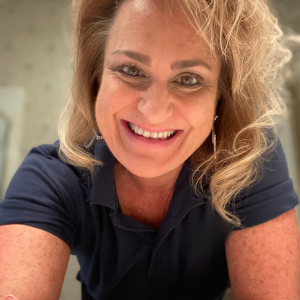
Drawing on more than 25 years of experience in fitness, leadership, human performance, and workplace dynamics, she helps founders, executives, teams, and organizations recognize the invisible patterns affecting trust, decision-making, culture, and enterprise durability.
Kathie is the author of Human Patterns Under Pressure and The Truth Bubbles Up, and host of The Kathie Owen Perspective.
Her speaking and private consulting work invite leaders to pause, observe more clearly, and make better decisions before people patterns become expensive problems.
Visit www.KathieOwen.com to explore her books, speaking, and consulting, or book a private strategic conversation with Kathie to begin a conversation.
Read the article on LinkedIn that has the human diligence in M&A perspective.
Read More Articles from Kathie




Transcript
Pressure does something dangerous to the imagination. It can make one bad moment feel like the whole truth, one closed door feel like the end of the goal, one embarrassing experience feel like proof that we do not belong. One difficult employee, one disappointing number, or one unexpected problem can make a leader believe there is only one explanation and only one possible response. But what if the immediate threat is not showing you the whole picture? What if the future depends on what you are still capable of imagining while the evidence appears to be against you? Welcome to the Kathie Owen Perspective podcast. My name is Kathie Owen. I am a private consultant, speaker, and author of Human Patterns Under Pressure and The Truth Bubbles Up, and I have also worked in fitness for nearly 25 years as a certified fitness trainer and with specialized experience working with older adults and athletes. That part of my background matters because fitness is one of the first places I learned to observe what people do when they feel uncomfortable, exposed, uncertain, or convinced they cannot do something. I have watched people become stronger because they stayed with an uncomfortable moment long enough to discover that the moment was not a final verdict. And I know what that feels like because I have lived it myself. Before we get into it, please like this video and subscribe to my channel. It helps more people find these conversations. And if you know someone who is allowing one difficult moment to define what is possible for them, share this video with them. Over 25 years ago, I walked into an aerobics instructor certification course. There was only one small problem. I could not dance. And I do not mean that I was being modest. I did not know how to follow an eight count with my body. I understood the count in my head. I knew there were eight beats. I could probably explain what everyone else was doing, but when it was time to make my arms and legs and feet perform those movements together, the message did not arrive. The other instructors seemed perfectly choreographed. They moved together. They knew when to step, turn, and change direction. And then there was me. I was trying to figure out which foot we were on. It was humiliating to say the least. I was not struggling privately in the back of the room either. My struggle was visible to a room full of people who seemed to know exactly what they were doing. That moment created an immediate threat. It was not a threat to my physical safety. It was a threat to my identity, my competence, and my sense of belonging. The pressure of that moment could have narrowed my imagination to one conclusion. I cannot dance, so I cannot be a fitness instructor. That conclusion would've made sense based on what I could see in the room, but it would not have been the whole truth. The room revealed one thing I could not do yet. It could not reveal everything I would become. I completed the certification, and soon after that, I became a certified fitness trainer. I fell in love with working with older adults, and later I earned specialized certification to work with that population. I became a highly sought-after water aerobics and SilverSneakers instructor. I was very good at it, not because I magically became the best dancer in every room. I found the kind of instructor I was meant to be. My strengths were connection, observation, encouragement, and modification. I could look at the person in front of me and help that person move safely. I could make exercise approachable. I could help people feel capable in their bodies. None of that evidence existed while I was standing in that first certification room. I had to imagine beyond the immediate threat. I have this funny picture that says, "You can dance. Wine." But in my mind, I changed that last word. You can dance. Imagination. In my imagination, I could see myself becoming an excellent fitness instructor before I had the physical evidence to support it. That was not fantasy, and it was not denial. I did not sit at home imagining myself teaching while refusing to enter the uncomfortable room. I entered the room, I learned, I got certified, and I kept showing up. Imagination did not replace the action. Imagination changed what the action meant. Without imagination, my difficulty in that room could have meant I do not belong here. With imagination, it meant I have not discovered how I belong here yet, and that is a very different conclusion. One closes the door, the other leaves room for life to surprise you. This connects to one of my favorite concepts in reality transurfing, goals and doors. The goal is what calls to you. It is the experience, expression, or direction that feels true for you. The door is the way you get there. But we often confuse the two. We try one door, it feels awkward, it is not easily open, and we become embarrassed, rejected, or uncomfortable. Then we decide the goal must not belong to us. But one difficult door does not always mean the goal is wrong. Sometimes we are standing at the wrong door. Sometimes we are still learning how to open it. And sometimes that door is showing us something important about the version of the goal that truly belongs to us. If I had decided that perfect choreography was the only door into fitness, I might have abandoned the goal. Instead, water aerobics opened, older adult fitness opened, personal training opened, speaking, consulting, and studying human patterns under pressure opened later. I did not have to know every door in advance. I needed enough imagination to stop treating the first uncomfortable door as the final answer. This is where visualization can become useful. We can imagine ourselves receiving the goal. We can experience the posture, feeling, and identity connected to it before every circumstance agrees. But we do not need to grip one exact route. That is where non-attachment matters. Hold the goal gently. Stay awake to the doors. Do not demand that life use the route your mind selected before you had all the information. Imagination helps us see possibility. Non-attachment allows possibility to arrive in a form we did not predict, and the pause keeps pressure from making the decision too soon, because pressure has a way of turning a moment into an identity. You receive a rejection and pressure says, "Nobody wants you." You have a slow month in business and pressure says, "It's all falling apart." You go through a quiet creative period and pressure says, "You are lazy." You wake up anxious in the middle of the night and pressure says, "Something must be wrong with your life." You struggle in one room and pressure says, "You do not belong in rooms like this." Those thoughts may feel convincing, but that is a thought, not a direction. A limiting belief often takes a temporary experience and turns it into permanent identity. Imagination creates space around that conclusion. Maybe I'm not lazy. Maybe I am creating a life with more ease. Maybe I'm not lost. Maybe the next step hasn't revealed itself yet. Maybe this door is closed. Maybe another door is available. Maybe I'm not failing. Maybe I'm learning which part of this work actually belongs to me. Maybe, maybe not. And that little bit of space matters. It matters in our personal lives and it matters deeply in leadership. When leaders remain trapped in urgency, they can lose the ability to imagine interpretations and options beyond the immediate threat. A customer is angry, revenue drops, a key employee resigns, two executives are in conflict, a deal begins to wobble, a founder feels control slipping away. The pressure is real, but pressure can make the most threatening interpretation feel like the only interpretation. Someone must be blamed. Someone must be removed. We must act right now. This employee is disloyal. The team cannot handle the truth. If I pause, I will look weak. If I do not take control immediately, everything will collapse. This is how intelligent, experienced people can make narrow decisions. It is not because they lack knowledge. Sometimes pressure has reduced the number of possibilities they can see. The quality of a leader's decision depends partly on how many possibilities that leader can still see under pressure. A reactive leader sees one interpretation and one response. A clear leader creates enough space to see more. What else could be true? What am I assuming? Is this an actual emergency, or has emotional urgency taken control of the room? I love that question. Is this an actual emergency, or has emotional urgency taken control of the room? And what will this decision do to the people who remain? What options will disappear if I react too quickly? Who do I want to be while I handle this? That is strategic imagination. It is not soft leadership. It is not avoiding a hard decision. It is the ability to see beyond the first story pressure offers you, so you can make the decision the situation truly requires. The best leaders are not people who never feel pressure. They are people who can create enough internal space that pressure does not make every decision for them. That is why I talk so much about the pause. The pause does not remove the problem. It keeps the problem from controlling your imagination. If this part of the conversation is speaking to you, take a moment to like the video and subscribe to the channel and share it with a leader, founder, or friend who may need more space around a decision right now. So my dog Rusty understood this in his own way. Rusty used to go to work with me every day, and I was the wellness director at a company, and I ran a gym for that company. And Rusty became the unofficial trainer at that gym. He did not let the fact that he was a dog or that nobody had officially hired him hold him back. He was approachable. He offered high fives for workouts, and people loved him. I would walk around campus with him, and people I did not even know would call his name. Rusty never stopped to ask whether he had the right title. He did not wait for someone to announce that he belonged. He simply occupied the role. There's something wonderful about that. We spend so much time waiting for evidence that we are allowed to become who we can already imagine ourselves becoming. We want the title first. We want the invitation first. We want the applause, the perfect circumstances, or the clear guarantee first. But sometimes the identity begins quietly. You wear the dress. You enter the room. You teach the class. You ask better questions. You make one decision from the person you are becoming. Quiet confidence is not the promise that you will never doubt yourself again. It is knowing that doubt does not have to choose your next door. You may leave the state you prefer. You may wake up in the middle of the night afraid. You may briefly believe an old story. You may feel pressure closing in around you. That does not mean you have lost everything you have practiced. You can pause. You can remember. You can imagine again. You can return to the state without shame or condemnation. Returning does not mean the practice failed. Returning is the practice. The room you are standing in may reveal a current limitation. It may show you a skill you have not learned, a truth you need to face, or a door that is not opening. Pay attention to that information, but do not confuse the room with the whole future. The room does not get to name you. Pressure does not get to reduce your life to one interpretation, and one difficult door does not get to decide whether that goal belongs to you. Pause long enough to imagine beyond the immediate threat. There may be another meaning. There may be another response. There may be another door, and there may be a version of you on the other side who is grateful that you did not let one humiliating moment make the decision. All right, thank you for joining me on this episode of the Kathie Owen Perspective Podcast. I trust that you found it helpful. The companion article for this episode includes the video, the podcast, and bonus resources to help you explore these ideas more deeply. You will find a link to my calendar there as well. If you are navigating a leadership decision, transition, or human pattern under pressure, you can book a private strategic conversation with me, and we can begin there. Please like this video, subscribe to the channel, and share it with someone who could benefit from it. Every like, subscription, and share helps these conversations reach more people. I will see you in the next episode of the Kathie Owen Perspective Podcast.

Rusty never waited for permission to belong—and neither should you. Explore how imagination shapes identity, how pressure narrows leadership decisions, and how Reality Transurfing’s Goals and Doors reveal possibilities beyond the immediate threat. #Imagination #Leadership #RealityTransurfing #HumanPatterns