
What Becomes Possible When You Stop Resisting? My Most FAQ Answered

The Hidden Cost of How Things Should Be
Have you ever been disappointed in someone?
Maybe they didn’t do what you thought they would do. Maybe an opportunity didn’t unfold the way you pictured it. Maybe you left work, but a conversation followed you home.
Now you’re in the kitchen explaining your point to someone who isn’t there. Or you’re spending time with your family while your mind keeps returning to a situation you cannot fix.
“They should have handled that differently.”
“This should not be happening.”
“Why can’t they just understand?”
There’s that word: should.
One of the questions I hear most often when I speak about human patterns under pressure is, “Kathie, how do I practice non-attachment? I’ve tried, but this is where I get stuck.”
I understand that question because I have lived it. I still practice it.
To me, non-attachment means letting go of what you think things should be like. When you release that demand, you create space to see more information, more perspectives, and more possibilities.
Sometimes you discover that what you thought you wanted wasn’t what you wanted at all.
How expectations take over your attention
It’s human to have a picture of how life should happen. You have ideas about how your family should behave, how people should lead, and how your business should grow.
You may have good reasons for wanting those things. Respect matters. Relationships matter. Your work matters.
But notice what happens when your attention becomes consumed with the gap between what you expected and what is happening.
You replay the conversation. You prepare your response. You check again. You look for another detail that supports your point.
Meanwhile, your own life is asking for your attention.
When pressure hits the room, I often notice that we lose our peace first, then our power, then our presence. We get pulled into urgency. We want an answer now. We want to be correct. We want the situation settled.
My process begins with a pause.
In that pause, we can observe what is happening, including what is happening within us. Awareness creates choice. And choice is where our power begins to return.
Three principles guide this process: non-attachment, radical responsibility, and courage. Non-attachment gives us room to begin.

The decision I remember making with my sons
Years ago, there were things happening with my sons’ father that I could not control. I spent an enormous amount of attention and energy on what he was doing and how I thought things should be different.

I remember reaching a point where I said, “You know what? I’m not going to keep resisting this. Let him do what he’s doing. I’m going to focus on what I’ve got to do.”
That was a conscious decision.
I brought my attention back to my own choices. What could I do? How could I show up? What was mine to take care of?
I remember the space that decision gave me. It felt like freedom had entered the picture.
And something else became clear: my relationship with my sons did not have to depend on their father’s behavior. As I released my focus on him, I had more attention available for my relationship with them. Those relationships deepened.
That’s why this story matters to me. Letting go gave me room to recognize what I truly wanted and put my energy toward it.

When you carry the workplace home
I’ve seen this pattern in the workplace, too.
You may have thoughts about how someone should communicate, how leadership should respond, or how a situation should be handled. Sometimes there is a useful conversation to have or a decision to make.
But there is also a point where you are carrying the same thoughts around like huge suitcases.
Imagine sitting at a family gathering. Someone is telling a funny story. People are laughing. Yet your mind is back at work, preparing a response to a conversation that ended hours ago.
Your body made it to the gathering. Your attention is still in the meeting.
When I notice this in myself, I ask, “Where am I putting my attention right now?”
Am I considering something I can act on? Or am I replaying what I wish someone else would do?
That question helps me return to my own choices.
In my experience, the pause also helped me see that what I thought I wanted from a workplace situation would not necessarily take me where I wanted to go. I needed enough space to see beyond the argument.
I could still speak up or make a decision. Then I could put the suitcases down and give my attention back to my life.

Turning the other cheek: a shift in attention
I’ve been listening to David Bayer, and his discussion of turning the other cheek has stayed with me.
Jesus speaks about turning the other cheek in:
Matthew 5:39 But I tell you, do not resist an evil person. If anyone slaps you on the right cheek, turn to them the other cheek also.
When I reflect on that teaching, I see a personal connection to non-attachment.
For me, it becomes a reminder to turn my attention toward God, toward my higher self, toward a perspective larger than my immediate reaction.
I can see something I don’t like and feel the pull to judge it, defend myself, or keep thinking about it. Then I can consciously turn toward something else.
What becomes available when I stop staring at this one thing?
What might I see from another perspective?
What do I want to give my attention to?
Those questions help me create room for another way forward.

Observing the scene without entering every scene
There’s a wedding situation in my own life where I’ve been practicing this.
I had ideas about how things should happen. When I kept looking through those expectations, I kept finding things to react to.
As I loosened my attachment, I found I could see more. I could notice patterns without making a whole case about them.
“Oh, okay. There’s that pattern playing out.”
No shame, no condemnation of myself or others.
Sometimes I think of it as theater. A scene is playing out, and I can observe it without needing to jump into every scene.
I don’t have to figure everybody out. I don’t need a complete explanation of someone’s motives before choosing what I want to do next.
In that pause, I realized that the environment did not feel healthy for me personally. My attention became available for experiences that did feel healthy and moved me toward my true desires.
That was a meaningful discovery. The space helped me understand what I wanted.

Give your attention somewhere to go
Here’s where non-attachment becomes practical.
If I say, “I’m letting go,” and spend the next three hours watching, discussing, and replaying the situation, I’m still giving it my attention.
I need somewhere else for that attention to go. This takes a conscious effort, especially at first.
Hobbies, meditation, and walks in nature give me ways to practice.
Maybe you like to garden, paint, cook, exercise, or work on a project. For a little while, you become interested in what is in front of you. You’re learning, making, or enjoying something.
Your life gets some room again.
When I walk outside, there are things to notice that have nothing to do with what upset me. A bird. The trees. Something happening at the pond.
Sometimes I realize halfway through a walk that I’ve spent the whole time having an imaginary conversation. That’s my opportunity to return my attention to the walk.
Meditation offers another place to practice. A thought comes up. I notice it. I can let it pass without following every possible conversation and outcome.
After I’ve been quiet, I sometimes see something differently. An idea comes to me. I remember an option I had overlooked. I have an insight I hadn’t considered before.
I don’t force that to happen. I give it room.

Reality Transurfing: dropping importance
Reality Transurfing gives me useful language for this practice, especially through importance and pendulums.
The way I use “dropping importance” is to notice when I’ve made one outcome feel as though everything depends on it.
“This person has to understand me.”
“This opportunity has to work.”
“This event has to happen the way I pictured it.”
That’s a lot of pressure to place on one thing.
When I drop importance, I allow more than one way forward. I can want something while making room for possibilities beyond the version I pictured.
I also use the idea of pendulums to recognize the pull to keep reacting. Something happens, and I feel hooked. I want to explain, defend myself, or check again.
Then I notice: “Oh, I’m getting pulled into this.”
That moment matters. It’s an opportunity to pause, turn my attention, and return to my own life.

How to practice non-attachment today
Start with one situation that keeps taking your attention.
Ask yourself what you keep saying should be different. Listen for the expectation underneath the repeated thought.
Then pause before giving it another round of mental arguments. You don’t need to settle the whole situation in that moment.
Ask, “What is mine to do here?”
There may be an action to take. There may also be space to stop watching and return to something you enjoy.
Give your attention somewhere to go. Take the walk. Spend time with your hobby. Sit quietly. Return to the work you want to do.
Then notice what becomes visible when your attention has more room.
You may still feel disappointed. You may get hooked again. You might release something in the morning and find yourself arguing with it by lunch.
No shame, no condemnation.
Each time you notice, you have another opportunity to practice. Non-attachment is a conscious choice I return to: letting the moment be what it is, taking care of what is mine, and making room to see what else is possible.
Explore this conversation further
Watch the video or listen to the accompanying episode of The Kathie Owen Perspective for more of my personal experience with these practices.
My book, The Truth Bubbles Up, shares the stories behind these insights, including my experiences with my sons and workplace patterns. Explore the book and my Reality Transurfing resources through my home page.
If you would like to work with me privately, bring this conversation to your leadership team, or invite me to speak at an event, visit my website to learn more and reach out.
About the author
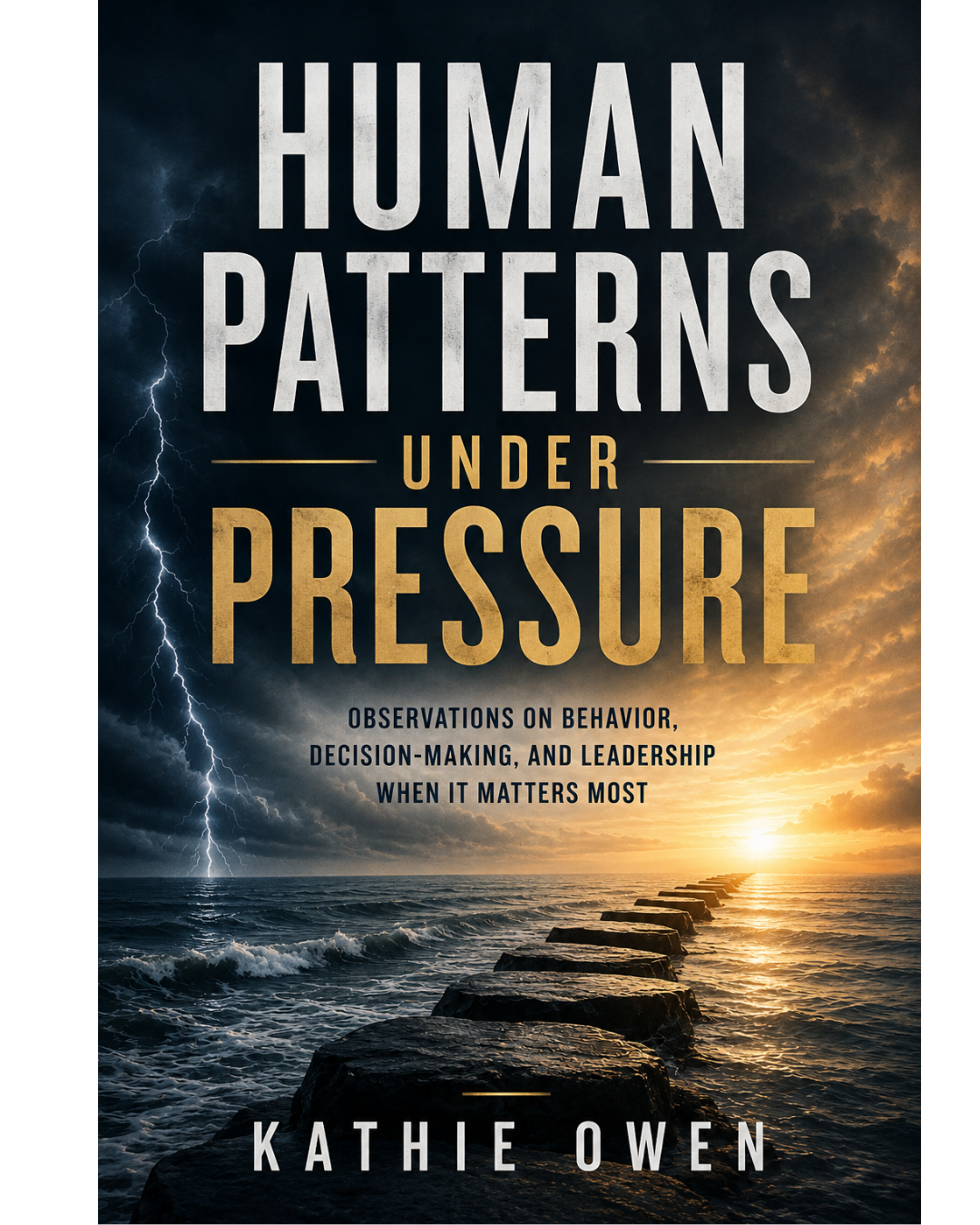
Kathie Owen is a private consultant, speaker, and author of Human Patterns Under Pressure and The Truth Bubbles Up, with more than 25 years of experience across fitness, corporate wellness, and leadership, and an academic background in psychology.
Based in the Houston area, she focuses on human patterns under pressure and the behaviors that shape relationships, leadership decisions, and workplace dynamics.
Her work brings together non-attachment, radical responsibility, and courage to help people pause, observe, and choose with greater clarity.
She hosts The Kathie Owen Perspective, where she shares practical insights drawn from her professional work and lived experience.
Hello, World!
Read More Articles from Kathie


Transcript
Today, I am going to answer my most frequently asked question when I talk about human patterns under pressure, either on stage, in consulting gigs, and even with my friends. They say, "Kathie, how do I practice non-attachment? I have tried, and this is where I get stuck," they tell me. So let's get to it. Have you ever been disappointed in someone? Maybe they didn't do what you thought they would do. Maybe something you were excited about didn't turn out the way you had pictured it, and then you kept thinking about it. They should've done this. It should've happened this way. Why is this happening? I have been there, and one question I get asked when I speak on stage about non-attachment is, "How do you actually do that? How do you let go?" And today, I wanna answer that question through my own experience because non-attachment is the first principle in my process, and to me, it means letting go of what you think things should be like. There's that word, should. Welcome to the Kathie Owen Perspective podcast. My name is Kathie Owen. I am a private consultant and speaker with more than 25 years of experience across fitness, psychology, organizational dynamics, corporate wellness, and leadership. My work focuses on human patterns under pressure. When pressure hits the room, I have noticed we lose our peace first, then our power, and then our presence, usually in that order. We get pulled into urgency. We want to know. We want to be correct. We want the situation settled. That is where the human mind jumps in to solve pressure situation. And our human minds are fallible. Ego, or, as I like to say, edging God out, gets selfish and cannot see the bigger picture. My process begins with a pause, because the pause allows us to see the situation differently, and let's put the ego on the shelf for a minute during that pause. We can observe, we can see the patterns playing out, and we can bring awareness to the pressure. Awareness creates choice, and this is where our power returns. And three principles that guide the process that I teach are non-attachment, radical responsibility, and courage. And today, we're gonna talk about non-attachment. Let's say you have a picture in your mind of how something should happen. That's totally human. How someone should treat you, how your business should grow, and how your family should behave. There's that dirty word, should. And know that you may have good reasons for wanting those things, but when you keep fighting everything that doesn't match that picture, it can take up so much of your attention and energy that you stop seeing what else is available. And that is where the pause comes in. When you pause, you create space. And in that space, you can begin to see more information, more perspectives, and more possibilities. But you have to make a conscious effort, especially in the beginning of understanding this, or where pressure hits the situation. Pressure reveals patterns, as I always say, and if you watch closely, you're gonna start to see those patterns. So today, let's observe the patterns because that is where we get our power back. Let me give you some personal examples of letting go or non-attachment. I can remember a time where I made that choice with my sons. There were things that were happening with their father that I could not control, and I was spending an enormous amount of attention and energy on what their father was doing and how I thought things should be different. I remember reaching a point where I said, "You know what? I am not gonna keep resisting this. Let him do what he's doing." And I'm going to focus on what I've got to do. Remember, what you resist persists, and that is key to remember in non-attachment. What I let go of was my insistence or my resistance to the thought that I had to change what their father was doing before I could move forward. I brought my attention back to my own choices. What could I do? How could I show up? What was mine to take care of? That is a very real example of non-attachment for me, and I remember the decision. I remember the space that it allowed me to actually live my life. It was like freedom all of a sudden entered the picture. That decision is something you may have to make more than once, and you might release something in the morning and find yourself arguing with it again by lunch. No shame, no condemnation. I love to say that. I always remind myself of that. No shame, no condemnation of yourself and others. You notice now you get to choose again. So I've seen this in the workplace, too. You can spend so much time thinking about how people should lead, how they should communicate, or how they should handle a situation. There's that word again, should. And sometimes there really is something that needs to be addressed. But there's also a point where you are no longer doing anything useful with that information. You're just carrying it around like huge suitcases. You leave work, but the conversation comes home with you. You're walking around your kitchen still explaining your point to someone who is not there. Or let's make this even more awful. You're spending time with your family at a fun event, but in your mind, you're still going back to that situation that you can't fix, and you're not in the present moment. I know that experience all too well. For me, letting go means noticing when I'm doing that and asking, where am I putting my attention right now? Am I thinking about something I can act on, or am I replaying what I wish someone else would do? Then I can bring my attention back to my work, my choices, and the direction I want to go. To me, that's freedom. You know, I can still speak up. I can still make a decision, but I don't need to keep having the same argument in my mind all evening. I've been listening to David Bayer, and something he talks about has really stayed with me. A lot of things he talks about have stayed with me, but he talks about turning the other cheek in these situations. And in the Bible, Jesus talks about turning the other cheek in Matthew 5:39. "If anyone slaps you on the right cheek, turn them the other cheek also." So when I reflect on that teaching, I see connection to non-attachment in my own life. I can notice what's happening without letting it hook me into another reaction. I turn my attention toward God, toward my higher self, the universe, whatever you call it, and I create space to see another way forward. I see something happening that I don't like, maybe my ego doesn't like it, and I feel the pull to get into it, to judge it, to keep thinking about it, and then I consciously turn toward something else. What becomes available when I stop staring at this one thing? What might I see from a different perspective? What do I want to give my attention to? That's how turning the other cheek connects with non-attachment for me. So there's a wedding situation going on in my own life where I have been practicing this for months. I had thought about how things should be, and when I kept looking through those expectations, I kept finding things to react to. When I loosened my attachment to how it should happen, I found that I could see a whole lot more. I could notice patterns without having to make a whole case about them. Oh, okay, that's a pattern playing out over there. No shame, no condemnation on myself or others. And sometimes I think of it as theater There's a scene playing out, and I can observe it without needing to jump into every scene. I don't have to figure everybody out. I don't have to know exactly why someone did something. I can notice what I notice and decide what I want to do next. And sometimes what I want to do is just take a walk. That might sound simple, but this is where the practice becomes real and very practical. Because if I say I'm letting go and then spend the next three hours watching it take- talking about it and replaying it, I'm still giving it my attention, my fuel, my energy. I need somewhere else for my attention to go. And when I took my attention somewhere else, AKA turned the other cheek, I found out that what I thought I wanted really wasn't that at all. I want to bring that back because what I thought I wanted really wasn't that at all. So take my sons, for example. I realized my relationship them was not dependent on their father and his behaviors, which actually deepened our relationships. Our relationships together deepened because I let go of what their father was doing. Take the workplace example. I realized that in that space, AKA the pause, that what I thought I wanted was not going to elevate me to the next level, and I let go. Take the wedding situation. I realized in that pause that the environment was not a healthy place for me personally, and instead, I found an opportunity in my life to focus on that which was healthy for me and actually led me to my true desires. Everything appeared to disappear. All of those thoughts that I was having, they appeared to disappear. As it says in scripture, 2 Corinthians 4:18 notes that the things which are seen and temporary and fleeting are passing away, while unseen things are eternal. So this is why I want to talk about hobbies, meditation, going outside, taking a walk in nature. What do you enjoy doing that lets you become interested in something else? Get away from the phone. Get away from the distractions. Get away from those thoughts just for a moment. You know, I'll tell people to do their meditation or practice a hobby because meditation may be not for you. No, don't talk about that. Cut that. Maybe you like to garden. Maybe you like to paint, cook, exercise, or work on a project. For a little while, your attention is on what's in front of you. You're learning something. You're making something. You're enjoying something. Your life gets some room again. That is the pause, the space between the pressure and your mind. When I walk outside in nature, there are things to notice that have nothing to do with what I was upset about. A bird, the trees, something happening at the pond, and I can choose to pay attention. I can be halfway through a walk and realize I've spent the whole time having an imaginary conversation. That's my opportunity to come back and actually experience the walk. Meditation gives me another place to practice, and I do this often. A thought comes up, I notice it. I don't have to follow it through every possible conversation and outcome. And sometimes after I've been quiet, I see something totally differently. An idea comes to me. I remember an option that I hadn't considered, or for me, I have an insight or a download to something I had never thought of before. Talk about powerful. I don't force that to happen either. I give it room. This also connects with reality transurfing, especially the ideas of importance and pendulums. The way I use dropping importance is to notice when I've made one outcome feel like everything depends on it. This person has to understand me. This opportunity has to work. This event has to go the way I pictured it. That's a lot of pressure to put on one thing, and when I drop importance, I allow more than one forward. I allow God, the universe, my higher power, whatever you call it, to provide me with the space I needed to let go and see the bigger picture. And pendulums give me a way to recognize that pull to keep reacting. Pendulums in reality transurfing are just energy thought structures that want my energy. They prod for it. They can be quite powerful if you allow it, and usually that happens when you are in ego. Also known as edging God out. Something happens and I'm hooked. I want to defend myself. I want to explain. I want to check it again. And then I notice, oh, I'm getting pulled into this. That moment of noticing matters. That's the pause. So you can pause. Then I turn my attention. I can turn the other cheek. I can go do something that brings me back into my own life. So if you're asking, how do I let go of attachment? Start with something specific. What do you keep telling yourself should be different? Notice the expectation, then pause before you feed it with another round of thoughts. Ask yourself, "What is mine to do here? Where can I pause?" Give your attention somewhere to go. Take the walk. Spend some time with your hobby. Sit quietly. Return to the work you want to do. You may still feel disappointed. You may still get hooked again. But each time you notice, you have another opportunity to practice. For me, non-attachment is that conscious choice to stop holding on so tightly to how I think things should be. I let the moment be what it is. I take care of what is mine, and I make room to sit with what else is possible. That's where I begin. No shame, no condemnation, just a pause, a choice, and some space. If you'd like to go deeper on this, I have wrote a blog post that is linked at kathieowen.com for this episode and resources to help you explore these questions. In fact, my book, The Truth Bubbles Up, which is now on Amazon and also on my website, you can learn more about these processes and exactly how I did this back in the day when I was going through this with my sons and in fact, even with the workplace, and I still go through it today. However, I have a different perspective, and you might wanna look that, at that and I'll have links to that in the show notes and description below. And if you're watching on YouTube, it'll be linked in the first comment so it's easy to see. If you'd like to work with me privately, bring this conversation to your leadership team, or invite me to speak at your event, you can learn more and reach out through my website. Like this video and subscribe if you'd like more conversations like this. And remember, pause long enough to see beyond how you think it should be. Then choose from what you can see now. That is non-attachment, and that is freedom. All right, that's my episode for today. I trust that you found it helpful, and you may wanna listen to this a few times to let it sink in. And if you know someone who could benefit from this, please share it with them, and I will see you in the next episode of the Kathie Owen Perspective podcast

Learn how to practice non-attachment, let go of expectations, and stop carrying workplace stress into your personal life. Kathie Owen shares personal stories, Reality Transurfing insights, and simple ways to create space through meditation, hobbies, and nature walks.
#NonAttachment #LettingGo #RealityTransurfing #WorkplaceStress