
Your Mind Blueprint: Can You Change the Pattern?

When Anxiety Enters, Where Does Your Power Go?
Anxiety just entered the room.
Nobody else could see it, but I dang sure could feel it.
It was February 2007. I was working as a fitness trainer and was the only female trainer at the gym.
I stepped into the locker room and checked my phone.
There was an email.
My former husband usually wrote his entire email in the subject line. Technology was not his thing. But this message looked different. I believed I recognized his wife’s writing.
There had been painful messages before. Accusations that I was abandoning my children. That I was a bad mother.
Those words carried so much weight.
I walked out of the locker room crying. The other trainers had never seen me like that.
“What happened?”
“I have to leave,” I told them. “I just have to leave.”
I got into my car and drove down a road I had traveled for at least ten years.
Suddenly, I could not recognize where I was.
A familiar road. A familiar place.
And I felt completely lost.
My therapist later helped me understand that frightening experience. A year earlier, in 2006, I had received a clinical diagnosis of complex post-traumatic stress disorder. I was living through a custody battle that would last fourteen years.
I could not have explained my patterns that day. I was trying to get through the moment.
Understanding came over many years.
The connection between anxiety, presence, and choice
Today, I am a private consultant, author of The Truth Bubbles Up, and creator of Human Patterns Under Pressure. My background includes psychology, more than two decades in fitness and wellness, and years working inside a corporate environment.
I work with individuals, leaders, and teams to recognize the patterns that show up when pressure rises.
That work has roots in learning to recognize my own.
Looking back at the gym, I can describe my experience this way:
First, I lost my peace.
Then, I felt like I lost my power.
Then, it felt like I lost my presence.
Over time, I came to understand presence differently.
For me, presence is awareness. It is the ability to notice a thought, feel an emotion, or recognize that I am rehearsing an argument.
In my spiritual understanding, that presence remains available even when I struggle to feel connected to it.
When I become absorbed in a fearful story, my attention follows it. My sense of choice gets smaller. My peace feels farther away.
Returning to presence helps me reconnect with both.

Is court still in session inside your head?
For years, I carried a courtroom inside me.
Someone would say something painful, and I would begin preparing my case.
I explained my intentions. I imagined their reply. Then I prepared my answer to that reply.
I found more evidence. Called another witness.
All while making lunch or driving to work.
Meanwhile, the other person might have been having a perfectly ordinary afternoon.
Inside my head, court was still in session.
I wanted people to understand that I was a good mother. I wanted the truth to be obvious.
There was real pain behind that desire. But replaying imagined arguments gave the pain more of my time and attention.
Eventually, I began to recognize the route I kept taking.
I call it a mind blueprint.
What is a mind blueprint?
A mind blueprint is my term for a familiar pattern of thinking and responding.
Something happens. We give it meaning. We speak or act from that meaning. With repetition, the response can become a habit.
Under pressure, one person becomes controlling. Another withdraws. Someone becomes critical. Someone else takes on every problem.
These patterns can be easy to recognize in other people.
We hear the sharp tone. Notice the silence. See the sudden need to check every detail.
Recognizing our own patterns takes practice.
It begins with watching.
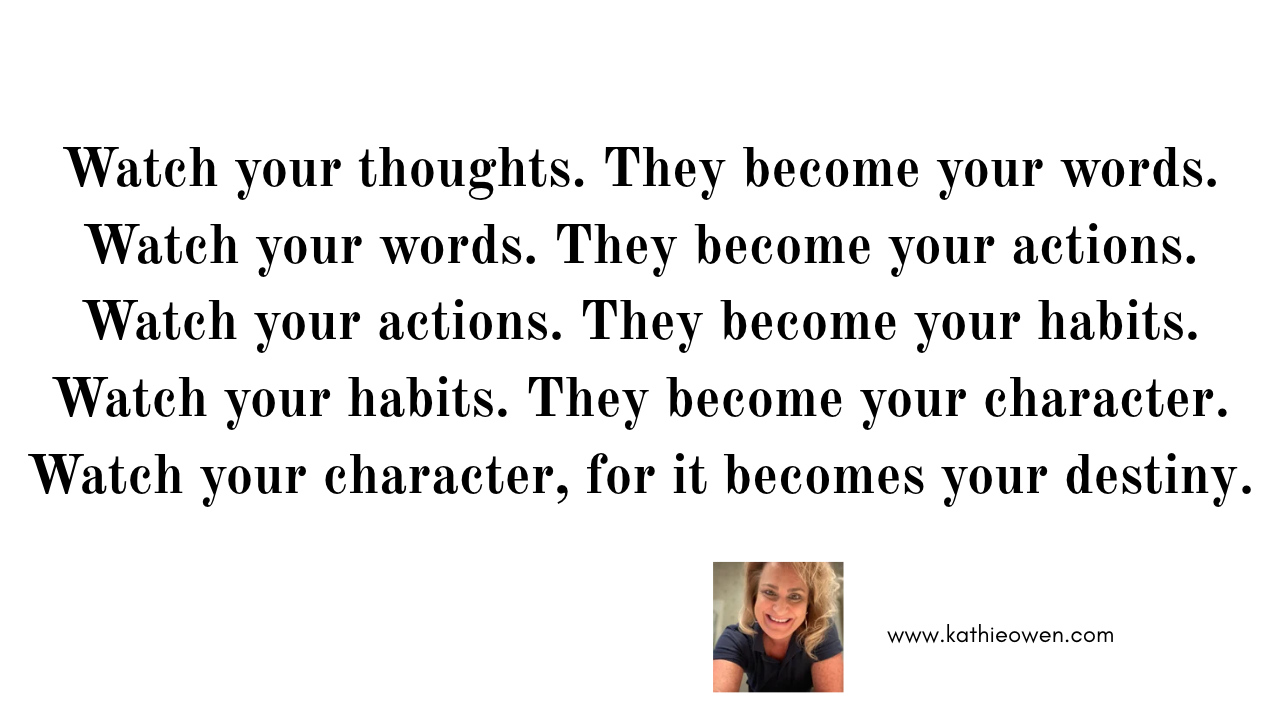
Every “watch” offers another pause
I keep this passage on my refrigerator:
Watch your thoughts. They become your words.
Watch your words. They become your actions.
Watch your actions. They become your habits.
Watch your habits. They become your character.
Watch your character, for it becomes your destiny.
Notice the word before every part.
Watch.
Each “watch” can become a pause.
You can notice a thought before building a whole scene around it.
You can hear yourself telling the same story again.
You can recognize an action while you are taking it.
You can notice a habit after years of repeating it.
There is forgiveness in that.
You may think, “I already said it. I missed my chance.”
You can pause now.
You can say, “Let me try that again.”
You can repair a conversation or make a different decision.
Awareness does not need to become another reason to criticize yourself. The moment you notice gives you somewhere to begin.
The serpent and the tempting story
The serpent in Genesis gives me a spiritual picture for this process.
This is how I connect that story to my own life: the serpent represents the tempting invitation to follow a deceptive story.
“You know what they meant.”
“You need to defend yourself.”
“This always happens to you.”
Sometimes the invitation sounds like preparation. Sometimes it sounds like responsibility.
I have learned to ask:
“Am I addressing something that needs attention, or am I entering the courtroom again?”
The temptation can appear at every “watch.”
You notice your words, and another thought says, “They deserved it.”
You recognize a habit: “That is just who you are.”
You decide to begin again: “You should have figured this out years ago.”
Watching gives me room to question that invitation.
In my spiritual understanding, awareness is where I reconnect with God. You may use another name for that connection.
For me, presence has a quiet steadiness. It allows me to notice that I have been arguing and choose how I want to respond.
After the pause: using imagination with intention
Lately, I have been practicing something that goes beyond noticing the courtroom.
I have been changing the scene in my imagination.
Neville Goddard taught a spiritual practice he called the pruning shears of revision. It involves revisiting an experience in imagination and reshaping the scene to reflect an ideal you want to experience.
That teaching has become meaningful to me.
I know how absorbed I can become in a painful inner scene. I began exploring what happens when I give a different imaginative scene that same attention.
A scene with relief.
Understanding.
Freedom.
An experience of being loved, supported, and at peace.
For me, the pause creates room to choose that imaginative act.
From the courtroom to the garden
Imagine you keep replaying a conversation where you felt dismissed.
Each time you remember it, you begin explaining yourself again.
You notice. You pause.
Then you create a different inner scene.
Perhaps you imagine a kind conversation where you feel heard. You picture yourself leaving with a sense of lightness.
My own preference is often a symbolic scene.
Picture yourself walking out of the courtroom into a beautiful garden.
You leave the papers behind.
The door closes.
Sunlight touches your face. Animals move through the garden. You have somewhere else to go.
You allow yourself a moment to experience that relief.
You know what actually happened. You can still address it. Revision is an intentional imaginative practice, rather than a replacement for the facts.
What changes is the scene receiving your attention.
In my experience, the shift can feel profound. The argument stops occupying the whole space. The tension loosens its grip.
The thoughts “appear to disappear.”
That describes how it can feel for me. The situation may still need attention, but the inner battle is no longer taking all of mine.
I reconnect with presence. My sense of power and peace returns.
Power, presence, and peace belong together
Here is how I use these words:
Presence: the awareness that allows me to notice what is happening.
Power: my ability to choose where I place my attention and how I participate.
Peace: a greater sense of inner steadiness.
They work together in my practice.
I may still feel uncomfortable. I may still have an unresolved problem. But I can reconnect with awareness and consider my next step.
Professional support has been part of my journey, too. My work with counselors, mentors, and coaches has mattered deeply.
These spiritual practices are part of my experience. Difficulty with anxiety does not mean someone has failed at faith or imagination.
Three principles that help me return
Non-attachment
Non-attachment helps me loosen my grip on the original scene.
I can release the demand that someone must say the perfect words before I allow myself to experience relief.
I can care about what happened and still give my attention somewhere else to rest.
Radical responsibility
Radical responsibility brings me back to what is mine.
What am I rehearsing?
Where am I placing my attention?
What action is needed now?
I can take responsibility for my next response without taking blame for someone else’s behavior.
Courage
Sometimes courage means having a difficult conversation.
Sometimes it means setting a boundary.
And sometimes it means putting down the imaginary case while the situation remains unresolved.
I have been learning to become more comfortable with uncertainty. Presence helps me consider what needs action and what I can allow to remain unanswered for now.
Putting down the imaginary defense
A Course in Miracles includes the words:
“In my defenselessness my safety lies.”
I connect that teaching to the courtroom inside my mind.
How much energy was I spending proving who I was to an imaginary audience?
In my practice, this means releasing some of that inner argument while remaining clear about boundaries and seeking help when needed.
Another passage says:
“Nothing real can be threatened. Nothing unreal exists. Herein lies the peace of God.”
I reflect on those words when I catch myself treating an imagined future as a settled fact.
The event I lived through mattered. My pain mattered.
But the next accusation I am rehearsing may never happen.
Can I recognize what I am adding?
Can I return to presence and choose what I practice within myself?
A reminder from the seat beside me
Recently, a client happened to be sitting next to me at a meeting.
Something happened during a contest that we both believed was wrong.
It bothered us. We started talking about it and getting pulled into it.
Then he said, “Non-attachment. Non-attachment.”
I went, “Ah!”
He started cheering for himself. He had caught it.
And I told him, “The student and the teacher are one.”
He was reminding me.
We still had concerns about what had happened. But we could recognize the pull, loosen our grip, and choose our response.
That is what I love about this work. It becomes useful in the middle of a real day, sometimes with a laugh from the person beside you.
Why these patterns matter in leadership
My experience in 2007 happened at work.
My coworkers saw me crying. They could not see everything that had led to that moment.
That understanding helped shape the questions I bring into workplaces today.
What changes when someone feels challenged?
What happens when the stakes rise?
What keeps repeating?
Consider a hypothetical founder who receives an email from the board:
“We need to discuss the numbers.”
Before the conversation happens, the founder imagines criticism and rehearses a defense.
By the next team meeting, they are impatient. They interrupt answers and check every detail.
People become careful about what they say.
A concern that needs discussion may go unspoken.
An inner story can influence behavior. That behavior can affect what information reaches a leader and how decisions are made.
During growth, succession, or an acquisition, those conversations deserve attention.
In my consulting work, I observe conversations, meetings, and recurring responses. I work with people to understand what is happening and identify practical changes.
A leader may value open discussion while responding sharply to disagreement. Recognizing that gap gives us somewhere to work.
Presence becomes practical in how a leader listens, asks questions, and follows through.
Try this with an everyday frustration
You do not have to lead a company to recognize a mind blueprint.
It can appear in a relationship, a family conversation, or a message you keep rereading.
Start with something manageable.
Notice the replay. What scene keeps returning?
Pause. Feel your feet against the floor and look around.
Separate the event from the added story. What happened? What are you assuming?
Choose an inner experience. Would relief, dignity, or feeling heard be helpful?
Create a brief scene. Imagine a kind exchange or a peaceful, symbolic place.
Return to the present. Is there a useful action to take?
If the exercise feels overwhelming, return your attention to your surroundings and seek support. There is no need to force a scene.
Have a conversation with me
Perhaps you keep rehearsing the same argument.
Perhaps you are navigating a transition and want help understanding your responses.
Or perhaps your leadership team keeps encountering the same tension in meetings and decisions.
I work with individuals, leaders, and corporate teams to recognize those patterns and identify practical ways forward.
We can discuss what you are noticing and whether my consulting work is a fit.
Return to this article or the episode when you need a reminder. On one visit, notice your thoughts. On another, pay attention to your words, actions, or habits.
Share it with someone who may find it helpful.
Anxiety may still enter the room in my life. When I notice it, I have a practice I can return to.
Watch. Pause. Choose.
That is where I reconnect with my power and find my peace.
And I am still practicing.
About the author

Kathie Owen is a private consultant, author of The Truth Bubbles Up, and creator of Human Patterns Under Pressure.
With a background in psychology, more than two decades in fitness and wellness, and experience as a corporate wellness director, she helps individuals, leaders, and teams recognize behavioral patterns under pressure.
Her work centers on non-attachment, radical responsibility, and courage, with a focus on leadership, working relationships, and high-stakes transitions.
Read More Articles from Kathie








Transcript
Anxiety just entered the room. Nobody else could see it, but I dang sure could feel it. It was February 2007. I was working as a fitness trainer, and I was the only female trainer at this gym. I stepped into the locker room and checked my phone. There was an email My former husband had a habit of writing his entire email in the subject line. Technology was not his thing. But this message looked different, and I believed I rec- recognized his wife's writing. There had been painful messages before, accusations that I was abandoning my children, that I was a bad mother, and those accusations carried so much weight for me. I walked out of the locker room crying. The other trainers looked at me. They had never seen me like that. "What happened?" "I have to leave," I told them. "I just have to leave." And I got into my car and started driving down the road I had traveled for at least ten years at this time. And suddenly, I did not notice where I was. A familiar road, a familiar place, and I could not recognize it. My therapist later helped me understand that experience. I had a full-blown panic attack, and a year earlier, in 2006, I had received a clinical diagnosis of complex post-traumatic stress disorder. I was living through a custody battle that would last 14 years. That day became one part of a much longer journey, a journey that eventually helped me understand the connection between my imagination, my patterns, and what I now call power, presence, and peace, and how the truth bubbles up, always. Welcome to the Kathie Owen Perspective podcast. My name is Kathie Owen. I am a private consultant, the author of the book The Truth Bubbles Up, and creator of Human Patterns Under Pressure. My background includes psychology, more than two decades in fitness and wellness, and years working inside a corporate environment. Today, I work with individuals, leaders, and teams to recognize what happens when pressure rises and how these patterns affect their lives, their relationships, and their work. Today, I want to share where this began for me and something I have been practicing lately that has made this work even more meaningful because the pause opens a door. What we choose to imagine after that pause matters, too. When I look back at that day, I can describe it this way. First, I lost my peace. Then I felt like I lost my power. Then it felt like I lost my presence. Everything became consumed by what was happening inside of me. Over time, I came to understand presence differently. For me, presence is awareness. It's that part of me that can notice a thought, notice a feeling, notice that I am rehearsing an argument again and again and again. I have come to understand that presence is always there, even when I struggle to feel connected to it because I am caught up in my mind. My attention can become so wrapped up in a story that I lose touch with that awareness. And when I follow the story, my peace goes with it, too. My sense of choice gets smaller, smaller, and smaller until it becomes a panic attack or even just simple anxiety inside my body. And the practice has become learning to recognize that moment and return to presence, AKA the pause. This is where the truth resides, and that is where I reconnect with my power and my peace because the good news and the bad news is anxiety never goes fully away. Anxiety is just our nervous system giving us a response. For years, I carried a courtroom inside of me. Have you ever done that? You know, someone says something painful, and you start preparing your case. You explain what really happened. You imagine what they will say next, then you prepare your answer to that. You will find another piece of evidence. You will call another witness. You are doing all of this while making lunch or driving to work. This is the way our mind works. It thinks it's helping us, and the other person may just be going about their day. Meanwhile, court or your mind is still in session inside your own head. I knew that courtroom very well. As a pattern recognizer, I saw the patterns very, very clearly. And not only that, I had my own patterns I was living in. So I wanted to prove that I was a good mother. I wanted people to understand my intentions, and I wanted the truth to be obvious to everyone. There was real pain behind those feelings. That's anxiety. But the imagined arguments gave that pain more of my time and attention. I could replay a conversation and keep adding to it and adding to it. Then I would feel the distress again. That was part of what I began to recognize as what I call my mind blueprint. A mind blueprint is the name I give to a familiar pattern of thinking and responding. Something happens, we give it meaning, we speak or act from that meaning, and with repetition, that response can become a habit. For one person, pressure brings control. For another, withdrawal. Someone else becomes critical. Someone takes on everything because asking for help feels uncomfortable. These patterns can become easier to see in other people. We recognize the tone, the silence, the sudden need to check every detail. But recognizing our own blueprint, hmm, requires watching. And that brings me to a passage I want you to hear. I actually have this passage on my refrigerator, so I can see it daily and see it often. I invite you to write this down, or if you're watching on YouTube, screenshot this so that you catch this as well. Watch your thoughts, they become your words. Watch your words, they become your actions. Watch your actions, they become your habits. Watch your habits, they become your character. Watch your character, for it becomes your destiny. What word comes before every part? Watch. Every watch offers another opportunity to pause. Watch your thoughts. Can you notice a thought before you build a whole scene around it? Watch your words. Can you hear yourself telling the story again? Watch your actions. Can you recognize what you are doing while you are doing it? And watch your habits. Can you notice the route that you keep taking, the same habits that you fall into to kind of ignore the thought? And watch your character and the ways you keep showing up aligned with the person that you want to be. There is forgiveness in every one of those moments, and I love this. You may think, "Well, I already said it. I missed my chance." You can pause now. You can say, "Let me try that again." You can repair something. You can make a different choice. You can recognize a habit after years of repeating it and begin practicing another response. You do not have to turn awareness into another reason to criticize yourself. The moment you notice is useful. That is presence, and presence gives you access to choice. There is a spiritual picture that helps me understand this. That's the serpent in the garden in Genesis. The serpent is deceptive, cunning, sneaky, and very tempting. Here is how I connect that story to my own life. I see the serpent as tempting invitation to follow a deceptive story. You know what they mean. You need to defend yourself. This always happens to you. It can be very, very sneaky. Sometimes it sounds like preparation, sometimes it sounds like being responsible, but I have learned to ask, "Am I addressing something that needs attention, or am I entering that courtroom again?" The serpent can show up at every watch. You notice your words, and then the next thought says, "Well, they deserved it." You notice a habit, and the next thought says, "This is just who you are." You decide to begin again, and another thought says, "You should have figured this out years ago." There is the invitation. Will I follow it, or can I return to awareness? In my spiritual understanding, awareness is where I reconnect with God. You may call that connection the universe or use another name. For me, presence has a quiet steadiness. It does not need to win the argument. It allows me to see that I have been arguing. I may still feel fear in my body, but I can begin listening from a steadier place. That is where alignment becomes possible. My words and actions can begin to match what I value Now here's the part I want to spend some time on. Lately, I have been practicing something that goes beyond noticing the courtroom, and it has been very, very helpful. I have been changing the scene in my imagination. Our imagination is very powerful, but when we feel anxiety, we tend to turn that imagination against ourselves, which creates a vicious cycle. Instead, I invite you to try something different. Neville Goddard taught a practice that he called the pruning shears of revision. He described revisiting an experience and imagination and reshaping the scene to reflect the ideal you want to experience. That teaching has become very meaningful to me because my imagination can be very vivid. You noticed the panic attack I had, right? I know how deeply I can become absorbed in a painful scene. That's how powerful my imagination can be. So I began exploring what happens when I create a different inner experience with that same attention. I trick my subconscious mind 'cause it doesn't know the difference. I'm just saying. I trick it with a scene with relief, understanding, freedom, a scene that lets me experience myself as love, supported, and at peace. That pause gives me the room to choose that imaginative act. Let me give you an example of what this could look like. Imagine you keep replaying a conversation where you felt dismissed. Every time you remember it, you begin explaining yourself again, and you are back in the courtroom. You notice. You pause. Then you choose to create a different scene in your imagination. Perhaps you hear the person say, "I understand what you are trying to tell me." Perhaps you imagine a kind conversation where you both feel heard. You picture yourself leaving with a lightness in your body. You let yourself experience that relief for a moment. Or what I prefer to do is a completely symbolic scene. My subconscious mind loves that because it is very, very imaginative, and I actually prefer to do something like this. Imagine walking out of the courtroom into a beautiful garden. You leave the papers behind, the door is closed, there's sunlight on your face, there are animals everywhere, and you have somewhere else to go. You can create an image that has personal meaning for you. You know what actually happened. You can still address it. The revision is an intentional inner practice for your subconscious mind rather than a replacement for the facts. What you are changing is the scene you keep rehearsing. You are giving your attention another place to rest. I have been doing this on my own lately, and the shift can feel very, very profound. I became so absorbed in the imaginative scene that arguments stopped occupying the whole space. The tension loses a lot of its grip. The thoughts that I felt so loud, guess what? They begin to fade. They appear to disappear. That is the phrase that comes to mind. That describes how it can feel. It appears to disappear. The situation may still need attention, but the inner battle is no longer taking all of mine. I let go of that grip and that force. I love that. I feel connected to my presence again, and with that connection, I can feel my power and peace returning. My power is the ability to choose where I place my attention and how I participate. My peace is that greater inner steadiness. My presence is the awareness that makes the choice even possible, and they all belong together. That is my experience of a spiritual practice. I would never tell someone that difficulty with anxiety means they failed at imagination or faith. Professional support has been a part of my journey too, and I speak about how profound my work with my counselors, mentors, and coaches in my life have been often on my channel and even in my books. So my three principles are woven through this, and they are very helpful. Those three principles are non-attachment, radical responsibility, and courage. Non-attachment allows me to release my grip on the original scene. I can stop demanding that the other person must say the perfect words before I allow myself to experience relief. Radical responsibility brings me back to what is mine. What am I rehearsing? What am I thinking? What am I saying words to? Where am I placing my attention? What action is needed now? And I like when I get in touch with my presence at that point, because the action just comes. It's synchronistic. It's the bridge of incidents that Neville Goddard talks about. And I can take responsibility for those things without blaming anyone for their behavior or what happened. And courage helps me practice something unfamiliar. Sometimes it takes courage to put down the case, to stop checking whether everyone agrees with you, to allow yourself a peaceful moment while something remains unresolved. I actually have learned to fall in love with uncertainty, because when you can fall in love with uncertainty, that is acceptance, and it's also can make it magical. Try it. And sometimes courage means having the conversation or setting the boundary, and presence helps me discern the next step. A Course in Miracles says, "In my defenselessness, my safety lies." I connect that teaching to the courtroom inside my mind. How much of my energy was going into proving who I was? I didn't need to prove anything to the stepmom. I didn't need to prove anything to anybody. And how many times did I need to present my case to an imaginary audience? How many times did I need to do that to an imaginary audience in my mind? The energy wasted there was immense. In my own practice, defenselessness means I can release some of that inner argument. I can remain clear about my boundaries. I can seek help, and I can stop spending every quiet moment preparing a defense. In fact, my quiet moments are spent relaxing into the flow. A Course in Miracles also says, "Nothing real can be threatened. Nothing unreal exists. Herein lies the peace of God." I reflect on that when I catch myself treating an imagined future as a settled fact. The event I lived through mattered. The pain mattered. But the next accusation I am rehearsing may not have happened and may not ever happen. Can I recognize what I am adding? Can I return to presence and choose what I practice within myself? So recently, a client of mine happened to be sitting next to me in a meeting. Something happened during a contest that both of us believed was wrong. It was bothering us. We were talking about it, getting pulled into it, and he said, "Non-attachment. Non-attachment." And I went, "Ah." Then he started cheering for himself. He had caught it, and I told him, "The student and the teacher are one," because he was reminding me. We were learning together in that moment. We still had concerns about what had happened, but we could recognize the pull, loosen our grip, and choose how we wanted to respond, and that is what I love about this work. It becomes useful in the middle of a real day, and sometimes it comes with a laugh from the person sitting beside you. Where does this meet leadership? My experience in 2007 happened while I was at work. The other trainers saw me crying. They could not see everything that had led to that moment. Over time, that understanding shaped the questions I brought into workplaces. What is happening when someone feels challenged? What changes when the stakes rise? What keeps repeating? Imagine a founder receives a brief email from the board. "We need to discuss the numbers." And before that conversation happens, the founder begins imagining criticism. They rehearse defending the business. By the time they meet with their team, they are impatient. They interrupt answers. They check every detail. People become careful about what they say. That is a hypothetical example, but you can see the connection. An inner story can have influence in a leader's behavior. That behavior can affect what information reaches them, and that information affects decisions, which also affects enterprise value. This is where my consulting work comes in. I observe conversations, meetings, and recurring responses. I work with people to understand what is happening and identify practical changes. A leader might discover that they value open discussion but responded sharply to disagreement. That gap gives us somewhere to work. They can practice listening. They can rehearse receiving a difficult update with curiosity. They can enter the next meeting with a clearer intention and follow through in their behavior. Presence becomes practical. It shows up in how the room is led. Guess what, you Do not have to lead a company to recognize a mind blueprint. It can show up in a relationship, a family conversation, a career change, a message you keep rereading. You may be doing your job and getting through the day while carrying a loud inner argument. I know what that can feel like. My work with individuals creates space to examine those patterns, explore your choices, and practice responding with greater intention, and my work with leaders and teams brings attention into working relationships and decisions. In both settings, we begin by noticing. If you want to explore this, begin with an everyday frustration, something manageable. Notice the scene you keep replaying, then pause. Feel your feet against the floor. Look around. Ask yourself, "What happened? What am I adding?" Then consider, "What would I like to experience within myself instead?" Perhaps it is relief. Perhaps it is dignity. Perhaps it is a sense of being heard. Create a brief scene that carries that feeling. I can't tell you how powerful this is. You might imagine a kinder conversation. You might picture yourself closing a door and walking into a peaceful place. Let yourself spend a little time there. Then return to the present and ask, "Is there a useful action for me to take?" You're practicing both imagination and choice inside that pause. If the exercise feels overwhelming, come back to your surroundings and seek support. Ask a friend. There's no need to force a scene. When anxiety entered the gym that day, I could not explain any of this. I was frightened. I was overwhelmed. I was trying to get through the moment. Understanding came over many years. I mean, today, it's 20 years now. It came through support, through study, through observation, through practice, and beginning again. What I now understand is that I can become so absorbed in a story that I lose touch with my peace and my sense of power. But presence is something I can return to. I can watch. I can pause. I can choose what I rehearse in my imagination. I can choose an action that reflects what I value. That is part of how the truth bubbled up in my life and part of how Human Patterns Under Pressure began. If you recognize a pattern in your own life, we can have a conversation about it. Perhaps you keep rehearsing the same argument. Perhaps you are navigating a transition and want help understanding your responses. Perhaps you lead a company where the same tensions keep appearing in meetings, decisions, or working relationships. I work with individuals, with leaders, and corporate teams to recognize those patterns and identify practical ways forward. You can visit www.kathieowen.com and have a conversation with me. We can talk about what you are noticing and whether my consulting work is a fit. There is also an article that goes with this episode with bonus resources and more information about working with me. You will find the link in the show notes and in the description below and in the first comment on YouTube so it's easy to find. I encourage you to listen to this episode again, then come back to it another time. On one listen, pay attention to your thoughts. On another, notice your words, then your actions, then your behaviors, then your habits. Returning to the ideas can help keep them familiar. Practicing them gives you opportunities to notice a pattern in the middle of your day. You may remember one word when you need it, watch, or someone sitting beside you may offer the reminder. If this episode brought someone to mind, share it with them. It may open a helpful conversation. Anxiety may still enter the room. I'm gonna say that again. Anxiety will still enter the room, and when I notice it, I can return to presence. I can put down the imaginary case. I can create another inner scene, and from that awareness, I can choose my next step. That is where I reconnect with my power. That is where I find my peace, and I am still practicing. All right, that's my episode for today. I trust that you found it helpful, and if you know someone who can benefit from this, please share it with them, and I'll see you on the next episode of the Kathie Owen Perspective podcast.

Discover how to recognize anxiety, break negative thought patterns, and reconnect with power, presence, and peace. Kathie Owen shares her personal journey, practical self-awareness exercises, and Neville Goddard’s revision practice to support emotional regulation, mindful leadership, and personal growth.
#AnxietyAwareness #EmotionalRegulation #SelfAwareness #Leadership