
What Enron Taught Me About Psychological Safety

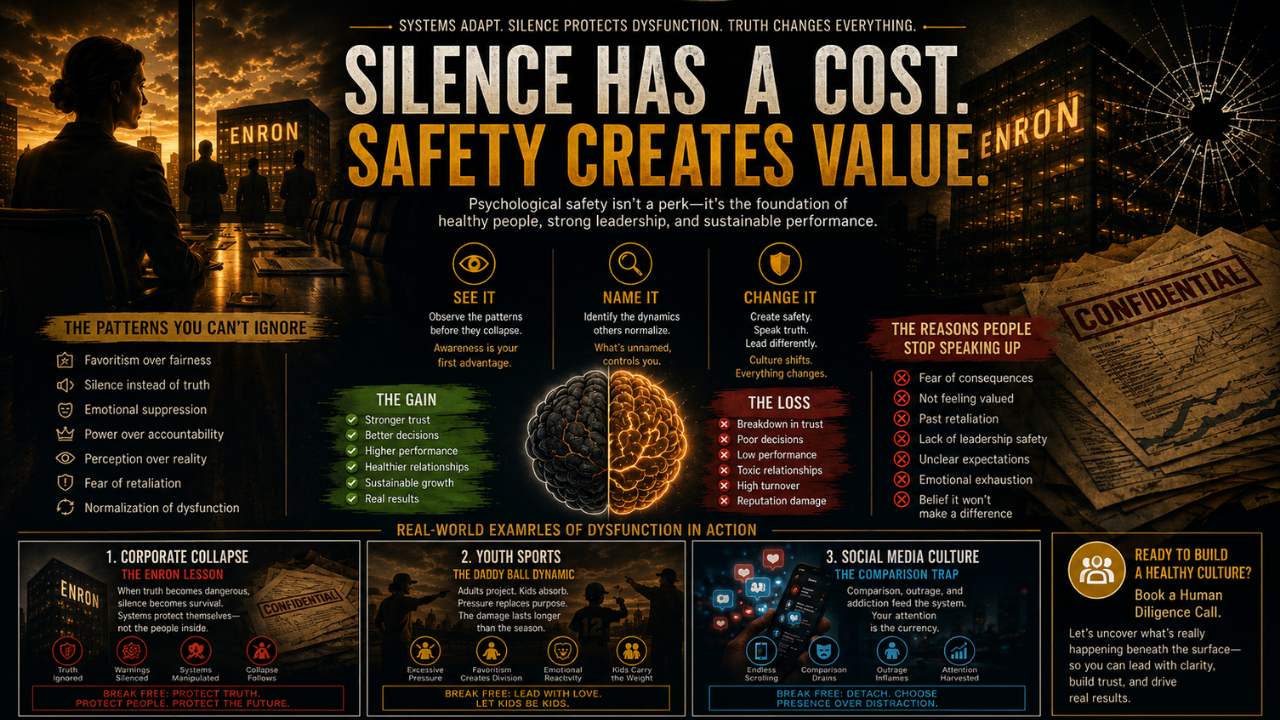
Systems Adapt to Dysfunction Long Before They Collapse
In the early 1990s, I was sitting in a downtown Houston office working as a contract administrator for MG Trade Finance.
Our New York office was on the line.
We were in video conference meetings constantly — something that still felt new at the time. High-pressure finance environments. Acquisitions. Fast-moving deals. Big personalities. Mostly male-dominated industries.
And that is where I first met Sherron Watkins.
Not through the media.
Not through history books.
Not through Enron.
I actually worked with her.
We worked in the same department.
And I remember observing her constantly.
I remember the way she dressed. The professionalism. The composure. The way she communicated in meetings. The way she carried herself. Even her body language stayed with me.
I admired her deeply as a young woman trying to find her place in corporate America at a time when women were just beginning to rise into major leadership roles in these environments.
Years later, the world would know Sherron Watkins as the Enron whistleblower.
And I still cannot fully explain what it feels like to watch people you knew professionally suddenly sitting in front of Congress during one of the biggest corporate collapses in American history.
Not celebrities.
Not people on television.
People you worked with.
People you spoke with regularly.
I knew Sherron professionally.
I knew Jeff McMahon professionally.
I watched them testify before Congress.
And something about that stayed with me for decades.
At the time, I did not fully understand why it affected me so deeply.
Now I do.
Because long before I had language for it, I was already studying human behavior under pressure.
The Part About Enron Most People Miss
When most people think about Enron, they think about financial fraud.
But what fascinated me even more was the human behavior underneath it.
Because systems do not collapse overnight.
They adapt first.
That is the pattern.
People slowly adapt to things they once would have questioned.
Behaviors become normalized.
Silence becomes strategic.
Truth becomes dangerous.
And eventually the system starts protecting itself more than the humans inside it.
That is what psychological unsafety does.
And honestly?
One of the things that still deeply affects me about the Enron story is watching what happened to Sherron Watkins afterward.
Here was a woman trying to speak truth inside a system that had adapted to dysfunction. (I felt that, it happened to me as I blew a whistle in corporate in 2024).
And instead of being celebrated immediately, she became controversial.
That matters psychologically.
Because psychologically unsafe systems often label truth-tellers as the problem.
Not because the truth is wrong.
But because the truth threatens the emotional stability of the system itself.
That happens everywhere:
corporations,
founder-led businesses,
families,
schools,
sports,
social groups,
and even online communities.
Once a system becomes emotionally organized around protecting itself, anyone disrupting that system can become viewed as dangerous.
That is an incredibly important leadership lesson.
Systems Adapt Quietly
One of the most dangerous things about dysfunction is that it rarely enters loudly.
Usually, it enters quietly.
Gradually.
Emotionally.
People adapt a little at a time until eventually the behavior no longer feels unusual.
“This is just how they are.”
“This is just how business works.”
“This is just how sports are.”
No.
That is adaptation.
And once adaptation becomes normalized, culture begins forming around the dysfunction itself.
I have seen this pattern everywhere.
I saw it in corporate finance.
I saw it in founder-led businesses.
I saw it in blue-collar environments.
I saw it in families.
And honestly, I saw it constantly in youth sports.
‘Daddy Ball’ and Emotional Contagion
If you have ever spent years around competitive youth sports, you probably already know exactly what “daddy ball” means.
Favoritism.
Politics.
Parents emotionally over-identifying with their children’s performance.
Adults unconsciously placing enormous emotional pressure onto kids whose nervous systems are still developing.
I watched parents scream at children from the stands.
I watched exhausted kids left on the mound because politics mattered more than emotional regulation.
I watched children blamed publicly for mistakes while entire groups normalized the behavior because nobody wanted to disrupt the emotional system.
And the heartbreaking part is this:
Most people involved are not trying to hurt children.
They are participating unconsciously inside emotionally charged systems.
That is what emotional contagion does.
The pendulum becomes so strong that people stop observing their own behavior objectively.
They react emotionally instead.
And once enough people emotionally feed the system, the dysfunction starts feeling normal.
That affects children profoundly.
Not just performance.
Identity.
Confidence.
Self-worth.
Emotional regulation.
Attachment patterns.
The nervous system remembers these environments long after the game ends.
Psychological Safety Is Not an HR Buzzword
Today, psychological safety has become a corporate buzzword.
But in my experience, most people do not fully understand what it means.
Psychological safety is not about making everybody comfortable.
It is not about avoiding accountability.
And it is definitely not about eliminating pressure.
Pressure exists everywhere:
leadership,
parenting,
athletics,
relationships,
entrepreneurship,
mergers and acquisitions,
and organizational growth.
The real issue is what happens when people no longer feel safe telling the truth inside the pressure.
That changes everything.
Because once psychological safety deteriorates:
people perform instead of communicate,
emotional suppression increases,
favoritism normalizes,
silence becomes strategic,
nervous systems shift into survival,
and perception management replaces authenticity.
Eventually, people stop asking:
“Is this healthy?”
And start asking:
“How do I survive this system?”
That is a very different psychological state.
The Cost of Seeing It
And here is the part I really need people to understand.
Just because you can see these systems clearly does not mean they stop hurting you.
In many ways, I think it hurts more.
Because you are watching human beings adapt in real time.
You are watching nervous systems shift into survival.
You are watching truth become dangerous.
You are watching emotional suppression normalize itself inside systems that people desperately want to believe are healthy.
And if you speak up inside the wrong environment, retaliation often follows.
I know that personally.
I lost a job I genuinely loved and was extremely good at because of these exact kinds of dynamics.
Not because I did not care.
Not because I was ineffective.
But because psychologically unsafe systems often protect the system before they protect the truth.
That is difficult emotionally.
Not just professionally.
Because when you truly care about people, you do not just see the dysfunction.
You see how it hurts everyone involved.
You see how it affects leaders.
Employees.
Children.
Families.
Trust.
Health.
Communication.
And eventually enterprise value itself.
The Reality Transurfing Connection
One reason Reality Transurfing affected me so deeply when I first discovered it is because Vadim Zeland talks about pendulums.
And honestly?
Pendulums are exactly what many dysfunctional systems become.
They feed on:
emotional energy,
emotional reactivity,
unconscious participation,
identity attachment,
fear,
and importance.
Sports can become pendulums.
Politics can become pendulums.
Corporate systems can become pendulums.
Social media absolutely becomes a pendulum.
And the stronger the emotional attachment becomes, the harder it becomes to observe the system objectively.
People stop observing.
And start feeding the emotional field itself.
That is when clarity disappears.
That is when dysfunction normalizes.
That is when people lose themselves.
Why This Work Matters So Much
Over time, my reticular activating system started seeing these patterns everywhere.
Now I cannot walk into a room without noticing:
nervous system activation,
emotional suppression,
fear-based communication,
favoritism,
silence,
over-accommodation,
power dynamics,
emotional contagion,
and psychological safety patterns.
And honestly, this is why leadership consulting and human diligence work have become such an important part of my life.
Because once leaders can clearly see these patterns, they stop unconsciously feeding dysfunction inside their organizations.
That changes:
communication,
trust,
retention,
culture,
performance,
leadership stability,
and enterprise value.
But most importantly…
it changes human beings.
The Real Goal
The goal is not controlling people.
The goal is not becoming emotionless.
The goal is not eliminating pressure.
The real work is remaining coherent under pressure without unconsciously adapting to dysfunction.
That changes everything.
And once you see the pattern…
you start seeing it everywhere too.
About the Author
Kathie Owen is a private consultant, speaker, and creator of the Human Patterns Under Pressure framework. With a background spanning corporate wellness, leadership observation, organizational behavior, emotional regulation, and merger & acquisition environments, she specializes in identifying the hidden human dynamics that quietly shape enterprise value, leadership effectiveness, and workplace culture.
Her work focuses on psychological safety, nervous system adaptation, founder dynamics, emotional contagion, and the invisible behavioral patterns traditional assessments often miss.
Kathie works with leaders, founder-led companies, and organizations navigating growth, transition, pressure, and cultural instability. Through consulting, speaking, content creation, and observational human diligence work inside organizations, she helps leaders recognize and address the patterns that silently erode trust, communication, performance, and long-term organizational durability.
To learn more about Kathie’s work, leadership consulting, speaking, or human diligence services, connect with her through her website, podcast, or LinkedIn.
#PsychologicalSafety #Leadership #OrganizationalBehavior #HumanPatternsUnderPressure #WorkplaceCulture #CorporateCulture #EmotionalIntelligence #LeadershipDevelopment #HumanDiligence #FounderLed #EnterpriseValue #RealityTransurfing #NervousSystem #SportsPsychology #EmotionalRegulation #BusinessLeadership #CorporateWellness #MergersAndAcquisitions
Read More Articles from Kathie







Transcript
There it was, in the early nineteen-nineties, I was sitting in a downtown Houston office working for MG Trade Finance, working as a contract administrator. Our New York office was on the line. We were in a video conference meeting, something that was new in the early '90s. We were in video conference meetings constantly. High-pressure finance environments, acquisitions, fast-moving deals, big personalities, mostly male-dominated industries. And that's where I first met Sherron Watkins. Not through the media, not through Enron, not through history books. I actually worked with her. We worked in the same department, and I remember observing her constantly. I remember the way she dressed, the professionalism, the composure, the way she communicated in meetings, woo, and the way she carried herself. Even her body language stayed with me. I admired her deeply as a young woman trying to find her place in corporate America at the time when women were just beginning to rise into major leadership roles in these environments. Years later, the world would know Sherron Watkins as the Enron whistleblower. And I cannot fully explain what it feels like to watch people you know professionally suddenly sitting in front of Congress during one of the biggest corporate collapses in American history. Not celebrities, not people on television, people you worked with, people you spoke with regularly. I knew Sherron professionally . I knew Jeff McMahon professionally. I watched them testify before Congress, and something about that stayed with me for decades. At the time, I didn't fully understand why it affected me so deeply, but now I do because long before I had the language for it, I was already studying human behavior under pressure. Welcome to the Kathie Owen Perspective podcast. My name is Kathie Owen. And today, we are talking about something that honestly connects almost every area of my life and work. Systems adapt to dysfunction long before they collapse from it, and once you truly see this pattern, you start seeing it everywhere. Not just in corporations, everywhere. You see it in sports, you see it in families, you see it in leadership teams, you see it in social media, you see it in schools, you see it in relationships, you see it in wellness culture, you see it in founder-led businesses, you see it in blue-collar environments. You see it anywhere humans are operating under emotional pressure for long enough. And what blows my mind now is realizing that I thought everybody saw this. I genuinely believed everyone noticed the emotional dynamics happening underneath systems. But most people are not observing the system itself. They're emotionally reacting inside the system. That's a completely different thing. And I think that distinction is one of the most important conversations we can have right now because psychologically unsafe systems do something very specific to human beings. They train people to adapt. That's what humans do. If favoritism becomes normalized, people adapt. If speaking truth becomes dangerous, people adapt. If emotional suppression becomes rewarded, people adapt. If leadership becomes unpredictable, people adapt. And eventually, the adaptation itself becomes culture. That's the part people miss. Dysfunction rarely enters systems loudly. Usually, it enters quietly, gradually, emotionally, until one day, people are participating in dynamics they no longer even question. And honestly, I've seen this everywhere. I saw it in corporate environments, I saw it in founder-led businesses, I saw it in my personal life, and I saw it constantly in youth sports I call it daddy ball. And if you've ever been around competitive youth sports, you know exactly what I mean. Favoritism, politics, parents emotionally over-identifying with children's performance, kids carrying pressure their nervous systems were never designed to hold. It breaks my heart. I remember watching adults scream at children from the stands. I remember watching exhausted kids left on the mound because politics mattered more than emotional regulation. I remember watching children blamed publicly for mistakes while entire groups normalized behavior because nobody wanted to disrupt the emotional system. That breaks my heart, too. And here's the hard part. When you can see the dynamics clearly, it doesn't mean they stop hurting you. In many ways, I think it hurts more. Because you're watching human beings adapt in real time. You're watching nervous systems shift into survival. You're watching emotional suppression become normalized. You're watching people stay silent because they understand the social cost of speaking up. And I've lived that personally, too. I lost a job I genuinely loved and was extremely good at because of these exact kinds of dynamics. Not because I didn't care, and not because I wasn't effective. But because psychologically unsafe systems often protect the system before they protect the truth. And this is why psychological safety matters so much more than most people realize. This is not just an HR buzzword. This affects leadership, enterprise value, emotional health, communication, trust, performance, retention, families, children, and nervous systems. Because prolonged psychological unsafety changes people physiologically, emotionally, behaviorally, and once I consciously recognized this pattern, my reticular activating system started seeing it everywhere I went. Now, I cannot walk into a room without noticing emotional suppression, nervous system activation, Perception management, power dynamics, favoritism, silence, over-accommodation, fear-based communication, and emotional contagion. And honestly, this is one reason Reality Transurfing affected me so deeply when I first discovered it. Because Vadim Zeland, the author of Reality Transurfing, talks about pendulums, and pendulums are exactly what many dysfunctional systems become. They feed on emotional energy, emotional reactivity, importance, unconscious participation. Sports can become pendulums. Politics can become pendulums. Corporate systems can become pendulums. Social media absolutely becomes a pendulum. And the more emotionally attached people become to the system, the harder it becomes to observe the system objectively. People stop observing and start feeding the emotional field itself. That's when clarity disappears. That's when dysfunction normalizes. That's when people lose themselves. And to tell the truth, I think this is why leadership coaching and consulting is becoming such an important part of my work now. Because once leaders can see these patterns clearly, they stop unconsciously feeding dysfunction inside their own systems. That changes everything. That changes communication. That changes trust. That changes retention. That changes culture. That changes enterprise value, and most importantly, it changes human beings. If this conversation resonates with you, please subscribe to the channel because we are going much, much deeper into this. Please hit that like button and even comment too. This shows YouTube this content matters, and I believe it matters now more than ever. Honestly, I think there are probably at least fifty, probably a hundred conversations connected to this one topic alone. I'm sure your comments alone will bring more conversations to light. And as always, I include a blog post that includes bonus resources and a lot more content that goes with this episode, and I will link that in the show notes and description below. Be sure to check that out too. And if this episode made you think differently- share it. Sharing it helps too, because these are conversations we desperately need right now. I'm so excited about this. People are adapting to distraction. They're adapting to emotional overload. They're adapting to the noise, to the dysfunction, and many don't even realize it's happening. But once you see the pattern, you start seeing it everywhere, and that awareness can completely change the way you lead, communicate, regulate yourself, and move through the world. All right. Thank you so much for being here. I trust that you found today's episode helpful, and I will see you in the next episode of the Kathie Owen Perspective Podcast.

Explore the 12 rules of Reality Transurfing through human patterns under pressure. Kathie Owen connects pendulums, excess potential, intention, slides, and goals and doors to leadership, relationships, and everyday choices. Watch the video and try three practical questions.
#RealityTransurfing #HumanPatternsUnderPressure #Leadership