
Your Face Is Costing You Trust

🧠 Your Face Speaks Before You Do
A leader walked into the building.
No announcement.
No explanation.
No meeting.
Just a face.
Tight jaw.
No eye contact.
Fast steps.
Closed posture.
Nothing was said.
But everything changed.
People stopped talking.
They stopped asking questions.
They stopped sharing ideas.
Not because they didn’t care.
Because they didn’t feel safe.
👀 The Moment Trust Quietly Breaks
This wasn’t a loud breakdown.
There was no big conflict.
No visible explosion.
It was subtle.
A shift in energy.
A shift in behavior.
And here’s what triggered it:
A sudden change in the company.
High-performing employees were let go.
No clear explanation.
No real closure.
Just silence.
📊 What the Assessment Revealed
When I was brought in, I didn’t start with assumptions.
I started with an anonymous assessment.
And the signal was clear:
👉 The team did not trust leadership
👉 Psychological safety was gone
People didn’t feel safe speaking up.
They didn’t feel safe asking questions.
They didn’t feel safe being honest.
And when that happens, something important shifts:
People stop contributing… and start protecting themselves.
🔍 What I Observed Next
After the assessment, I moved into observation.
Not what leaders said.
But how they showed up.
And it became obvious very quickly.
Leaders were walking around the building…
Looking angry.
Not intentionally.
But consistently.
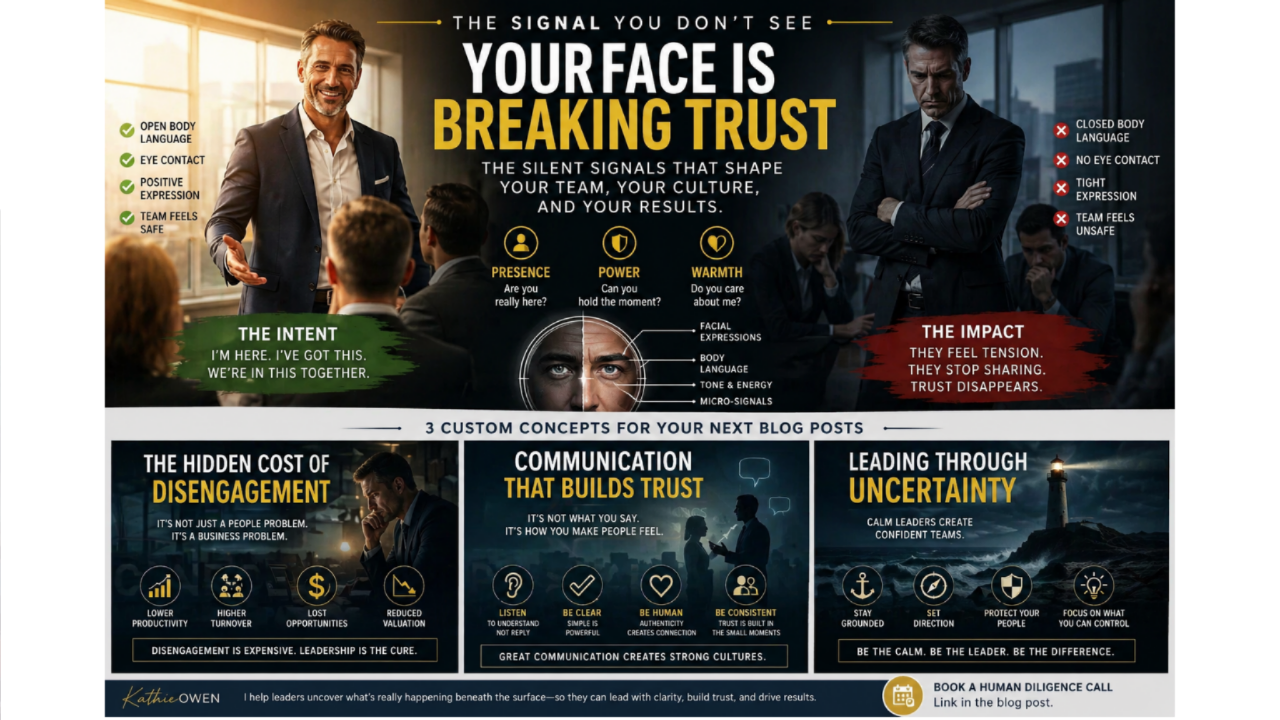
tight facial expressions
closed posture
no eye contact
avoiding interaction
staying removed from the team
They thought they were focused.
The team felt something very different.
👉 tension
👉 pressure
👉 uncertainty
👉 threat
⚠️ A Neutral Face Is Not Neutral Under Pressure
This is where most leaders get it wrong.
They think:
“I’m just thinking.”
“I’m just focused.”
But the team reads:
👉 anger
👉 frustration
👉 disappointment
Especially after something disruptive.
Because the brain is already on alert.
And when people are on alert…
They don’t analyze.
They react.
🧬 Why This Happens (The Science Behind It)
Your brain is wired for survival.
In milliseconds, it scans faces and body language for safety.
Before logic.
Before words.
Before explanation.
It decides:
👉 safe or unsafe
👉 open or closed
👉 trust or protect
This is happening subconsciously.
Which means:
Your team is reacting to you before they even realize it.
That’s why communication alone doesn’t fix it.
Because your words arrive after your signals.
✨ The Framework That Changes Everything
The fastest way to shift this is through a simple but powerful framework from The Charisma Myth:
Presence. Power. Warmth.
This isn’t about charisma.
It’s about what people feel in your presence.
🎭 The Marilyn Monroe Moment
There’s a famous story about Marilyn Monroe.
She was sitting on a subway.
No one noticed her.
No one recognized her.
She looked like anyone else.
Then she turned to her photographer and said,
“Do you want to see her?”
And in that moment…
She shifted.
Her posture changed.
Her face softened.
Her energy opened.
She turned on presence, power, and warmth.
And suddenly…
People recognized her instantly.
That’s not just fame.
That’s signal control.
👁 Presence — The Foundation of Trust
Presence is the most important piece.
It means you are fully here.
Not distracted.
Not rushing.
Not in your head.
When you’re present:
people feel seen
people feel heard
people feel acknowledged
When you’re not?
They feel that too.
And safety disappears quickly.
🧱 Power — Stability in Uncertain Moments
Power is not your title.
It’s your steadiness.
Your ability to hold the moment without reacting.
It looks like:
grounded posture
steady tone
calm decision-making
When leaders show power, the team feels:
“Someone is holding this.”
And that reduces fear.
❤️ Warmth — The Missing Piece
This is where most leaders struggle.
Especially under pressure.
They go cold.
They go distant.
They become transactional.
But people are asking:
👉 Do I matter?
👉 Am I safe here?
Warmth looks like:
genuine eye contact
using someone’s name
a real smile
small human interactions
And this is what rebuilds trust.
🔑 The Shift That Rebuilt the Team
We didn’t start with strategy.
We didn’t start with messaging.
We started with behavior.
We changed how leaders showed up:
softened their facial expressions
opened their posture
slowed their pace
made eye contact
engaged with employees again
brought warmth back into the room
Simple shifts.
But powerful ones.
Because now…
When leadership walked into a room…
The signal changed.
📈 What Happened Next
People started talking again.
Not all at once.
But slowly.
conversations opened
ideas returned
tension softened
trust began to rebuild
Nothing about the business changed first.
What changed was how leadership felt to be around.
🚫 What Makes It Worse
There’s one mistake leaders often make here.
They get defensive.
They try to control the narrative.
They expose feedback that should have stayed safe.
And when that happens:
People don’t become more honest.
They disappear.
Silence grows.
And once silence takes over, recovery becomes much harder.
🌎 This Happens Everywhere
This isn’t just business.
This is life.
In relationships.
In families.
In friendships.
You walk into a room…
And people feel you.
Before you explain.
Before you speak.
That’s influence.
🧭 Final Thought
You don’t lose trust in one big moment.
You lose it in the thousands of small signals that follow.
So before you fix your strategy…
Before you rewrite your message…
Ask yourself:
“What does it feel like when I walk into a room?”
Because that answer…
is shaping everything.
👤 About the Author
Kathie Owen is a private consultant specializing in human patterns under pressure inside founder-led and private equity–backed companies.
Kathie’s Book: Human Patterns Under Pressure
She works with CEOs, founders, and leadership teams during high-stakes moments like mergers, acquisitions, rapid growth, and internal disruption—helping them identify the hidden behavioral patterns that quietly erode trust, performance, and enterprise value.
Kathie begins every engagement with a focused diagnostic assessment, uncovering what teams are experiencing but not saying. From there, she observes real-time interactions across the organization to identify the subtle signals—like leadership presence, communication patterns, and emotional dynamics—that shape outcomes.
Her work is grounded in three principles: Non-Attachment, Radical Responsibility, and Courage.
📞 Work With Kathie
If something feels off inside your organization…
and you can’t quite explain it…
That’s usually where the real work begins.
You can book a private call to explore human diligence inside your organization and uncover what may be impacting trust, leadership effectiveness, and performance beneath the surface.
Read More Articles from Kathie






Transcript
Today I'm gonna start with a moment. A moment you've probably seen in your own workplace. A leadership team walks the floor after a major change that happens in the business. No announcement, no clear explanation, just silence, and then you see it. Tight faces, closed posture, quick steps, no eye contact, no interaction. No one says anything, but the entire building feels it. People get quieter. They stop sharing ideas. They start watching instead of contributing. And here's what's happening. Your face is speaking before you do. Welcome to the Kathie Owen Perspective podcast. My name is Kathie Owen. I am a private consultant and I specialize in identifying human patterns under pressure inside organizations, especially during high stakes moments like transition, growth, and even disruption. I don't come in to motivate teams. I come in to observe what's already happening. That no one has put words to yet. Because the problem always shows up in the room before it shows up in the numbers. And today we're gonna talk about how it shows up in your presence, in your facial expressions. Let me walk you through how this actually plays out. When I enter a company, I don't start with assumptions. I start with an assessment, anonymous, direct, honest, and in this case, the signal was clear. The team did not trust leadership and psychological safety was gone. People didn't feel safe speaking up. They didn't feel safe asking questions. And when that happens, performance doesn't improve, It contracts. So once I saw that in the assessment, I went to the next layer observation. How are leaders actually showing up? Not what they say, not what they intend. What are they signaling? And it became obvious very quickly. Leaders were walking through the building with angry looks on their faces. They weren't intentionally doing it, but they were consistently doing it. Tight expressions, closed body language, no eye contact, avoiding interaction, and staying removed from the team. They thought they were focused. The team felt something very different. They felt the tension, they felt the pressure, they felt the uncertainty, and they felt the threat. And here's the truth, when trust is already fragile, your nonverbal signals carry more weight than anything you say. And this doesn't just happen in business. This happens in real life, in relationships, in families, in everyday conversations. You walk into a room with a certain energy and people feel it instantly before you explain yourself. Before you say a word, people feel you. And this happens subconsciously. Your brain is wired to scan for safety in milliseconds. It decides safe or unsafe, open or closed, trust or protect. So when your face is tight. You know, they call it resting bitch face when your posture is closed. You know that stance that looks angry all the time, or when your presence just feels off. People don't sit there and analyze it. They react to it. This is one of the first things I correct when I'm brought into an organization, not because it's the only issue, but because it is the fastest lever to shift how people feel, and when people feel different, they behave differently. The framework I use to teach this comes from the book, the Charisma Myth. I'll have a link to that book in the show notes and description below, and it's simple, but it's powerful. There's three words, presence, power, and warmth. Let me give you a quick story from the book. Marilyn Monroe was once sitting on a subway with her photographer. No one noticed her. No one recognized her. She looked like anyone else. Then she turned to her photographer and said, do you wanna see her? And in that moment, she shifted. Her posture changed, her face changed, her energy changed. She turned on presence, power, and warmth, and suddenly people recognized her instantly. That's influence. So let me break this down simply. Presence is the foundation of all of it. This is the most important one. Presence means you are fully here, not distracted, not in your head, not rushing past people. When you are present, people feel seen, people feel acknowledged, and people feel safe. And they do this subconsciously. They can also tell when you're not being present. This is key, because when you're not, they feel that too, and safety disappears quickly. Power. It's stability under pressure. Power is not authority. It is steadiness. It is calm, and it's your ability to hold the moment without reacting emotionally. When you have power, your voice is steady, your posture is grounded, your decisions feel clear and your team feels someone is holding this. Warmth is human connection. This is where trust gets built, especially after something disruptive like a merger or an acquisition. So you wanna build that trust. What does warmth look like? It looks like genuine eye contact, using someone's name when you're speaking to them, a real genuine smile, and small human interactions. And under pressure this is the first things most leaders lose. I've seen it so many times. But it's the thing people need the most. Now, here's what matters you don't need a perfect speech. You don't need the perfect message because your team is not just listening to your words, they're reading your signals. So what did we do when we changed this? We didn't start with strategy. We didn't start with messaging. We started with behavior because we wanted to build that trust, that influence, that perspective right away. So we changed how the leaders showed up. We softened their facial expressions. We made that intentional. We opened up their posture, we slowed their pace. We made eye contact again. We spoke to people by name and we reengaged with the team. Simple changes, but powerful ones. Because now when leadership walked into a room, the signal changed. And when the signal changed, the environment changed. People started speaking again. Energy shifted. Trust began to rebuild. Because leadership is not just what you say, it's what people feel in your presence. So here's a question I want you to sit with. What does it feel like when you walk into a room? Not what you intend, not what you think you're projecting? What do people actually feel? Because that answer is shaping your leadership, your relationships and your organization. And if you're a leader, a founder, or part of a team going through high stakes change, this is exactly where I come in. I don't guess. I observe, I assess, and I identify the patterns that are quietly impacting trust, performance, and most importantly, enterprise value. I call it human diligence. If you wanna go deeper into this, I've linked the full blog post in the description. And there are additional resources there to help you apply this immediately. That book, the Charisma Myth is very, very helpful. In fact, she helps leaders do exactly what I'm talking about here, and she has plenty of examples inside this book. And if you're looking for someone to come into your organization and assess what's really happening, you can visit my website and my speaking page. In fact, I speak on presence, power, and warmth inside one of my keynotes. That's where you'll see exactly how I work with leadership teams in high stakes environments. So until next time, remember, the problem shows up in the room before it shows up in the numbers, and more importantly, your presence is shaping that room, whether you realize it or not. All right, that's my episode for today. I trust that you found it helpful, and if you know someone who could benefit from this, please share it with them, and I will see you next time on the Kathie Owen perspective Podcast.

Grief, non-attachment, and pressure can reveal information we couldn't see before. Kathie Owen explores Reality Transurfing's principle of advantage and how attention and human patterns affect relationships, leadership, M&A, and business transitions.
#RealityTransurfing #HumanPatterns #Leadership