
Dream Analysis, AI, and Human Performance
The Observer State: How Dreams, AI, and Meditation Help Me Understand Human Performance Under Pressure
A few nights ago, I had a dream about candy.
Not just any candy.
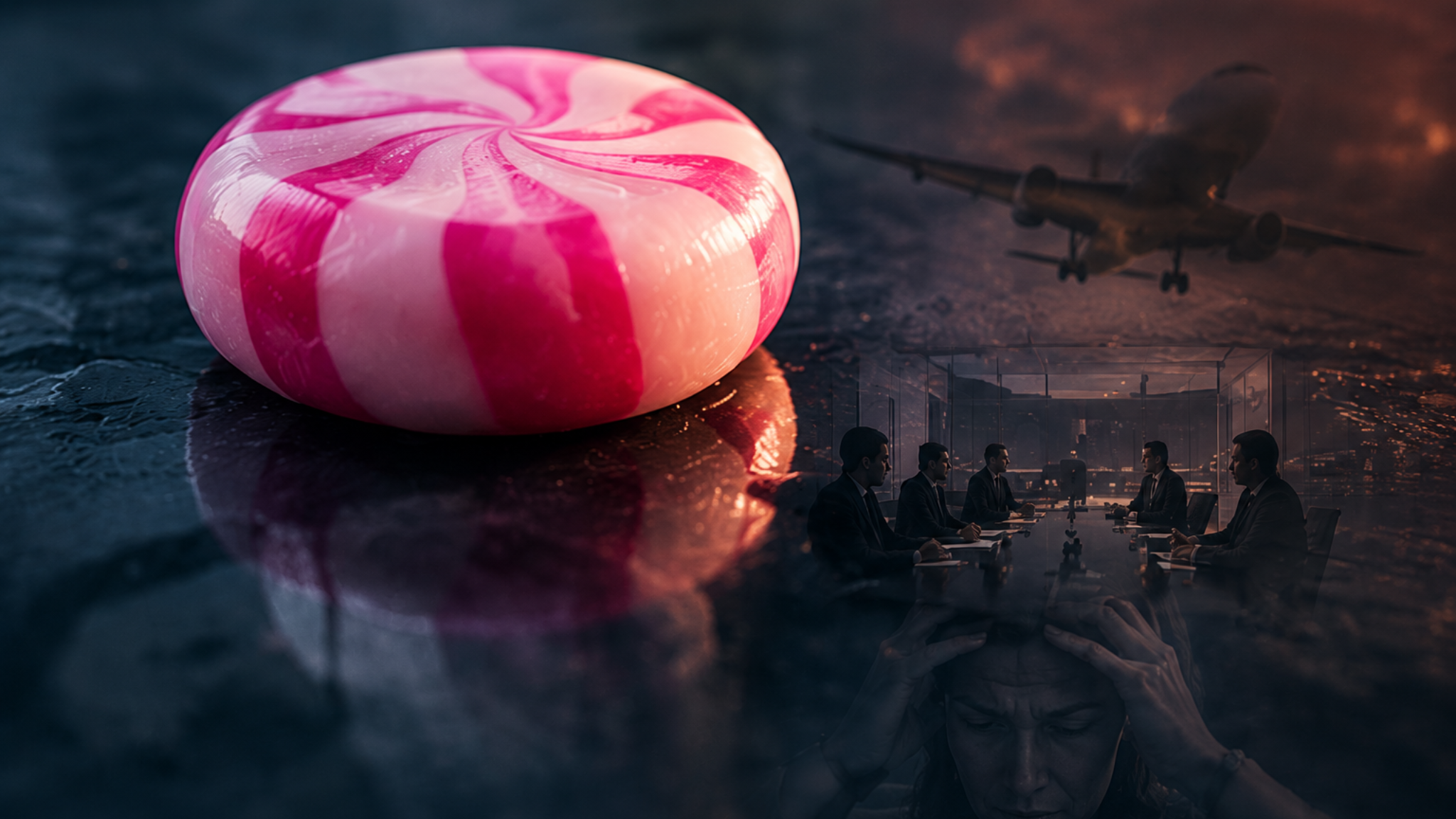
It was pink and white. It looked soft. Almost pretty. Someone handed it to me before a sporting event and told me it was “performance candy.”
In the dream, I paused.
I did not just eat it.
I looked at it.
I wondered, “What exactly is in this?”
That moment stayed with me when I woke up.
Because the dream was not really about candy.
It was about performance.
It was about pressure.
It was about the things we consume, accept, tolerate, and use in order to perform better.
Sometimes those things are physical.
Caffeine. Sugar. Alcohol. Medication. Supplements. Food. Fitness routines.
Sometimes they are emotional.
Approval. Urgency. Fear. Control. Validation. Perfection. Comparison.
Sometimes they are cultural.
Hustle. Image. Over-functioning. Proving. Performing. Pretending everything is fine.
The next morning, I realized my subconscious had created a perfect metaphor for the work I am building around Human Performance Under Pressure.
Because real performance is not just about doing more.
It is about asking better questions.
What am I consuming?
What am I reacting to?
What am I depending on?
What is driving this behavior?
And what is actually happening underneath the surface?
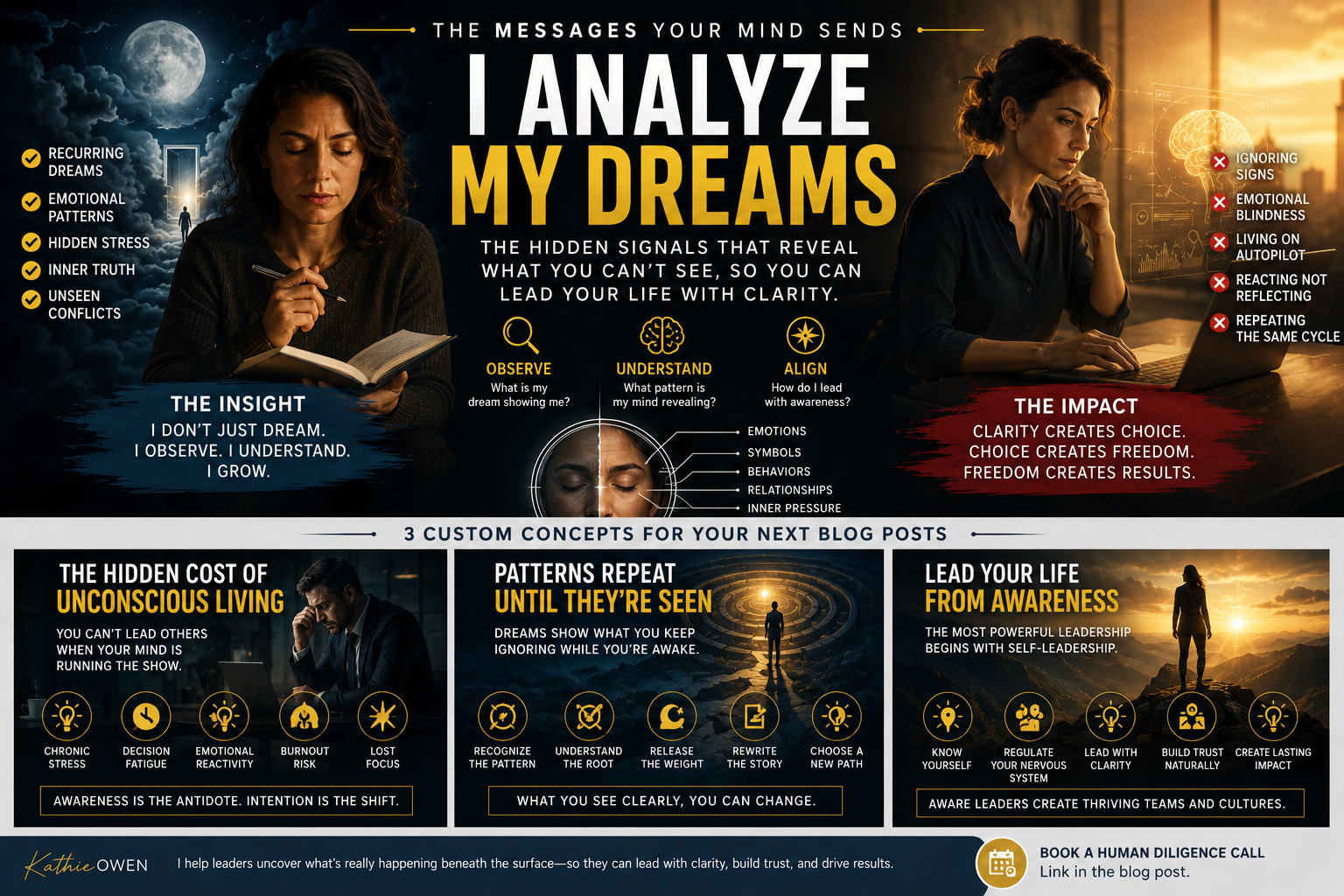
I Have Been Analyzing My Dreams for Over a Year
For over a year now, I have been analyzing my dreams with AI.
Almost every morning, I wake up with a dream.
Sometimes the dream is vivid.
Sometimes it is strange.
Sometimes it is emotional.
Sometimes it makes no sense at first.
But I have learned something powerful.
Dreams are rarely random noise.
They are often symbolic intelligence.
They show me what my nervous system is processing before my conscious mind has words for it.
I do not approach dreams as predictions.
I do not ask, “What is going to happen?”
I ask, “What pattern is showing itself?”
That distinction matters.
Dreams became less about prediction and more about observation.
That one shift changed everything.
I started to see how my dreams revealed overstimulation, fear, attachment, stress, intuition, grief, relational dynamics, and emotional truth.
They showed me where I was still performing.
They showed me where I was still afraid.
They showed me where I was trying to control an outcome.
They also showed me where I was becoming calmer, clearer, and more grounded.
Over time, my dreams became a kind of internal dashboard.
Not a scoreboard.
Not a fortune teller.
A dashboard.
They helped me see what was active inside my system.
And that matters because the way we process pressure privately often shapes how we respond to pressure publicly.
How I Use AI Like a Reflective Coach
When I use AI, I do not use it like a search engine.
I talk to it like I am leaving a voice note for a coach.
I explain the dream.
I explain what I felt.
I explain what happened the day before.
I explain what stood out.
Then I ask for reflection.
Not because I want AI to “tell me what it means.”
That is not the point.
The value is in the mirror.
AI helps me organize the symbols.
It helps me see repeated themes.
It helps me notice emotional patterns.
It helps me find language for things I sensed but could not yet explain.
It helps me slow down.
Most people use AI transactionally.
They ask for answers.
They ask for captions.
They ask for lists.
They ask for speed.
I use it reflectively.
I use it to process.
I use it to observe myself.
I use it to study human behavior.
That is very different.
It is not about outsourcing my intuition.
It is about giving my intuition a place to speak.
There is a big difference.
AI does not replace my inner knowing.
It helps me hear it more clearly.
My Process Is Observation First
This is the heart of my work.
Observation comes first.
Before I interpret, I observe.
Before I react, I observe.
Before I decide, I observe.
This is true in my dreams.
It is also true in my consulting work.
I notice emotional tone.
I notice repeated words.
I notice body language.
I notice what people avoid.
I notice where energy drops.
I notice who gets quiet.
I notice who performs.
I notice who controls.
I notice who interrupts.
I notice where the message and the behavior do not match.
The same pattern can appear in a dream, a boardroom, a family system, or a leadership team.
Pressure reveals patterns.
And if you are too reactive, you miss them.
That is why nervous system regulation matters so much.
You cannot observe clearly when your body is in threat.
You cannot read a room well when your ego is trying to protect you.
You cannot hear truth when you are busy defending an identity.
Observation requires space.
It requires humility.
It requires non-attachment.
It requires the ability to say, “Let me look at this before I make it mean something.”
That is where the gold is.
Meditation Helps Me Integrate What I See
Dream analysis is only one part of my process.
Meditation is another huge piece.
Meditation helps me let the information settle.
It helps me not grab too quickly.
It helps me avoid forcing meaning onto something just because I want certainty.
That is important.
Because the mind loves a fast answer.
The nervous system loves control.
The ego loves being right.
But deeper insight usually needs quiet.
So I walk or workout.
I meditate.
I breathe.
I step back.
I let things unfold.
Sometimes I do not know what a dream means right away.
Sometimes I understand it later that day.
Sometimes it connects to a business idea.
Sometimes it connects to a relationship pattern.
Sometimes it connects to a leadership principle.
Sometimes it shows me something I was not ready to admit while awake.
Meditation gives me room to receive the message without turning it into drama.
That is the difference between awareness and reactivity.
The Airplane Crash Dream
Another dream I had recently involved an airplane crash.
But what mattered most was not the crash.
It was my position in the dream.
I was observing.
I was not consumed by panic.
I was not frozen.
I was not swept into chaos.
I was watching human behavior under pressure.
That distinction matters enormously.
Because that is often what my consulting feels like.
Organizations under pressure reveal the truth.
A merger reveals the truth.
Rapid growth reveals the truth.
A leadership transition reveals the truth.
A succession issue reveals the truth.
A crisis reveals the truth.
Pressure does not usually create the fracture.
Pressure exposes the fracture.
That is why I pay attention to behavior under stress.
Who regulates the room?
Who destabilizes it?
Who becomes controlling?
Who disappears?
Who performs confidence but lacks clarity?
Who tells the truth?
Who protects the system?
Who protects themselves?
These are not small details.
They are enterprise signals.
Some of the most important signals in a company are not spoken.
They are observed.
That airplane crash dream showed me something I already know from my work.
The observer state is powerful.
Not detached in a cold way.
Not indifferent.
Not numb.
But steady.
Present.
Aware.
Unconsumed.
That is the state from which true pattern recognition becomes possible.
What Dreams Teach Me About Leadership
Leadership under pressure is not just about strategy.
It is about state.
A dysregulated leader can take a good strategy and turn it into confusion.
A regulated leader can take a hard moment and create safety, clarity, and movement.
This is why emotional regulation is not soft.
It is structural.
It affects decisions.
It affects trust.
It affects communication.
It affects timing.
It affects how people interpret change.
It affects whether people tell the truth.
When leaders are reactive, they often miss what is right in front of them.
They miss the silence.
They miss the fear.
They miss the informal power structure.
They miss the employee who has already emotionally left.
They miss the executive who is performing alignment but privately resisting.
They miss the nervous system of the company.
That is why data alone is not enough.
Numbers matter.
Legal documents matter.
Financial diligence matters.
But human patterns matter too.
Because people carry the strategy.
People carry the culture.
People carry the transition.
People carry the risk.
And people reveal the truth under pressure.
Why This Matters for Human Performance Under Pressure
This is one of the reasons I am launching Human Performance Under Pressure.
Because performance is often misunderstood.
Many people think performance means pushing harder.
Doing more.
Being tougher.
Staying busy.
Producing at all costs.
But true human performance under pressure begins with awareness.
Can you observe yourself before you react?
Can you notice your body before you override it?
Can you tell the difference between intuition and fear?
Can you pause before consuming the “performance candy”?
Can you stay present when something feels chaotic?
Can you lead without dumping your nervous system onto the room?
Can you make decisions without needing to prove, please, control, or defend?
That is the deeper work.
And it applies everywhere.
In leadership.
In business.
In relationships.
In health.
In fitness.
In transitions.
In conflict.
In uncertainty.
Pressure is not the enemy.
Unconsciousness under pressure is the problem.
When we become unconscious, we repeat patterns.
When we become aware, we gain choice.
And choice is where change begins.
The Strange Gift of Dreams
Over the last year, this process has changed my life.
It has made me calmer.
It has made me more observant.
It has made me less reactive.
It has helped me trust my intuition.
It has helped me understand my own nervous system.
It has helped me see people with more clarity and less judgment.
It has also helped me understand leadership in a much deeper way.
And strangely enough, some of my best business ideas have come through dreams.
Not because I was trying to force them.
Not because I was chasing inspiration.
But because I had created enough space to listen.
Dreams are not separate from our waking life.
They are part of the same intelligence.
They show us symbols.
They show us pressure.
They show us patterns.
They show us what we are ready to see.
For me, dream analysis is not a hobby.
It is part of how I study human behavior.
It is part of how I understand pressure.
It is part of how I observe.
It is part of how I build.
It is part of how I lead.
And it is part of how I help others see what they may be too close to notice.
Because the real work is not just interpreting the dream.
The real work is becoming the observer.
The person who can stay present.
The person who can notice without collapsing.
The person who can see the pattern without becoming the pattern.
That is where clarity begins.
That is where leadership begins.
That is where human performance under pressure begins.
About the Author
Kathie Owen is a private consultant, speaker, and author specializing in human patterns under pressure inside founder-led and private equity-backed organizations. Her work focuses on the hidden behavioral dynamics that quietly impact leadership, culture, trust, decision-making, and enterprise value during high-stakes transitions, growth, and uncertainty.
With a background in corporate wellness, leadership observation, fitness, emotional regulation, and nervous system awareness, Kathie brings a unique lens to human performance. She studies the subtle patterns most people miss — behavioral shifts under stress, emotional signaling, overperformance, informal power structures, and the nervous system dynamics that influence both individuals and organizations.
Kathie is the author of Human Patterns Under Pressure and host of The Kathie Owen Perspective, where she explores leadership psychology, observation, symbolic pattern recognition, emotional regulation, Reality Transurfing, and the deeper human dynamics that shape performance under pressure.
Her upcoming program, Human Performance Under Pressure, integrates leadership awareness, nervous system regulation, dream analysis, meditation, fitness, and reflective processing to help individuals operate with greater clarity, resilience, and self-awareness in high-pressure environments.
Read More Articles from Kathie



Transcript
A few nights ago, I had a dream that someone handed me a pink and white piece of candy. It was performance candy, and it was before a sporting event. And in the dream, I paused. I remember looking at that piece of candy and thinking,"What exactly is in this?" Now, that sounds strange at first, but when I woke up the next morning, I realized that dream perfectly explained the work I'm building around human performance under pressure. Because most people never stop to ask themselves what they are consuming in order to perform. And I'm not just talking about food. I'm talking about pressure, stress, validation, overworking, control, people-pleasing, alcohol, dopamine, urgency, image management, and even performance itself. And the reason I want to talk about this today is because over the last year, I've been analyzing my dreams almost daily using AI, meditation, observation, nervous system awareness, and reflective processing. And honestly, it has completely changed the way I understand leadership, human behavior, emotional regulation, and pressure. Welcome to the Kathie Owen Perspective podcast. My name is Kathie Owen. I'm a private consultant focused on human patterns under pressure inside organizations, leadership teams, and high-stakes environments. My work sits at the intersection of leadership psychology, nervous system regulation, observation, culture, emotional dynamics, and human performance. I study the things most people miss, the subtle things: behavior under pressure, micro shifts in energy, the difference between what people say versus what they actually communicate, the nervous system of a company, and the nervous system of a leader. And honestly, the nervous system tells the truth long before the words do. Now, before we go any further, if you enjoy the conversations like this, deeper conversations about leadership, human behavior, emotional intelligence, nervous system regulation, human performance, consulting, mindset, and observation under pressure, make sure you hit that like button, subscribe to the channel, and hit that little bell so you never miss a video from me. Because this channel is really becoming a home for people who want to understand what's happening beneath the surface. And today's conversation is a big one, because this is not really a video about dream interpretation. This is a video about observation. That's the difference. People hear dream analysis, and they immediately think mystical prediction or fortune-telling or trying to decode symbols like a magic trick. That's not what I'm doing, and that's not what I've ever done. What I'm doing is observing patterns. That's it. Dreams became less about prediction and more about observation, and that distinction changed my life. Because what I started realizing is that my dreams were revealing emotional pressure before my conscious mind could fully recognize it. Sometimes my dreams show overstimulation. Sometimes they show attachment. Sometimes they show fear. Sometimes hidden stress. Sometimes relationship dynamics. Sometimes overperformance. Sometimes control. Sometimes exhaustion. And what's fascinating is that the exact same patterns show up inside organizations. That's what really blew my mind. Because once I started studying my dreams closely, I started noticing the same human dynamics everywhere: inside businesses, inside leadership teams, inside companies going through growth, inside mergers and acquisitions, inside stressed executive teams, inside family systems. Pressure reveals patterns, always. And here's something really important that I think leaders miss. Pressure usually does not create the fracture. Pressure exposes the fracture, and that is huge. Because most companies think they have a pressure problem, but many times they actually have an awareness problem. The pressure simply reveals what was already there. And dreams work the same way. Dreams reveal what's already active inside the nervous system. Now, one of the things I do that's very different is how I use AI. Most people use AI transactionally. They ask it questions. They ask for answers. They ask for productivity. But I use AI reflectively. I literally talk to AI almost like I'm leaving a voice note for a coach. I explain the dream. I explain what happened that day. I explained what I felt emotionally. I explain relationship dynamics. I explain body sensations, and then I let the conversations expand the pattern. And that's very different than asking AI to tell me what my dream means. I'm not outsourcing intuition. I'm organizing observation, and that is different. And honestly, this is where I think AI becomes incredibly powerful, not just for productivity, but for self-awareness, but for reflective processing, for seeing blind spots, for nervous system awareness, for emotional intelligence, and for pattern recognition. I think reflective AI is going to become one of the biggest tools in human performance over the next decade, especially for leaders, for founders, and for people under chronic pressure, because many leaders are moving so fast that they never stop long enough to observe themselves. And if you cannot observe yourself, pressure will run you unconsciously. I've seen it so many times. Now, something else that became really important in this process is meditation, because observation without regulation can become obsession. That kind of sounds funny to me because it sounds like a sentence that you want to hear all the time, so I'm gonna repeat it. Observation without regulation can become obsession, and that is important You cannot stare at every symbol and panic. You cannot overanalyze every emotion. You cannot force meaning onto everything. That's where meditation changed the game for me. Meditation taught me how to observe without attaching. That is huge. And honestly, I think this may be one of the most important leadership skills in the future, the ability to observe without immediately reacting, because reactive leaders destabilize rooms. Regulated leaders, they stabilize rooms. Think about that for a second. When pressure enters an organization, what happens? People watch leadership. They watch facial expressions, tone, timing, energy, silence, body language, confidence, urgency. And most leaders don't realize this, but nervous systems communicate faster than words. That's why some leaders walk into a room and people instantly tighten up, and others walk into a room and people exhale. That is nervous system communication, and it matters far more than executives realize. This is one reason why I believe observation is such a powerful consulting tool, because many of the most important signals inside a company are not spoken. They are observed. Who interrupts people? Who shuts down? Who performs confidence? Who over-explains? Who avoids conflict? Who controls meetings? Who people look at before answering a question? Who changes emotionally under pressure? Those are enterprise signals, not personality quirks. Signals. And honestly, dreams started teaching me the exact same thing. They taught me how to slow down long enough to observe emotional truth beneath performance. And that brings me to another dream I had recently. It was an airplane crash. I saw it come and crash right in front of me. I'm not gonna deeply explain the entire dream here because I wrote more about it in the blog post connected to this video, and you can find that in the links in the description and show notes below. But what mattered most was this: I was observing the crash. I was not consumed by it. I was studying behavior under pressure. It was so interesting. And that distinction matters enormously because honestly That's what my consulting feels like. Organizations under pressure reveal the truth. Growth reveals the truth. Conflict reveals the truth. Leadership transitions reveal truth. Layoffs reveal truth. Mergers reveal truth. Uncertainty undoubtedly reveals truth. Pressure strips performance away, and underneath that performance, the nervous system appears. That's where the real information lives. And I think this is why I'm becoming so deeply interested in human performance under pressure. Because I no longer think human performance is just about productivity or discipline or routines or optimization. I think true human performance is about awareness. Can you observe yourself before reacting? Can you notice what your nervous system is doing? Can you regulate before responding? Can you separate intuition from fear? That one is huge. Can you pause before consuming the performance candy? Can you stay conscious under pressure? That's the work. And this upcoming Human Performance Under Pressure program is going to go deeply into all of this. We're going to talk about nervous system regulation, leadership under pressure, human behavior, fitness, energy, reality transurfing, dream analysis, observation, meditation, stress patterns, performance patterns, identity, fear, overstimulation, and how to actually function clearly inside pressure instead of becoming consumed by it. Because I really believe the future belongs to people who can stay conscious under pressure, not just productive, conscious. That's very different. And honestly, I think the world is starving for this conversation right now. People are exhausted. They're overstimulated. They're distracted. They're very reactive. They're disconnected from themselves. They're disconnected from their intuition. They're disconnected from observation. And I think one of the greatest skills we can rebuild is the ability to slow down enough to notice what is actually happening. Inside ourselves, inside relationships, inside leadership, inside organizations, inside culture, inside the nervous system, because awareness changes everything. And strangely enough, some of my best business ideas have actually come through my dreams. Not because I was trying to force ideas, but because I had created enough internal quiet to hear them. That's the part people underestimate. Stillness increases perception, and perception changes performance. Yeah, pretty powerful. Now, if this conversation resonated with you, make sure to check out the full blog post connected to this episode, because I go much deeper into my actual process there. And let me tell you something, it's pretty powerful. I've been analyzing my dreams for over a year now using AI, and I actually create a Notion document that goes with it, and it's almost like a journal. I can go back and s- search through my Notion on my dreams, and I love this. You would not believe the insights that come through this. It's pretty powerful. If this kind of work interests you, stay connected, because human performance under pressure is something I'm building very intentionally right now. This is becoming a major part of my work, and honestly, one of the deepest things I've ever created. It helps in your personal life. It helps in your relationships. It helps in your fitness, in your wellness, in your mindset. I can't stress that enough. Thank you so much for being here, and remember, pressure reveals patterns, but awareness gives you choice. I'll see you in the next episode.

What happens in the first second after pressure hits? Kathie Owen explores the pause that helps leaders notice their reactions, regain presence, and make clearer decisions. Watch her Human Patterns Under Pressure speech and learn the three principles she returns to when the stakes are high.
#HumanPatternsUnderPressure #LeadershipUnderPressure #ExecutivePresence #DecisionMaking