
How Do You Let Go When It Matters?
Is One Outcome Holding Your Peace Hostage?
This is my most frequently asked question: “How do I not attach to something that I feel is super important?”
I hear it when I speak on stage, explain my process, work with leadership teams, and sit with private consulting clients. I hear it from friends and colleagues, too.
And I understand why.
We are talking about something you care about. A relationship. An opportunity. A company you built. A future you have pictured for years. Being told to “just let go” can feel like being asked to stop wanting it.
But how do you loosen your grip while keeping what matters to you?
For me, the process begins with a pause. Then I look at the situation from a wider perspective. I question how I believe it should unfold. And I give myself room to see choices I could not see while I was demanding one answer.
Let’s walk through that process.
When pressure enters the room
Pressure often arrives with a sense of urgency.
“I need to know.”
“I need to be correct.”
“I need the answer now.”
You might be waiting for a message. A business decision may be approaching. Someone may have challenged your idea. Before long, you are replaying conversations, searching for clues, and trying to settle the entire situation in your head.
In my work, I talk about how pressure can pull us away from our peace, our power, and our presence. Our attention gets caught in defending a position or predicting an outcome. We lose sight of the choices available in the moment.
My process begins with a pause, observation, and awareness. Awareness creates choice. Three principles support that process: non-attachment, radical responsibility, and courage.
Non-attachment is a useful starting point because it helps us notice where we are resisting.

What are you actually attached to?
Sometimes the attachment is to an outcome. But often, it also includes what we believe that outcome would mean.
“I should get the promotion. That would prove they value me.”
“I should be included. That would prove I matter.”
“My idea should work. That would prove I know what I’m doing.”
Now the result has an extra job. It must answer a question about your identity or worth.
That is a heavy assignment for a promotion, an invitation, or one conversation.
Ask yourself: “What am I insisting should happen?”
Then go one layer deeper: “If it doesn’t happen, what am I afraid it will mean?”
You may discover that you are holding tightly to a conclusion: “I’m not good enough,” “I’ve wasted my time,” or “I’ll never get another chance.”
No shame. No condemnation. You are bringing a belief into view so you can examine it.

Four words that can reveal resistance
Listen for should, must, now, and how. These words can help you catch the moment a desire becomes a demand.
Should: the picture
“This should look different.”
“They should understand.”
“I should be further along.”
Should often points to a gap between what is happening and the picture you expected. Sometimes it reflects a reasonable standard. Respect, honesty, and clear communication matter.
The question is whether you can respond to what is happening while holding that standard—or whether you are spending all your attention arguing that the moment should already be different.
Must: the rule
“They must agree before I can move forward.”
“This must work.”
Must can turn one preferred outcome into the only acceptable outcome. Ask what you have made dependent on it. Is it a practical next step? Or have you made your peace and self-worth dependent on someone else’s decision?
Now: the deadline
“I need an answer now.”
Some deadlines are real. Other times, urgency comes from how uncomfortable it feels to wait.
Pause and ask: “Does this situation require immediate action, or am I trying to end the discomfort of not knowing?”
That question can help you choose a response that fits the situation.
How: the entire route
“How will every part of this work?”
Asking how is useful when it helps you plan. But it can become a demand to see the whole route before taking one step.
You may know enough to make a call, ask a question, or prepare a proposal. You may not know what will happen after that.
You can take a thoughtful next step while leaving some of the route unknown.

Use the pause to settle, then look again
It is hard to question a belief while you are rushing to defend it.
The pause gives you a chance to settle enough to observe. Sometimes that means a comfortable breath. Sometimes it means stepping away from the screen, taking a walk, sitting quietly, or meditating.
For me, nature and quiet can help. A hobby or activity that brings your attention into the present may help you create that space, too.
You do not have to reach perfect calm. Look for enough room to ask a different question.
This is also where I bring in my higher power. You might call that God, your higher self, the universe, or a deeper sense of wisdom. I ask for a view beyond the one I am caught in:
“Help me see what I’m missing.”
“Help me see beyond how I think this should be.”
For me, that changes the quality of the inquiry. I become more willing to discover something rather than collect more evidence for my first conclusion.

Take the 360-degree view
Imagine you have worked hard for a promotion. You believe you have earned it. Then you hear that someone else may get the role.
Immediately, your mind starts moving.
“I should get this. They must recognize my contribution. I need to know now. How am I going to fix this?”
You begin reading meaning into every meeting and email.
Start by naming the attachment: “I am attached to getting this role and to what I believe getting it would prove.”
Then pause. Once you have a little space, take the wider view.
What do I actually want from this promotion?
Perhaps you want more income, recognition, freedom, or a chance to use your strengths.
What is the actual experience this role would offer?
You may discover responsibilities you want. You may also discover travel, hours, or pressures you had not fully considered. You may still want the promotion. Now you are looking at the work as well as the title.
Is this the only route to what I want?
There may be a conversation about pay, a different role, another organization, or an opportunity to develop your work in a new direction.
Those possibilities are not guaranteed. They do, however, widen the picture.
You can move from “If I don’t get this, my future is ruined” to “I want this opportunity. I can ask for information and make my case. This one decision does not have to define my entire future.”
That is where the attachment starts to loosen.

Do you want inclusion—or the experience?
Now consider a gathering you expected to attend. You are not included, and it hurts.
“I should be there. I should be invited. I should be part of it.”
You can acknowledge that disappointment. Then, when you are ready, ask:
“Do I want the experience that is actually available here?”
“Or am I attached to what being included would mean?”
Those questions may reveal two different desires.
Perhaps you want connection and respect, while the gathering itself involves tension or obligations you would prefer to avoid. You can want connection without wanting that particular experience.
You might also wonder whether having some space offers something useful. You do not have to decide that you were protected or that everything happened for a reason. You can leave room for the possibility.
You may choose to ask about the invitation. You may address a concern in the relationship. You may make another plan.
The wider view gives you choices. “This should have happened” no longer has to make every decision for you.

Eckhart Tolle: “Is that so?”
Many years ago, Eckhart Tolle’s discussion of the Zen response “Is that so?” in A New Earth helped me notice how quickly we turn an interpretation into certainty.
I borrow those words as a reminder to question my own story.
“They didn’t choose me. That means I’m not good enough.”
Is that so?
“Everyone who gets that opportunity will be happy.”
Is that so?
“If this doesn’t happen as planned, nothing good can come from it.”
Is that so?
You do not need to manufacture a cheerful answer. You are allowing a conclusion to become a question.
Tolle’s teaching on non-resistance also helps here. Acknowledging what is happening now leaves you able to respond to what the situation requires.
“This is happening. What can I choose?”
You can correct information, set a boundary, ask a question, or make a change. Accepting the current moment gives you a place from which to act.

Reality Transurfing: lowering importance
Vadim Zeland discusses excessive importance in Reality Transurfing. Within that framework, inflated importance creates what he calls excess potential.
My practical application is to notice when I have made one outcome responsible for everything.
“This has to work, or nothing will work.”
“This person has to agree, or I cannot move forward.”
Then I bring the situation back to a size I can work with:
“This matters. What is my next useful action?”
I can prepare, ask, participate, or respond. I can give the situation care without demanding the whole future from it.
Zeland also describes pendulums as structures of shared thought and attention that draw people into reactions. I use that idea as a lens for noticing the pull of other people’s opinions.
“You should be furious.”
“This will be amazing.”
“This will be a disaster.”
“You have to do something.”
Ask: “Am I choosing my response, or getting carried along with the room?”
You can hear an opinion without making it your direction.
Put the ego on the shelf for a minute
For a founder, confidence and a strong sense of identity may have helped build the company. Those qualities have value.
But “I built this” can become “It must continue exactly my way.” Then a suggestion feels like a threat.
When I talk about putting the ego on the shelf, I mean giving the part of us that protects our identity a brief rest. You can ask:
“What could I hear if I didn’t have to defend myself right now?”
A leader may discover that another approach supports the vision they care about. Their commitment remains, while their options expand.
You can practice this in a meeting, a relationship, or a conversation with yourself.

Where the release happens
The release happens when one interpretation, one route, or one outcome stops being the only acceptable possibility.
You may still want what you wanted. You may still feel disappointed. But you can begin to say:
“I don’t know the whole picture yet.”
“There may be another way to meet this desire.”
“I can choose my next step without deciding what this means about my entire life.”
You do not have to replace a painful certainty with a positive certainty. You can loosen certainty itself.
The next time pressure hits, try this:
Notice the demand. What am I insisting should happen?
Pause and settle. Give yourself enough space to look again.
Take the wider view. What do I want? What do I know? What might I be missing?
Question the meaning. Is that so?
Allow another possibility. Could there be another route or interpretation?
Choose one next step. What can I do from this wider view?
Non-attachment loosens the demand. Radical responsibility helps you own your part. Courage helps you act while some things remain unknown.
And when the grip tightens again, you have another opportunity to practice.
Explore this in your own life or leadership
What do you notice most when pressure hits: should, must, now, or how?
Use that word as a cue to pause. You can care deeply and give yourself room to see beyond how you think it should be.
Watch the accompanying video for a walkthrough of this process. If you find it useful, like the video and subscribe to my YouTube channel. That helps more people discover these conversations.
If you would like to work with me privately, bring this conversation to your leadership team, or invite me to speak, explore my work at our home page and reach out for a conversation. Book a conversation with Kathie below:
About the author
Kathie Owen is a Houston-based private consultant, speaker, and author with more than 25 years of experience across fitness, psychology, organizational dynamics, corporate wellness, and leadership. She focuses on human patterns under pressure and the behavioral dynamics that shape relationships, decisions, and organizations.
Her consulting examines human risk in founder-led and private equity–backed companies, particularly during growth, succession, mergers, acquisitions, and other high-stakes transitions. Her approach brings together non-attachment, radical responsibility, and courage to help people recognize patterns and see their choices more clearly.
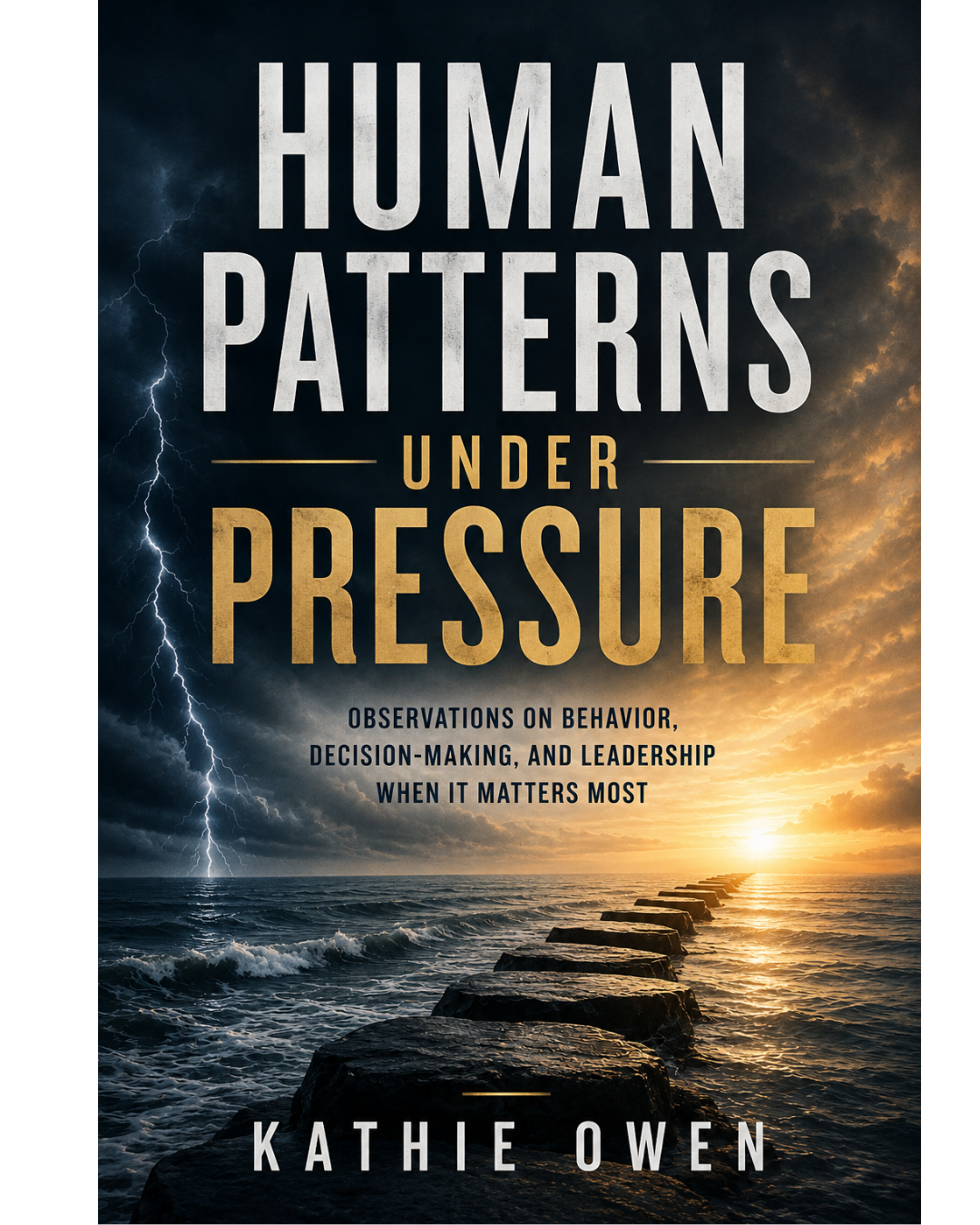
Kathie is the author of Human Patterns Under Pressure and The Truth Bubbles Up, and the host of The Kathie Owen Perspective. Through her writing, speaking, and private consulting, she teaches a process of observation, awareness, choice, and possibility.

Read More Articles from Kathie





Transcript
Today we're gonna talk about my number one question that I'm asked when I speak on stage, when I'm talking about my process, when I'm working with leadership teams, when I'm working with clients, and when I'm working with friends and colleagues. And you may wanna listen to this episode several times. And that question is, how do I let go of attachment, especially when something is important to me? It's a big question, and it's a useful place to begin because this is often where you start identifying what you are resisting. Listen to the words that show up when pressure hits. "This should or should not be happening. They must understand. I need an answer now, and I need to know how this is going to work." Should, must, now, how. Have you heard yourself say any of those? I have. Today I'm going to walk you through how to loosen that attachment, how to pause, look at the situation from a wider perspective, and find a choice you couldn't see while you were holding on so tightly to how it should be. Welcome to the Kathie Owen Perspective podcast. My name is Kathie Owen. I'm a private consultant and speaker with more than 25 years of experience across fitness, psychology, organizational dynamics, corporate wellness, and leadership. My work focuses on human patterns under pressure. When pressure hits the room, we can lose our peace, our power, and our presence. We get pulled into urgency. We want to know. We want to be correct. We want the situation settled. My process begins with a pause. We observe. We bring awareness. Awareness creates choice. And the three principles that guide that process are non-attachment, radical responsibility, and courage. And today, let's begin with non-attachment and my most frequently asked question. You may think you're attached to an event, a relationship, or an opportunity, but look a little closer. Sometimes you're holding onto a picture of how that experience should unfold. I should get that opportunity. They should include me. This conversation should go well. And underneath that picture, there may be another belief. If I get the opportunity, it proves I'm successful. If I'm included, it proves I matter. If the conversation goes well, I can finally relax. Now the outcome has a second job. It has to tell you who you are or give you permission to feel okay. That's where the grip can tighten. Here's your first question: What am I insisting should happen? Be honest with yourself and no shame, no condemnation. You might say, "I want them to recognize my work." That's a desire. Then you notice, "Am I telling myself that they must recognize it in this particular way right now, or it means they don't value me?" That is the belief to examine. You can keep the desire while loosening the demand around it. So let's look at those four words: should, must, now, and how. Should gives you a picture. This should look different. Must turns the picture into a rule. They must do this before I can be okay. Now adds a deadline. I can't stand not knowing. I need the answer now. And how can turn into a demand for the entire route. Now I need to know exactly how this will unfold before I can move forward. Of course, asking how can be useful, and planning matters. Notice when your questions stop helping you act and start asking life to remove every uncertainty. That's where you can pause. What am I asking this situation to guarantee? Because you might be asking for more than an answer. You might be asking for certainty about your worth, your future, or another person's feelings. One answer may never be able to carry all of that. The pause is where you interrupt the rush to react. Sometimes you can take a comfortable breath and listen. Sometimes you need a walk, quiet, meditation, a little time in nature, something you enjoy that brings your attention back to the present. This is where settling your nervous system supports the process. You don't have to become perfectly calm. Just give yourself enough space to look again. And for me, this is also where I bring in my higher power. You may call that God, your higher self, the universe, or a deeper sense of wisdom. I ask for a perspective beyond the one I am caught in. Help me see what I am missing. Help me see beyond how I think this should be. That's different from asking for proof that my original story is right. If you'd like an episode on nervous system regulation and practices for that pause, leave "regulation" in the comments because I am so ready to talk about this. But today we're using the pause to make room for a wider view. Let's take a three hundred and sixty degree view. Imagine someone who wants a promotion. They've worked hard. They believe they earned it. Then they hear that someone else may get the role. The pressure hits. I should get this. They must see what I've contributed. I need to know now, how am I going to fix this? They start building a case, replaying conversations, reading meaning into every email. Now, let's slow that down. First, name the attachment. I am attached to getting this role and to what I believe it would prove. Then pause. Take a walk. Settle enough to look at more than just the painful interpretation. Here comes the wider view. What do I actually want from this promotion? Maybe it's recognition, more income, more freedom, a chance to use their skills. What do I know about the role? Perhaps it includes travel they don't want, a schedule that could change their life, responsibilities they haven't fully considered. They may still want it, but now they are looking at the actual experience, not just the title. Then ask, Is this the only route to what I want?" I love that question. And there may be a conversation about pay, another role, a different opportunity, a way to develop their work that they haven't considered. None of those possibilities is guaranteed, but the original conclusion, if I don't get this, I'm not valued and my future is ruined, no longer gets to be the only conclusion in the room. That's the shift. They can say, "I want this opportunity. I can ask for clear information and make my case, and I don't have to make this one decision the final answer about who I am." They've loosened the attachment enough to choose. Here's another example. You aren't included at a gathering you expected to attend. Your first thought is, "I should be there. I should be invited. I should be part of it." That may hurt. You can acknowledge that. Then when you're ready, take the wider view. Do I want the actual experience that is available here, or am I attached to what being included would mean? Those questions can reveal two different desires. Maybe you want connection and respect, but the gathering itself involves tension, obligations, performance, or dynamics that you do not want to participate in. You might begin to see that you can want connection without wanting this particular experience. You could also wonder perhaps having some space offers something useful. You don't have to declare that you were protected or that everything happened for a reason. You can allow the possibility. You can also decide to ask about the invitation or address a relationship concern. A wider view leaves room for that too. The point is that this should have happened no longer has to control every choice you make next. Many years ago, Eckhart Tolle's discussion of the Zen response, "Is that so?" in A New Earth helped me question how quickly we turn an interpretation into certainty. I use those words as a reminder to pause with my own story. They didn't choose me. That means I'm not good enough. Is that so? Everyone who gets that opportunity will be happy. Is that so? If this doesn't happen the way I planned, nothing good can come from it. Is that so? You aren't required to find a cheerful answer, and you are creating room around a conclusion. Tolle's teaching on non-resistance also helps here. You can acknowledge the moment you're in, then respond to what it requires. This is happening. What can I choose? You can set a boundary, ask a question, make a change. You can release the argument that this moment should already be different and still take action to shape what comes next. Vadim Zeland talks about excessive importance in Reality Transurfing, and I talk about this a lot on my channel in Reality Transurfing, and I will include a link in the show notes and description below to all of my Reality Transurfing content so you can look deeper into that. But within that framework, inflated importance creates what Vadim calls excess potential. Here's how I apply it. I notice when I've made one outcome responsible for everything. This has to work or nothing will work. This person has to agree or I can't move forward. Then I bring it back to a size I can work with. This matters. What is my next useful action? I can prepare. I can ask. I can participate. I can respond. I don't have to demand the whole future from this one moment. Vadim Zeland also describes pendulums as structures of shared thought and attention that draw people into reactions. Think about the opinions surrounding an event. It's gonna be amazing. It's going to be a disaster. You should be furious. You have to do something right now. Notice the pull. Is this my choice, or am I getting carried along with everyone else's reaction? You can hear the room and still choose where you put your attention. Your attention matters. So this matters for leaders, too. A founder's confidence and sense of identity may have helped them build the company. That has value. But sometimes, "I built this," becomes, "It must continue exactly my way." Now, an idea for change feels like an attack. For this conversation, that's what I mean by ego or edging God out. You know, the part of us that protects our picture of who we are, put it on a shelf for a minute, especially in that pause, and ask, "What could I hear if I didn't have to defend myself right now?" The founder may discover that a new approach serves the vision they care about. Their commitment remains, their options expand. That is non-attachment in action. If this is helping you see situation differently, like this video and subscribe. That helps more people find these conversations about human patterns under pressure. And if you can think of someone you might wanna share this with, go right ahead and share this episode with them. So where does the release happen, Kathie? Let me make this clear. The release happens when you stop requiring one interpretation, one route, or one outcome to be the only acceptable possibility. You still might want what you wanted. You still might feel disappointed, but now you can say, "I don't know the whole picture yet. There may be more than one way to meet this desire. I can choose my next step without deciding what this means about my entire life." You don't have to replace a painful certainty with a positive certainty. You can loosen certainty itself. That's where possibility enters. So the next time pressure hits, notice your words, should, must, now, how. Ask, "What am I insisting should happen?" Pause and give yourself a chance to settle. Take the wider view. Bring in your higher power if that is a part of your practice. That is a big part of my practice. I bring in the higher power, God, the universe, y- your higher self, whatever that may be, and I pause and I settle into it, because here's why. When you bring in your higher power, it opens up infinite possibilities to what you're looking at as three solutions. There's so many more. And then when you do that, ask, "What do I actually want? What am I afraid this means? Is that so? What else could be possible?" Then choose one next step. Non-attachment loses the demand. Radical responsibility helps you own your part, and courage helps you act while some things remain unknown. And if the attachment returns, you have another opportunity to practice. All right, visit the blog post linked below at www.kathieowen.com for this episode and bonus resources to help you explore these questions. I include a blog post on every episode that I do, and I will link it in the first comments on YouTube so it's easy to find, but it will also be in the show notes and description below. And if you'd like to work with me privately, bring this conversation to your leadership team, or invite me to speak, you can learn more and reach out through my website. Like this video and subscribe if you would like more conversations just like this, and tell me in the comments, which word do you notice most when pressure hits, should, must, now, or how? You can care deeply. Just pause long enough to see beyond how you think it should be. Then choose from what you can see now. All right. That's my episode for today. I trust that you found it helpful, and I will see you in the next episode of the Kathie Owen Perspective Podcast.

Learn how to practice non-attachment, let go of expectations, and stop carrying workplace stress into your personal life. Kathie Owen shares personal stories, Reality Transurfing insights, and simple ways to create space through meditation, hobbies, and nature walks.
#NonAttachment #LettingGo #RealityTransurfing #WorkplaceStress