
Whose Nervous System Is Running the Room?

Did You Just Catch Someone Else’s Stress?
The napkins are the wrong color.
Ten minutes ago, everyone was setting up for a company lunch. Someone was arranging chairs. Someone was putting food on the table. Two coworkers were laughing as they carried in drinks.
Then the person in charge noticed the napkins.
A short comment. A sharp tone. A look that made someone stop laughing.
Now one employee is offering to go to the store. Another is explaining who ordered them. A third is trying to reassure the leader that everything still looks beautiful. The food is getting cold while everyone attends to a problem that barely existed a moment ago.
Imagine standing at the edge of that room. What would you notice?
The napkins haven’t changed. The people have.
And that raises a question worth taking into meetings, family gatherings, and everyday conversations: Whose nervous system is running the room?
When one person’s distraction becomes everyone’s task
A leader doesn’t have to shout to change the feeling of a room. They may arrive distracted, answer sharply, or struggle to listen. A simple question gets lost. Instructions change. Small details suddenly need immediate attention.
People respond in different ways. One tries to smooth things over. Another starts rushing. Someone goes quiet. Someone gets irritated and carries that irritation into their next conversation.
I have watched versions of this pattern unfold. What interests me is how quickly attention shifts. People begin watching the leader’s reactions and adjusting their own behavior around them.
Helping with a task is one thing. Trying to reach the moment when another person finally seems satisfied can become a much larger assignment.
You finish one request. Another appears. You offer reassurance. It doesn’t seem to land. You work harder and keep checking: Are they okay yet?
At that point, a useful question is: What are we actually trying to solve?
There may be a real problem. There may also be a strong emotional reaction around it. Understanding both helps us decide what needs attention.

Emotional contagion: what the research shows
Researchers use the term emotional contagion to describe how emotions can spread between people.
In a 2005 study published in the Journal of Applied Psychology, Thomas Sy, Stéphane Côté, and Richard Saavedra examined how leaders’ moods affected group members and group processes. Groups with leaders in a positive mood had a more positive group mood and better coordination than groups with leaders in a negative mood. pubmed.ncbi.nlm.nih.gov
This was a controlled study. It doesn’t explain every workplace or tell us why a particular leader seems distracted. It does support the broader point that a leader’s mood can influence the group and how it works.
When I ask whose nervous system is running the room, I am using that question to draw attention to a human pattern. We cannot measure someone’s nervous system by watching them across a conference table. We can observe interruptions, changing priorities, rushed answers, and people becoming reluctant to speak.
We can also notice our own responses. Did your shoulders tighten? Did you start talking faster? Did you volunteer before you understood what was needed?
Your response gives you something to explore. It doesn’t give you a complete explanation of the other person.

The emotional vacuum
I think of this pattern as an emotional vacuum. Picture the suction of a vacuum cleaner. Attention, effort, worry, and reassurance all get pulled toward one concern.
Soon, there seems to be no room for anything else. The quiet person with a useful idea goes unheard. Work gets interrupted. Everyone keeps checking the same person’s reaction.
This is a metaphor for the pull we can feel in a group. It can happen in an office, a family conversation, or a message thread that takes over your afternoon.
One thing I have learned in my own life is that a loud moment often loses intensity. People turn their attention elsewhere. The event passes. Something that felt enormous begins to look different.
Remembering this helps me avoid treating today’s intensity as proof of permanence.
That doesn’t mean every problem resolves on its own. A recurring pattern may need a conversation, a clearer process, or a boundary. The pause gives us room to consider which response fits.

Reality Transurfing: recognizing the pendulum’s pull
Reality Transurfing is a personal-development framework created by author Vadim Zeland. It explores attention, intention, non-attachment, and the importance we place on outcomes.
One of its central ideas is the pendulum. Within this framework, a pendulum is a collective pattern sustained by people’s attention and emotional involvement.
I use this teaching as a lens for observing how a group reaction can pull us in. Emotional-contagion research and Transurfing offer different kinds of explanation. We can be clear about that while finding practical questions in both.
Consider a tense group chat. Someone posts a complaint. Another person argues. Someone adds an old grievance. You open the conversation for a moment and spend the next hour composing a reply.
You may strongly oppose the argument and still give it your entire afternoon.
The invitation to join can sound like: Prove you care. Explain yourself. Fix this immediately. Take a side.
Sometimes nobody says those words. Your own thoughts supply them.
Non-attachment gives you room to ask: Where is my attention going? What am I about to join? What response would be useful?
Observation does not create obligation. Noticing tension gives you information. You can then decide what to do with it.

When a meaningful event carries too much weight
Zeland also teaches reducing excess importance. My practical application is noticing when an outcome becomes something that must happen exactly my way for me to feel okay. Reality Transurfing
A wedding can be deeply meaningful. A new baby can bring joy. A company celebration can help people connect. A business transition can deserve careful planning.
Then one detail starts carrying far more weight than it can hold. A seating choice becomes proof of who matters. A delayed reply becomes proof that someone doesn’t care. A small change feels like a threat to the whole occasion.
We start asking an event to settle questions about belonging, worth, or control.
A helpful question is:
Can this matter to me while still leaving room for things to unfold differently?
You can plan carefully and allow an imperfect detail. You can want a good outcome and listen to another option. You can enjoy an occasion without asking it to prove your value.
That is how I apply reducing importance: loosening the demand around an outcome while remaining involved in what matters.
Dialectical thinking: making room for two truths
Dialectical thinking helps us consider truths that seem to pull in different directions. It makes room for a fuller picture.
For example:
This person may be having a difficult day, and their behavior is affecting the team.
I care about this event, and every detail does not need to be perfect.
I want to help, and I need to understand the priority.
I noticed a pattern, and I may not know the whole story.
That last sentence matters for people who notice patterns quickly. You may correctly observe that a leader is interrupting and employees are becoming quiet. The reason behind it remains a question.
Curiosity keeps that question open.
This thinking practice also helps when we feel trapped between two choices. “Either I fix everything or I’m selfish.” “Either I stay silent or I confront them right now.”
Try another possibility: “I can offer useful help and ask what actually needs doing.” Or: “I can address this at a time when we can have a productive conversation.”
You don’t have to accept something false to create balance. Look for the part of the situation you may be leaving out.

Leaders: notice what people do around you
If you lead a team, turn the question toward yourself. What happens around you when you’re distracted?
Do people stop asking questions? Do they agree before you finish speaking? Do they rush to reassure you? Do priorities change with your reactions?
You can have a hard morning and still take responsibility for what you bring into a meeting.
Before entering, ask: What am I carrying? What does this group need from me? Perhaps you need a few quiet minutes or a written list of the decisions that matter.
If you’ve already created confusion, you can make an adjustment.
“I gave you three different directions. Here’s the priority.”
Or: “I’m distracted today. Let me slow down and make this clear.”
That is radical responsibility in action. No shame, no condemnation. Recognize your part and make the next interaction clearer.

The human diligence question
For founders, executives, and people involved in mergers and acquisitions, this pattern deserves attention.
Can the team make decisions when the leader is under pressure? Can people disagree? Can they separate an urgent business need from a passing reaction?
Repeated interruptions, unclear priorities, and work diverted toward reassurance may create costs worth investigating. Those costs can include time, trust, and decision quality. Establishing an effect on enterprise value requires evidence about the business itself.
A distracted afternoon is one moment. A recurring pattern raises useful questions: How often does it happen? What do people do next? What happens to the work?
Human diligence examines these patterns so leaders can make better-informed choices before a high-stakes transition adds more pressure.

A simple practice for this week
Choose one ordinary setting: a meeting, a family conversation, or a group chat.
Notice what changes. Stay with what you can observe. Then notice yourself. Are you rushing, reassuring, withdrawing, or preparing an argument?
Pause briefly and ask: What actually needs my attention here?
Try a sentence that holds two truths: “I feel the pressure, and I can choose my response.”
Then choose one useful action. Ask a clear question. Complete the task that matters. Wait before replying. Return to your own work.
The room may remain tense. Your pause still gives you a chance to participate with more intention.
Awareness creates choice.
Watch the video or listen to the accompanying episode of The Kathie Owen Perspective for more on emotional contagion, pendulums, and the patterns we join under pressure.
Then share your observation: What do you see happening in your world? How did this help you look at something differently? You can describe the pattern without identifying the people involved.
If you would like a fresh perspective on a pattern in your leadership, team, or organization, visit www.kathieowen.com to book a private consultation or start a conversation.
About the author

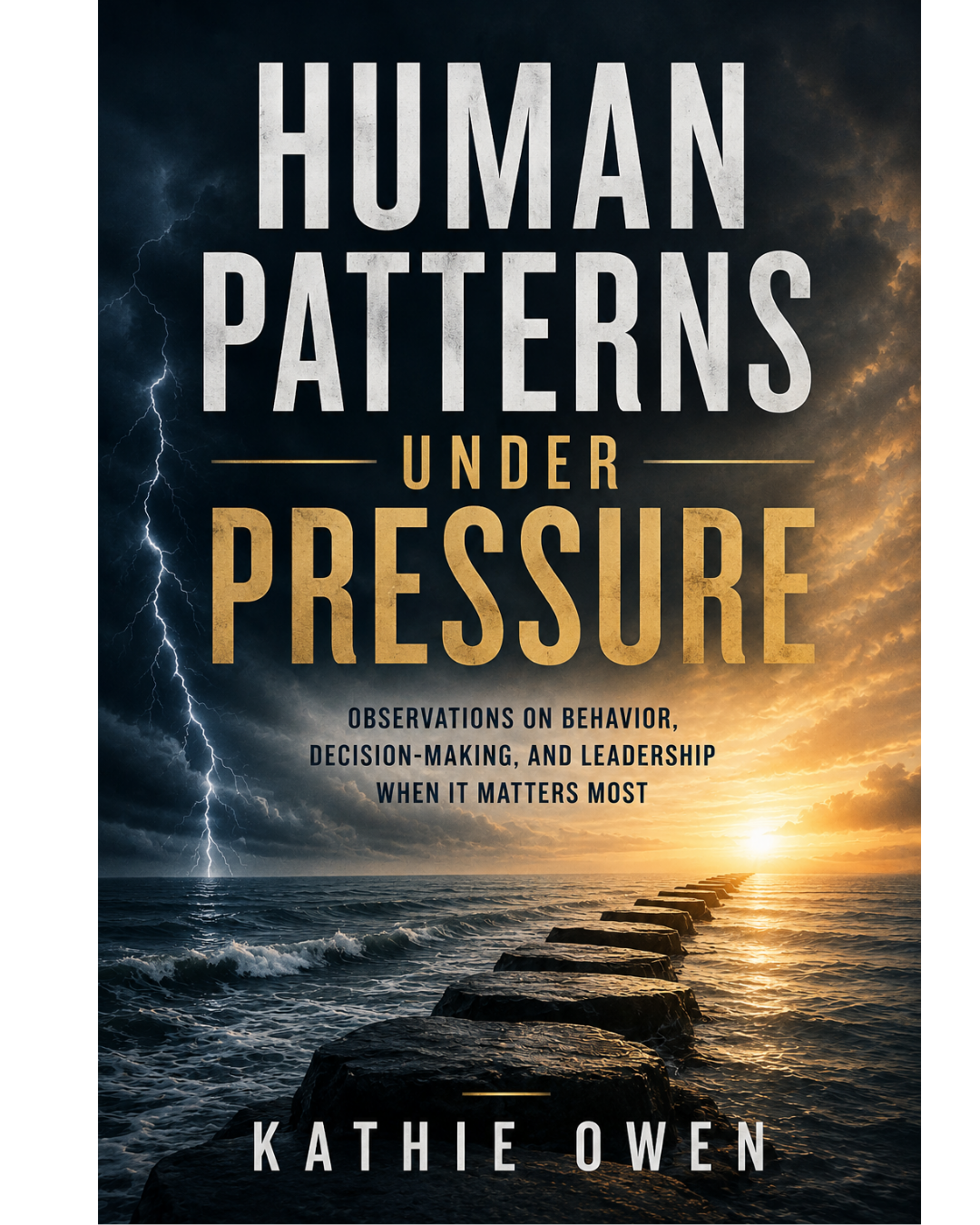
Kathie Owen is a Houston-based private consultant, speaker, and author of Human Patterns Under Pressure and The Truth Bubbles Up.
With a degree in psychology and more than 25 years of experience across fitness, wellness, leadership, and organizational dynamics, she examines the human patterns that influence decisions, culture, and performance under pressure.
Her consulting and speaking draw on non-attachment, radical responsibility, and courage, with particular attention to founder-led companies and high-stakes transitions. She hosts The Kathie Owen Perspective podcast. Visit kathieowen.com to explore her books, invite her to speak, or book a private conversation.

Read this article from a Human Diligence perspective on Linkedin
Read More Articles from Kathie






Transcript
Have you ever spent an entire morning trying to make someone else okay? You arrived ready to work. You had a plan. You were feeling pretty good. Then someone walked in distracted, short with people, barely listening, and suddenly your plan disappeared. You were fixing things, reassuring them, watching their face to see if the thing you just did helped. Or maybe you were that person. You had a rough morning. You walked into the room carrying it, and before you realized what was happening, everybody was tiptoeing around you. Nobody said, "Today we're all gonna manage one person's mood." But look around. Is that what happened? Whose nervous system is running the room? And how much of your day are you giving away before you notice? Welcome to the Kathie Owen Perspective podcast. My name is Kathie Owen. I'm a private consultant, speaker, and author of Human Patterns Under Pressure and The Truth Bubbles Up My work draws on more than 25 years of experience across fitness, wellness, leadership, and organizational dynamics. I pay attention to the human patterns that shape how people work, lead, and make decisions under pressure. Today, we're talking about a pattern you may recognize at work, at home, or in the middle of planning a big event. We're going to bring in research on emotional contagion, a simple thinking skill, and a lesson from Reality Transurfing, and we're gonna do it with no shame, no condemnation. Every one of us can get pulled into this. Every one of us can also bring pressure into a room. Picture a team getting ready for a big event. There are tables to set up, food to arrange. People have jobs to do. The person in charge arrives distracted. You don't know why. Maybe something happened at home. Maybe they're worried about the event. Maybe they're carrying something you know nothing about. You ask a simple question. They barely hear you. They point out something across the room that needs fixing. You fix it. Then there's another thing, and another. Now, watch everybody else. One person says, "It's gonna be fine. Everything looks great." Another starts rushing, "What do you need? What can I do? I'll take care of it." Someone gets frustrated. Someone gets quiet. Someone starts giving orders to the people around them. Before long, one person's distraction has become everyone else's assignment. I've watched versions of this happen. What fascinates me is how many different responses show up around the same person. Some people try to smooth things over. Some get caught up in the anxiety. Some disappear into the background, and some become very busy trying to help. Helping can be useful. The question is, what are we helping with? Are we getting the event ready, or are we trying to reach the moment when this person finally seems satisfied? That can become very different assignments. There's research behind the broader idea that emotions can spread through a group. Researchers call it emotional contagion. In a 2005 study, Thomas Tsai, Stephanie Cottier, and Richard Savard examined how a leader's mood affect group members and the way groups work together. Groups with leaders in a positive mood had a more positive group mood and better coordination than groups with leaders in a negative mood. That is one study in a controlled setting. It doesn't tell us what any particular person is feeling or why they're behaving a certain way, but it does support something worth paying attention to. A leader's mood can influence the group and its work. So when I ask whose nervous system is running the room, I'm asking you to observe how people are responding to one another. We can't look across the table and measure someone's nervous system. We can notice interruptions, rushed decisions, changing instructions, and whether people feel able to speak, and we can notice what starts happening inside of us. Are you suddenly tense? Are you talking faster? Are you volunteering before you've even understood the request? What changed between the moment you arrived and the moment you started scrambling? This week I heard the old expression, "The universe abhors a vacuum." It got me thinking about the word vacuum in a different way. Imagine the suction of a vacuum cleaner. Everything nearby gets drawn toward it. That's the picture I'm using here, an emotional vacuum. One concern starts pulling in attention, effort, reassurance, frustration, and more concern. Soon it feels as if there is no room for anything else. You can't think about your own work. You can't hear the quiet person with the useful suggestion. Your attention keeps coming back to the same question: Are they okay yet? I've noticed in my own life that the loudest moment often passes. Something that feels all-consuming today may lose its grip tomorrow. People turn their attention towards something else. That observation helps me pause. You know I like the pause. I don't have to treat the intensity of this moment as proof that it will last forever. Sometimes action is needed. Sometimes a repeated pattern needs a direct conversation or a boundary, but I can take a moment to see what is actually happening before I join the rush, and that pause matters. If you're recognizing a situation already, keep it in mind as we go along today. You can leave a comment about the pattern you've noticed without naming anyone. I'm interested in what this helps you see differently. If you're new to Reality Transurfing, it's a personal development framework created by author Vadim Zeland. It explores attention, intention, non-attachment, and the importance we place on outcomes. One of its central ideas is the pendulum. Within that framework, a pendulum is a collective pattern sustained by people's attention and emotional involvement. I use that teaching as a lens for noticing the pull of a group reaction. It is a different kind of framework from the emotional contagion research we just discussed. Think about a tense group chat. Someone posts something upsetting. Someone argues. Someone defends. Someone adds another story. Soon, people who had no intention of spending their afternoon on this are deeply involved. You may be arguing against the situation and still spending your whole afternoon inside of it. That's the pull I want you to notice. At work, it might be the demand to fix everything immediately. At home, it might be the urge to defend yourself against every comment. In an event committee, it might be the feeling that one small detail has become a test of everyone's loyalty. The invitation can sound like, "Prove you care. Explain yourself. Fix this. Take a side." Sometimes it comes from another person. Sometimes it comes from your own thoughts. The pause gives you a chance to ask, "What am I about to participate in? Where's my attention going? What response would actually help?" Another transurfing lesson is reducing excess potential or importance. My practical application is to notice when a meaningful outcome becomes something that must happen exactly my way for me to feel okay. Think about a wedding, a new baby, a company celebration, a major business transition. These things have meaning. People care deeply about them. Then the pressure grows. The seating arrangement becomes a statement about who matters. A delayed reply becomes evidence that someone doesn't care. One detail is carrying the weight of the entire relationship. Now, we're asking an event to do a very big job. Can I let this be meaningful while allowing some things to remain imperfect? Can I care about the outcome and still listen to another option? Can I enjoy the occasion without making every detail a test? Those questions give us room to think. This brings us to dialectical thinking. That's a big term for a useful practice, making room for two truths that seem to pull in different directions. This person may be struggling, and their behavior is affecting other people. This event matters to me, and every detail does not need to be perfect. I feel upset, and I can choose what I do next. I noticed a pattern, and I may not know the whole story. Hmm, that sounds like me. That last one is especially useful for those of us who notice patterns very quickly. I can see a leader interrupting people. I can see the room getting quieter. I can see people changing what they're doing. Those are observations. Why the leader is doing it is another question. Curiosity helps me leave that question open long enough to learn something. Dialectical thinking also helps you when you feel caught between two choices. So maybe you think, "Either I help with everything or I'm selfish." Try making room for another response. I can be helpful, or I can ask which task matters most. Or either I say nothing, or I have to confront this person right now. Try, "I can notice what happened and choose a useful time to address it." You don't have to force two ideas to fit if one is not true. The practice is to look for the part of the picture you may be leaving out. Let's turn the lens toward ourselves. If you're the person in charge, what happens around you when you're distracted? Do people stop asking questions? Do they agree quickly? Do they start offering to fix things before you've explained the problem? Because that is worth noticing. You can have a hard morning and still lead with care. You can feel frustrated and still give people clear priorities. Before you walk into the next meeting, ask yourself, "What am I carrying in? What does this group need from me?" Maybe you need a few quiet minutes. Maybe you need to write down the decision that actually needs to be made. And if you've already brought the rush into the room, you can reset it. You might say, "I'm distracted today. Let me slow down," and make the priorities clear. Or, "I gave you three different directions. Here's one we need to focus on." That is radical responsibility in practice. You can recognize your part and make a useful adjustment. For founders, executives, and people involved in mergers and acquisitions, these are valuable patterns to examine. When a leader is under pressure, can the team still ask questions? Can people still disagree? Can they tell which priorities are real? If people repeatedly divert their work to respond to changing moods or instructions, what happens to time, trust, and decision-making? Those are human diligence questions. They help us investigate how a company functions under pressure. A single distracted afternoon does not tell the whole story. A recurring pattern gives you something worth exploring. What happens? How often? What does the team do next? What happens to the work? This happens in families too. So don't think human diligence just applies to mergers and acquisitions. It applies to relationships. It applies to workplaces. It applies to your friendships. It applies to your families. So this week, choose one ordinary situation, a meeting, a family conversation, a group chat, an event you're helping plan. First notice what changes. Stay with what you can observe, then notice your own response. Are you rushing, reassuring, withdrawing, preparing an argument? Give yourself a brief pause before your next move. Pause, and ask, "What actually needs my attention here?" Then try one sentence that holds two truths. I want help, and I need to understand the priority. I care about this, and I can take a moment to think. I feel the pressure, and I can choose my response. Choose one useful action. Ask a clear question. Do the task that matters. Wait before replying. Return to the work you were doing. Your pause may not change the entire room, but it gives you a chance to stop repeating your part automatically. Remember, awareness creates choice. The blog post that goes with this episode is linked in the description and show notes below, and it's at www.kathieowen.com, and it brings these ideas together with the research references and reflection questions you can return to during the week. If you've recognized something in your workplace, your family, or yourself, visit that article and use it to take a closer look. Then tell me in the comments what do you see happening in your world, and how did this episode help you look at something differently? If this was valuable, like the video, subscribe for more conversations about human patterns under pressure and reality transurfing, And share it with someone who would find it useful. Those actions help more people discover this work. My name is Kathie Owen. I'm a private consultant, speaker, and author of Human Patterns Under Pressure and The Truth Bubbles Up. I help leaders in organizations examine the human patterns affecting performance, decisions, and culture, especially when pressure rises. If you want to explore a pattern in your organization or your life, you can reach out through the, my website for a private conversation. For this week, take this question with you: whose nervous system is running the room, and how do I want to participate? All right, thank you for being here. I trust that you found this helpful, and I'll see you in the next episode of the Kathie Owen Perspective Podcast.

Whose nervous system is running the room? Explore emotional contagion, leadership under pressure, and Reality Transurfing pendulums. Kathie Owen explains how pausing, reducing excess importance, and dialectical thinking can help you recognize patterns and choose your response.
#EmotionalRegulation #Leadership #RealityTransurfing #HumanDiligence