
When Pressure Hits, Hold a Finger: The Practice That Helps
The 5-Finger Practice I Keep Using
An ancient practice, a simple pause, and a different way to meet yourself under pressure.
Pressure does not always arrive with a warning.
Sometimes it arrives as an email.
A strange tone of voice.
A difficult meeting.
A bill you were not expecting.
A conversation you have been dreading.
Or one tiny comment that somehow hits you harder than you expected.
Your mind starts moving.
What does this mean?
What am I going to do?
Why did they say that?
What if this goes wrong?
And before you know it, your body has joined the conversation.
Your chest feels tight.
Your stomach turns.
Your face gets hot.
Your shoulders rise.
You want to fix something.
Explain something.
Defend yourself.
Leave.
Or make the feeling go away.
I know this experience well.
And one of the simplest practices I have found for moments like these requires no app, no special room, and no equipment.
I hold a finger.
Yes.
A finger.
It sounds almost too simple.
But I have found finger holding to be incredibly helpful during anxiety and pressure.
It does not make my problems magically disappear.
That is not why I use it.
It helps me slow down long enough to notice what is happening.
And that small pause can change everything.
Where Does Finger Holding Come From?
The practice I use comes from Jin Shin Jyutsu, a Japanese healing art.
The modern form of Jin Shin Jyutsu was developed by Jiro Murai in Japan in the early 1900s. Mary Burmeister later brought the practice to the United States and helped introduce it to a much wider audience.
Jin Shin Jyutsu is based on the idea that energy moves through the body.
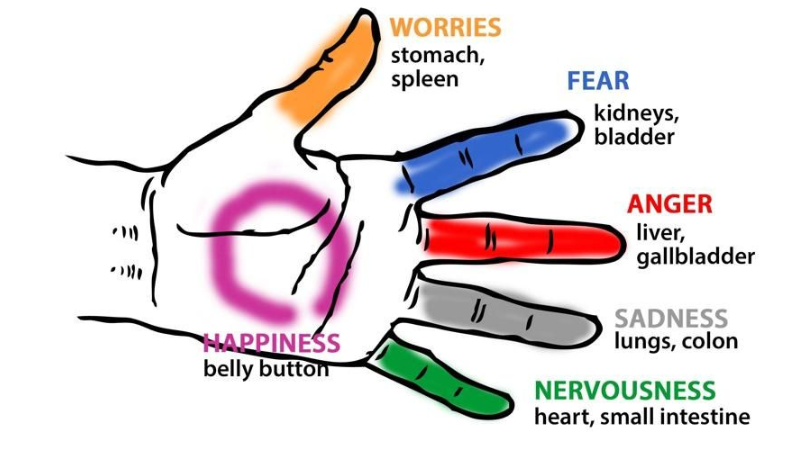
Within this tradition, different fingers are associated with different emotional attitudes and areas of the body.
The thumb is associated with worry.
The index finger with fear.
The middle finger with anger.
The ring finger with sadness and grief.
And the little finger with something called “trying-to.”
We will get to that one.
Because I think “trying-to” is fascinating.
Before we go any further, though, I want to make an important distinction.
These associations come from the traditional teachings of Jin Shin Jyutsu. Modern neuroscience has not established that holding your thumb neurologically controls worry or that holding your index finger switches off fear.
I don’t think we need to make those claims to find the practice useful.
I certainly don’t.
For me, the value is much simpler.
It gives me something physical to do while I observe what is happening inside of me.
And that fits beautifully with what I teach about human patterns under pressure.
Pressure Wants an Immediate Answer
When pressure hits, the mind often wants to do something.
Right now.
Fix it.
Explain it.
Control it.
Escape it.
Analyze it.
Figure it out.
Prove something.
We can mistake that urgency for wisdom.
It isn’t always wisdom.
Sometimes it is simply a human nervous system responding to pressure.
This is where I teach something I call The Observer’s Lens.
Instead of immediately asking:
“What should I do?”
Try asking:
“What am I noticing?”
Those are very different questions.
The first question can send us straight into reaction.
The second creates awareness.
And awareness creates choice.
Finger holding gives us a physical way to practice that pause.
You do not have to make the emotion disappear.
You don’t even have to understand it yet.
Hold.
Breathe.
Notice.
Observe.
Let’s look at each finger.

👍 The Thumb: Worry
In Jin Shin Jyutsu, the thumb is traditionally associated with worry.
It is also associated with the stomach and spleen and with the idea of nourishment.
Think about what worry feels like.
Worry rarely sits quietly in the corner.
It talks.
And talks.
And talks.
“What if this happens?”
“What if I can’t handle it?”
“What did that text mean?”
“What should I do tomorrow?”
“What if I make the wrong decision?”
Worry often tries to create certainty where certainty does not exist.
That’s why I find the thumb particularly interesting.
If I notice my mind running ten miles into the future, I don’t necessarily need to answer all those questions.
I can hold my thumb.
I can breathe.
And I can remind myself:
I do not need to solve this yet.
The situation may need my attention later.
But worry does not automatically mean action is required right now.
This can be especially useful for the Juggler pattern I describe in Human Patterns Under Pressure.
The Juggler wants to keep everything in the air.
Get everything right.
Think of everything.
Prepare for everything.
But sometimes there is nothing to prepare for yet.
Hold the thumb.
Come back to now.
☝️ The Index Finger: Fear
The index finger is traditionally associated with fear.
In Jin Shin Jyutsu, it is also connected with the kidneys and bladder.
Fear is interesting because it does not always say:
“I’m afraid.”
Fear can sound very intelligent.
“I should probably wait.”
“I need more information first.”
“Maybe this isn’t the right time.”
“I need to figure everything out before I move.”
Sometimes those thoughts are wise.
Sometimes they are fear wearing a very nice business suit.
This is why observation matters.
When I feel fear, I do not have to shame myself for it.
And I don’t have to obey it.
I can hold my index finger.
Breathe.
Feel my body.
And ask:
What do I actually know right now?
Not what am I predicting.
Not what am I afraid might happen.
What do I know?
This can be especially helpful when the Tightrope Walker appears.
The Tightrope Walker wants safety.
Under pressure, that can look like withdrawal, hesitation, shutting down, or becoming afraid to make the next move.
The goal is not to shove the Tightrope Walker off the rope.
The goal is awareness.
Fear can be present while we remain present too.

🖕 The Middle Finger: Anger
Yes. It’s the middle finger.
There is a little humor available to us here. 😂
In Jin Shin Jyutsu, the middle finger is traditionally associated with anger and with the liver and gallbladder.
Anger gets a bad reputation.
But anger is not automatically bad.
Anger can contain information.
Something felt unfair.
Someone crossed a boundary.
We feel ignored.
We expected something that did not happen.
We feel disrespected.
The problem isn’t necessarily that anger arrived.
The problem comes when anger takes over before awareness gets a chance to speak.
That’s when we fire off the email.
Say the thing.
Criticize.
Attack.
Blame.
Or start building a case against another person.
In my Human Patterns Under Pressure framework, this can look a lot like the Lion Tamer.
The Lion Tamer uses criticism to create control.
But what if we don’t immediately pick up the whip?
Hold the middle finger.
Breathe.
Notice the heat.
Notice the thoughts.
Notice the story.
We aren’t suppressing anger.
We are observing it.
There is a huge difference.
Feel first. Observe. Then choose your response.

💍 The Ring Finger: Sadness and Grief
The ring finger is traditionally associated with sadness and grief.
Jin Shin Jyutsu also associates it with the lungs and large intestine and with receiving and letting go.
I love that language.
Receiving.
And letting go.
Because letting go does not mean something did not matter.
It doesn’t mean we shouldn’t be sad.
It doesn’t mean we have to rush ourselves through grief.
And it certainly doesn’t mean pretending we don’t care.
This is where finger holding connects beautifully with one of the principles I teach:
Non-Attachment.
Non-attachment is not indifference.
It isn’t coldness.
It is not:
“Whatever. I don’t care.”
It is the ability to care deeply without demanding that reality become something other than what it currently is.
Sometimes something hurts.
Sometimes something ends.
Sometimes someone disappoints us.
Sometimes the future we imagined does not happen.
We can hold the ring finger and simply be with that.
No fixing.
No spiritual bypassing.
No demand that sadness leave immediately.
Receive.
Feel.
And, when you are ready, let go.

🤙 The Little Finger: “Trying-To”
This may be my favorite one to observe.
The little finger is traditionally associated with “trying-to.”
That phrase can sound odd at first.
Think of it as efforting.
Striving.
Pretending.
Performing.
Trying to appear one way while something very different is happening inside.
“I’m fine!”
But you’re not fine.
“I’ve got it!”
But you’re overwhelmed.
“No problem!”
But there is definitely a problem.
Recognize that?
I do.
This can show up in several Human Patterns Under Pressure.
The Clown may smile and keep everyone happy.
The Juggler may work harder and harder trying to get everything right.
The Strongman may decide to carry everything alone.
Trying-to can create a gap between what is happening inside and what we are presenting outside.
That gap takes energy.
Holding the little finger can become a beautiful reminder:
I don’t have to perform my way through this moment.
I can simply be here.
✋ What If You Don’t Know Which Finger?
This may be the most important part of this entire practice.
You don’t have to know.
You do not need to diagnose yourself.
You don’t need to sit there thinking:
“Is this worry? Maybe it’s fear. Wait. It could be grief. Or maybe I’m angry because I’m afraid…”
Now we’ve turned finger holding into another thing to get right.
No.
In Jin Shin Jyutsu, the palm can also be used as a general harmonizing hold.
You can hold the center of your palm.
Or simply choose a finger.
You can even move through all five.
The point is not perfection.
The point is presence.
Sometimes all I know is:
Something is happening inside of me.
That’s enough information to begin.

How to Practice Finger Holding
The practice can be very simple.
Take one hand and gently wrap it around a finger on the opposite hand.
Don’t squeeze.
Just hold.
Let your hand rest there.
Breathe naturally.
You may notice warmth.
You may notice a pulse.
You may notice your breathing begin to slow.
You may notice absolutely nothing at first.
That’s okay too.
Stay with it for a few minutes if that feels comfortable.
You can change fingers whenever you want.
You can practice sitting down.
Lying in bed.
Sitting in your car before a difficult meeting.
Waiting for a phone call.
Watching television.
Listening to someone speak.
You can even do it quietly under a conference table.
Nobody needs to know.
That’s one of the things I love most about it.
You always have your hands with you.

But Does Finger Holding Really Regulate the Nervous System?
This is where I want to be responsible with my language.
There is growing interest in body-based practices for stress and emotional regulation. Gentle touch, breathing, focused attention, and bringing awareness back into the body can all be useful components of calming practices.
Finger holding combines several of these elements.
But scientific research has not established that each individual finger has a unique neurological pathway that regulates the specific emotion assigned to it by Jin Shin Jyutsu.
Those finger-emotion relationships belong to the traditional system.
And I think both ideas can exist together.
We can respect where a practice came from without turning every traditional teaching into a modern scientific claim.
For me, the better question is:
What happens when you try it?
Do you slow down?
Does your breathing change?
Do you become more aware of your body?
Does your thinking become less frantic?
Do you gain a little distance from the story running through your head?
Can you respond differently because you gave yourself that pause?
Observe.
You don’t have to believe anything.

The Space Between Pressure and Pattern
This is where finger holding becomes much bigger to me than a relaxation technique.
Pressure hits all of us.
The question is what happens next.
Pressure.
Then pattern.
The Ringmaster controls.
The Tightrope Walker withdraws.
The Lion Tamer criticizes.
The Juggler perfects.
The Clown pleases.
The Strongman carries.
The Magician avoids.
These patterns can happen incredibly fast.
Finger holding gives us one small opportunity to interrupt that sequence.
Pressure → Pause → Observe → Awareness → Choice
Not because holding a finger magically removes pressure.
Because we stopped long enough to notice ourselves inside it.
That is the practice.
You don’t have to solve the future.
You don’t have to get rid of the emotion.
You don’t have to decide what everything means.
Hold your finger.
Feel your body.
Notice your breath.
Observe the story your mind is telling.
Then ask:
What do I know for certain?
You may discover something surprising.
The pressure can still be there.
And so can you.
Quick Finger Holding Guide
👍 Thumb — Worry
When your mind keeps forecasting, solving, or asking “what if?”
Reminder: I don’t have to solve this yet.
☝️ Index — Fear
When you feel anxious, uncertain, hesitant, or afraid.
Reminder: What do I actually know right now?
🖕 Middle — Anger
When you feel irritated, critical, resentful, or reactive.
Reminder: I can feel this without immediately acting on it.
💍 Ring — Sadness & Grief
When you are experiencing loss, disappointment, sadness, or difficulty letting go.
Reminder: I can care deeply and still release what I cannot control.
🤙 Little — Trying-To
When you are striving, proving, pleasing, pretending, or performing.
Reminder: I don’t have to perform my way through this.
✋ Palm — When You Don’t Know
When you can’t name what you are feeling.
Reminder: I don’t need to understand everything before I become present.
About Kathie Owen
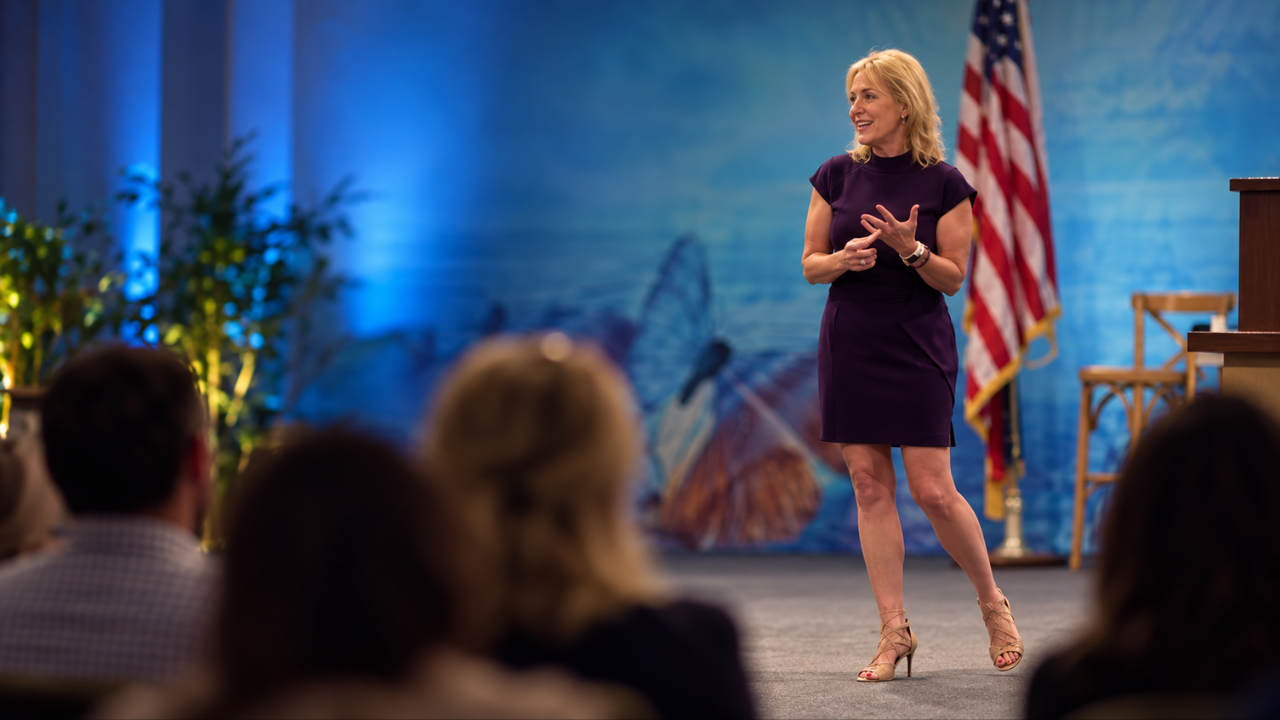
Kathie Owen is a private consultant, author, and creator of Human Patterns Under Pressure. Her work explores what happens to human behavior when pressure rises—and how awareness can create more choice before unconscious patterns take over.
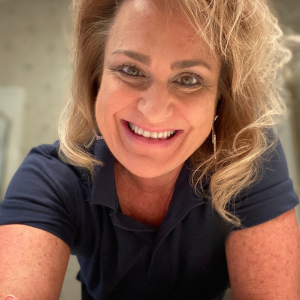
Through The Observer’s Lens and her Power • Presence • Peace framework, Kathie studies the subtle patterns that influence leadership, relationships, communication, and high-stakes decision-making.
Her work is grounded in three principles: Non-Attachment, Radical Responsibility, and Courage.
Kathie is the author of Human Patterns Under Pressure, The Truth Bubbles Up, and host of The Kathie Owen Perspective, where she explores leadership psychology, emotional regulation, human behavior, and the patterns that become visible when life applies pressure.
Because pressure doesn’t create our patterns.
It reveals them.
Read More Articles from Kathie




Whose nervous system is running the room? Explore emotional contagion, leadership under pressure, and Reality Transurfing pendulums. Kathie Owen explains how pausing, reducing excess importance, and dialectical thinking can help you recognize patterns and choose your response.
#EmotionalRegulation #Leadership #RealityTransurfing #HumanDiligence